Have you ever stood in the sun and wondered, “How old is this sunlight on my face?” Or maybe you’ve gazed at the night sky and asked yourself, “How long does it take for light to cross the vast emptiness between worlds?”
Welcome to FreeAstroScience.com, where we believe science should be for everyone—no matter your background, your age, or where you’re reading this from. Here, we break down the universe’s biggest mysteries into simple, honest stories. Today, we’re taking you on a journey at the fastest speed possible: the speed of light.
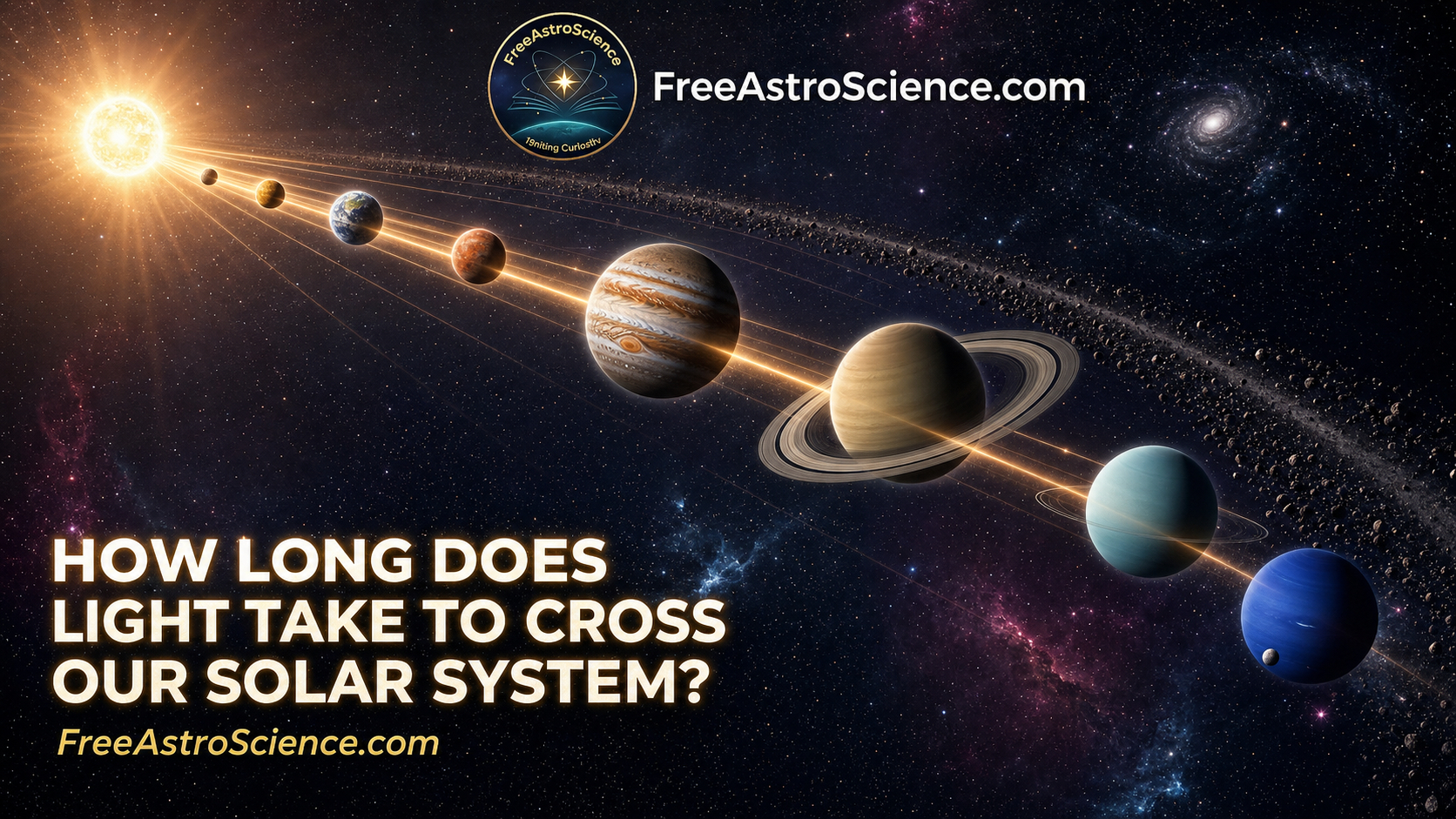
We’ll explore how fast light really is, how scientists measured it, and why nothing can outrun it. We’ll walk through the solar system, planet by planet, with a table you can search and filter yourself. We’ll talk about the real-world delays that space engineers face—sometimes waiting hours or even days for a signal to cross the solar system. And we’ll end with a mind-bending truth: every time you look up, you’re looking back in time.
Stick with us to the end. You’ll never see sunlight—or the night sky—the same way again.
Table of Contents
- What Exactly Is the Speed of Light — And Why Does It Matter?
- From Galileo to Einstein: A Brief History of Measuring Light’s Speed
- Why Can’t Anything Travel Faster Than Light?
- How Long Does Sunlight Take to Reach Earth? The Famous 8-Minute Rule
- How Long Does Light Take to Reach Every Planet? [Complete Table]
- Beyond Neptune: Light at the Edge of the Solar System
- What Light Travel Time Means for Space Exploration — The Communication Delay Problem
- Telescopes Are Time Machines — Light as a Window to the Past
- The Math Is Simpler Than You Think — Calculate Light Travel Time Yourself
- FAQ
- References
Light Across the Solar System: From Eight Minutes to Nearly Two Years
What Exactly Is the Speed of Light — And Why Does It Matter?
Light is the universe’s fastest messenger. In a vacuum, it races along at exactly 299,792,458 meters per second. That’s not just a measurement—it’s a definition. Since 1983, the meter itself is defined by how far light travels in 1/299,792,458 of a second. No uncertainty. No rounding. Just pure, cosmic precision.
To put it in perspective, light could circle Earth more than seven times in a single second. It covers 300,000 kilometers every second—fast enough to make even the wildest sports car look like it’s standing still.
Why does this matter? Our GPS satellites, fiber-optic internet, and even the way we measure the universe all depend on this speed. Astronomers use it to map distances. Engineers rely on it to keep your phone’s map accurate. It’s the ultimate speed limit, and it shapes everything from your morning commute to the way we explore the stars.
From Galileo to Einstein: A Brief History of Measuring Light’s Speed
Measuring the speed of light wasn’t easy. For centuries, people thought it was infinite. Galileo tried to measure it with lanterns on distant hilltops in the early 1600s, but light was just too quick for his clocks.
Then, in 1676, Ole Rømer watched Jupiter’s moon Io disappear and reappear. He realized the timing changed depending on Earth’s position. His estimate—about 220,000 km/s—was off by 25%, but it proved light had a speed.
Others followed. Christiaan Huygens backed Rømer. James Bradley, in 1728, used the “aberration of starlight” and got much closer: 298,000 km/s. In the 1800s, Hippolyte Fizeau and Léon Foucault used clever mirrors and wheels. Albert Michelson, from 1879 to 1926, refined the method and got 299,796 km/s—almost spot on.
By the 1970s, lasers and atomic clocks made the measurement so precise that in 1983, scientists just defined the speed of light as exactly 299,792,458 m/s. No more guessing.
| Year | Scientist(s) | Method/Discovery | Value (km/s) |
|---|---|---|---|
| Early 1600s | Galileo Galilei | Lanterns on hilltops | Too fast to measure |
| 1676 | Ole Rømer | Jupiter’s moon Io eclipses | ~220,000 |
| 1678 | Christiaan Huygens | Supported Rømer’s findings | ~220,000 |
| 1728 | James Bradley | Stellar aberration | ~298,000 |
| 1849 | Hippolyte Fizeau | Rotating toothed wheel | 313,000 |
| 1862 | Léon Foucault | Rotating mirror | 298,000 |
| 1879–1926 | Albert A. Michelson | Refined rotating mirror/mountain experiments | 299,796 |
| 1983 | CGPM (SI redefinition) | Meter defined by speed of light | 299,792,458 (exact) |
Why Can’t Anything Travel Faster Than Light?
Einstein’s special relativity, published in 1905, changed everything. He showed that the speed of light is the same for everyone, everywhere, no matter how fast you’re moving. Try to push something with mass up to light speed, and you’ll find it gets heavier and heavier. To actually reach light speed, you’d need infinite energy. That’s not just hard—it’s impossible.
If anything could go faster than light, it would break causality. You could send a message into your own past. That’s the stuff of science fiction, not science. Light is the universe’s ultimate speed limit. No matter, no energy, no information can outrun it.
How Long Does Sunlight Take to Reach Earth? The Famous 8-Minute Rule
The Sun sits about 150 million kilometers away from us—one astronomical unit (AU). Light covers that distance in just over eight minutes. So, the sunlight warming your skin right now left the Sun more than eight minutes ago. If the Sun vanished this instant (don’t worry, it won’t), we wouldn’t know until those eight minutes had passed.
Light Travel Time Formula:
Time (seconds) = Distance (meters) ÷ Speed of Light (299,792,458 m/s)
Time (minutes) = Distance (AU) × 8.3 minutes/AU
How Long Does Light Take to Reach Every Planet? [Complete Table]
This is where things get fun. Below, you’ll find a fully interactive table showing how long it takes for light to travel from the Sun to every major object in our solar system. You can search, filter, and sort. The colors help you spot inner planets, outer planets, dwarf planets, and the farthest edges. 🔍 Search:
| Object/Boundary | Distance from Sun (AU) | Distance (million km) | Light Travel Time (from Sun) |
|---|---|---|---|
| Mercury | 0.39 | 58 | 3 min 13 sec |
| Venus | 0.72 | 108 | 6 min |
| Earth | 1.00 | 150 | 8 min 20 sec |
| Mars | 1.52 | 228 | 12 min 40 sec |
| Asteroid Belt | 2.2–3.2 | 330–480 | 18–26 min |
| Jupiter | 5.20 | 778 | 43 min 12 sec |
| Saturn | 9.54 | 1,430 | 1 hr 19 min |
| Uranus | 19.2 | 2,870 | 2 hr 40 min |
| Neptune | 30.06 | 4,500 | 4 hr 10 min |
| Pluto (avg) | 39.5 | 5,900 | 5 hr 28 min |
| Kuiper Belt (outer) | 55 | 8,200 | ~7 hr 36 min |
| Heliopause (~123 AU) | 123 | 18,400 | ~17 hr |
| Oort Cloud (inner) | 2,000–5,000 | 300,000–750,000 | 10–28 days |
| Oort Cloud (outer) | 100,000 | 15,000,000 | ~1.87 years |
| Solar System Diameter | 200,000 | 30,000,000 | ~3.7 years |
| Notes: 1 AU = 149,597,870.7 km. Light speed = 299,792 km/s. Time = Distance ÷ Speed. | |||
What stands out? Light takes just over three minutes to reach Mercury, but more than five hours to reach Pluto. To cross the solar system’s full diameter—out to the edge of the Oort Cloud—light needs nearly four years. Even at the fastest speed in the universe, our cosmic neighborhood is staggeringly vast.
Beyond Neptune: Light at the Edge of the Solar System
Let’s go farther. The Kuiper Belt, home to icy worlds and dwarf planets, stretches out to about 55 AU. Light takes over seven hours to cross it. The heliopause, where the Sun’s influence ends and interstellar space begins, sits at about 123 AU—17 hours away at light speed. Voyager 1 crossed this boundary in 2012.
But the Oort Cloud, a shell of icy bodies, is even farther. Its inner edge is 2,000–5,000 AU from the Sun. Light takes 10 to 28 days to get there. The outer edge? That’s 100,000 AU—almost two light-years. To cross the whole solar system, edge to edge, light needs about 3.7 years. Imagine sending a message and waiting nearly four years for it to arrive.
What Light Travel Time Means for Space Exploration — The Communication Delay Problem
Mars Rovers: Operating on a 3-to-22-Minute Delay
When NASA drives a rover on Mars, they’re always working in the past. Depending on where Mars is in its orbit, signals take anywhere from 3 to 22 minutes to cross the gap. During Curiosity’s mission, engineers sent daily command sequences, then waited—sometimes nearly half an hour—to see what happened. The Viking landers in 1976? Four minutes of anxious silence after touchdown before Earth got the “I’m safe” signal. Perseverance, launched in 2020, faces the same challenge. That’s why Mars rovers are built to think for themselves.
New Horizons at Pluto: 4 Hours and 25 Minutes of Silence
On July 14, 2015, New Horizons zipped past Pluto. At that moment, it was 4.5 light-hours from Earth. NASA had to upload every command in advance. After the flyby, the team waited over four hours for the first signal to come home. It took more than a year to download all the data—at just 1–2 kilobits per second.
Cassini at Saturn: Over an Hour of Waiting
Saturn sits 1.43 billion kilometers from Earth. Cassini’s signals took about 79 minutes to arrive. Even a simple temperature reading was old news by the time it reached us. Cassini, like other deep-space probes, ran on preprogrammed sequences and smart onboard systems.
Voyager 1: 20+ Hours to Say Hello
Voyager 1, launched in 1977, is now in interstellar space. As of 2026, its radio signals take more than 20 hours to reach Earth. NASA’s Deep Space Network—giant 230-foot antennas—keeps the conversation going. But if you sent a command today, you’d wait nearly two days for a reply.
How Does NASA Handle These Delays?
- Preprogrammed command sequences for time-critical events
- Onboard autonomy so spacecraft can handle surprises
- Data prioritization and compression to make the most of slow, distant links
- Deep Space Network (DSN): a global array of huge antennas
- Error detection and correction to keep data safe across billions of kilometers
Telescopes Are Time Machines — Light as a Window to the Past
Here’s a mind-bender: every time you look at the sky, you’re looking back in time. The Moon? You see it as it was 1.3 seconds ago. The Sun? 8 minutes and 20 seconds ago. Proxima Centauri, our nearest star, shines at us from 4.3 years in the past.
The Crab Nebula, a supernova remnant, is 6,500 light-years away. When we look at it, we see it as it was 6,500 years ago—before the pyramids were built. The Hubble Space Telescope has captured galaxies over 13 billion light-years away, showing us the universe as it was less than a billion years after the Big Bang.
As NASA puts it:
“Telescopes can be time machines. Looking out in space is like looking back in time.”
This isn’t a limitation. It’s astronomy’s greatest gift. Light’s finite speed lets us read the universe’s history, one photon at a time.
The Math Is Simpler Than You Think — Calculate Light Travel Time Yourself
You don’t need a PhD to figure out light travel times. Here’s how you can do it:
Formula 1:t = d / c(where t = time in seconds, d = distance in meters, c = 299,792,458 m/s)
Formula 2:t (minutes) = d (AU) × 8.3
Worked Example:
Earth to Jupiter: 5.20 AU × 8.3 = 43.2 minutes
Earth to Neptune: 30.06 AU × 8.3 = 249.5 minutes ≈ 4 hr 9 min
Remember, planets move, so these are averages. But the math is always the same: distance divided by speed.
Conclusion
Light is the universe’s fastest traveler, racing at 299,792,458 meters per second. Yet, even at this speed, it takes over eight minutes to reach Earth from the Sun, more than five hours to reach Pluto, and nearly two years to reach the edge of the Oort Cloud. To cross the full width of our solar system, light needs almost four years.
Our solar system isn’t a cozy neighborhood—it’s a vast ocean of space. Every time we send a signal to a distant probe, we’re reminded just how big that ocean is. From Galileo’s lanterns to Voyager 1’s 20-hour radio whispers, we’ve always been reaching outward, chasing the light.
At FreeAstroScience, we write these stories to keep your mind awake—because the sleep of reason breeds monsters. There’s no better cure for intellectual sleep than staring at the cosmos and asking, “How far? How long?” Come back soon, and keep your curiosity burning bright.
FAQ
Q1: How long does it take for light to travel from the Sun to Earth?
A: Exactly 8 minutes and 20 seconds. The Sun is 1 AU (about 150 million km) away, and light travels at 299,792 km/s.
Q2: How long does it take for light to cross the entire solar system?
A: Depending on how you define “the solar system’s edge,” the answer ranges from about 17 hours (to the heliopause at ~123 AU) to approximately 3.7 years (across the full diameter including the Oort Cloud at ~200,000 AU).
Q3: How long does it take for light to reach Pluto?
A: At Pluto’s average distance of 39.5 AU (about 5.9 billion km), light takes about 5 hours and 28 minutes to travel from the Sun.
Q4: Why do NASA missions have communication delays?
A: Because radio signals travel at the speed of light. At Mars, the one-way delay is 3–22 minutes depending on orbital positions. At Pluto (New Horizons, July 2015), it was over 4 hours. At Voyager 1’s current distance, signals take more than 20 hours each way.
Q5: Is the speed of light exactly 299,792,458 m/s?
A: Yes — and it’s not a measured value but a defined one. Since 1983, the International System of Units has defined the meter itself based on the speed of light, making c exactly 299,792,458 m/s with zero uncertainty.
References
- 1. NASA Science: What Is a Light-Year?
- 2. NASA Solar System: Oort Cloud Facts
- 3. NASA New Horizons Mission
- 4. NASA Space Communications — 7 Things You Need to Know
- 5. NASA Webb: How Does Webb See Back in Time?
- 6. NIST SP-330 Section 2 (SI Units)
- 7. Space.com: How Far Is Earth from the Sun?
- 8. EarthSky: Riding Light — Tour the Solar System at Light Speed
- 9. Wikipedia: Speed of Light
- 10. Wikipedia: Rømer’s Determination of the Speed of Light
Written for you by Gerd Dani, President of FreeAstroScience.com — where we explain complex scientific principles in simple terms, and remind you: never turn off your mind. The sleep of reason breeds monsters. Stay curious, stay awake, and keep exploring with us.