What Makes NGC 5584 a Cosmic Key? The Story of a Galaxy, Its Stars, and the Secrets of the Universe
Have you ever wondered how a single galaxy can help us measure the size and age of the universe?
Welcome to FreeAstroScience.com, where we turn the mysteries of the cosmos into stories you can understand and share. Today, we’re exploring NGC 5584—a galaxy that’s not just a pretty spiral in Virgo, but a cosmic laboratory for some of the biggest questions in astronomy.Stick with us to the end, and you’ll see how a 19th-century astronomer, a handful of variable stars, and two spectacular supernovae all come together to help us measure the universe itself. This is your invitation to join a community that believes curiosity is for everyone, and that the sleep of reason breeds monsters. Let’s keep our minds awake—together.
Table of Contents
- What Is NGC 5584? The Galaxy’s Identity and Structure
- Who Was Edward Barnard? The Observer Who Found NGC 5584
- Why Are Cepheid Variable Stars So Important?
- What Makes the Supernovae in NGC 5584 Special?
- How Do Type Ia and Type Ic Supernovae Differ?
- Final Thoughts: Why NGC 5584 Matters to All of Us
- FAQ: Your Questions Answered
- References & Further Reading
NGC 5584: The Galaxy That Helps Us Measure the Universe
What Is NGC 5584? The Galaxy’s Identity and Structure
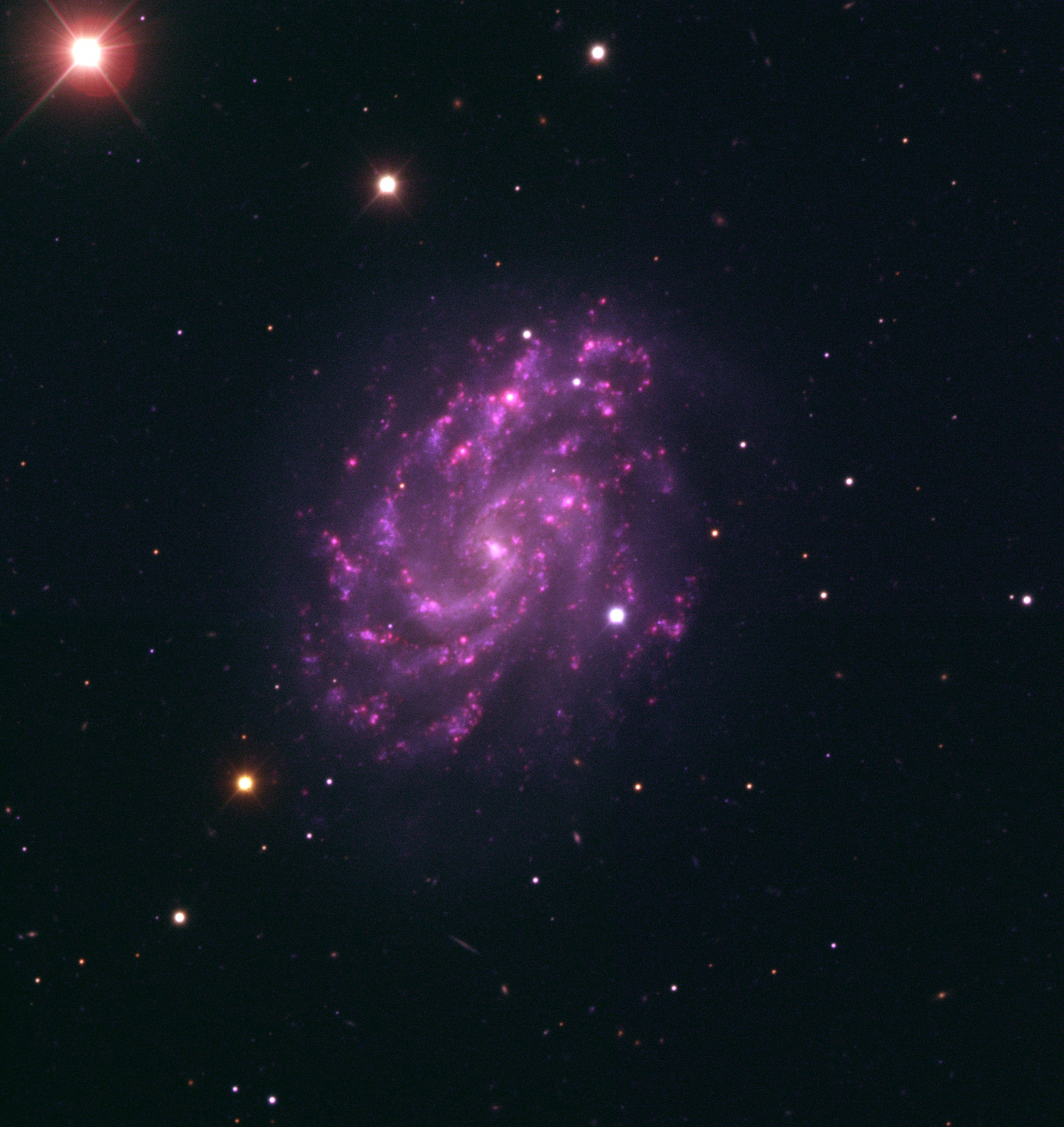
NGC 5584 isn’t just a name—it’s a cosmic address. You might also find it listed as PGC 51344 or UGC 9201, but whatever you call it, this galaxy sits about 72 million light-years away in the constellation Virgo. That’s far, but in cosmic terms, it’s close enough for us to study in detail .
Let’s break down what makes NGC 5584 stand out:
- Type: Barred spiral galaxy (SB(s)d in Hubble’s system)
- Diameter: At least 50,000 light-years—about half the size of our Milky Way
- Orientation: Nearly face-on, so we get a clear view of its spiral arms and central bar
- Spiral Arms: Packed with young, massive blue stars—signs of ongoing star formation
- Bar Structure: Well-defined, making it a textbook example for astronomers
- Catalog Names: NGC 5584, PGC 51344, UGC 9201, and many more
Here’s a responsive, accessible table summarizing the key facts:
| Property | Value |
|---|---|
| Main Catalog Names | NGC 5584, PGC 51344, UGC 9201 |
| Galaxy Type | Barred spiral (SB(s)d) |
| Diameter | ≥50,000 light-years |
| Distance | 72 million light-years |
| Constellation | Virgo |
| Cepheid Variables | ~250 detected |
| Notable Supernovae | SN 2007af (Type Ia), SN 1996aq (Type Ic) |
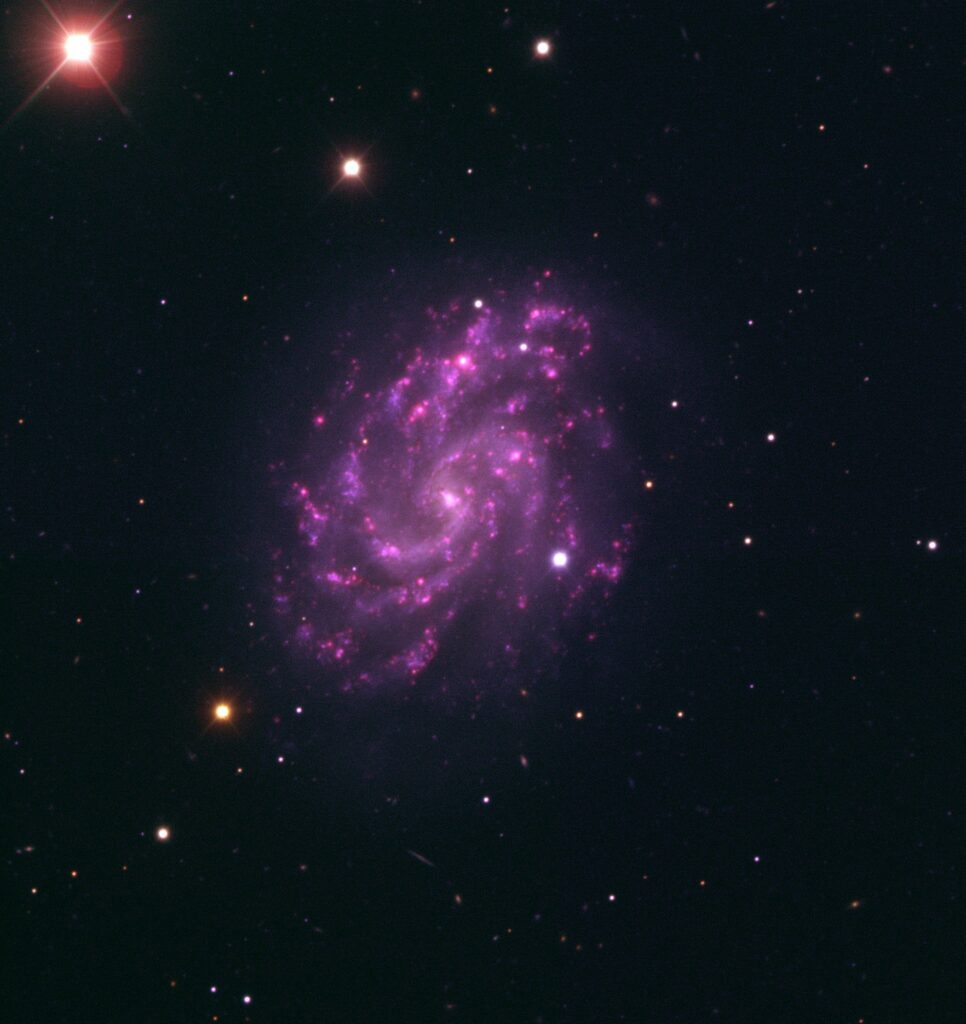
NGC 5584’s nearly face-on view lets us see its spiral arms and bar in stunning detail. The arms are dotted with blue stars—cosmic newborns lighting up the galaxy’s structure. Thin dust lanes snake out from the core, hinting at the complex dance of gas and stars inside.
Who Was Edward Barnard? The Observer Who Found NGC 5584
Let’s travel back to July 27, 1881. Edward Emerson Barnard, a young American astronomer from Nashville, Tennessee, pointed his 12.5-cm (5-inch) refractor at the sky and spotted a faint glow in Virgo. That glow was NGC 5584 .
Barnard’s story is one of grit and curiosity. Born in 1857, he grew up in poverty but never let that stop him. He started as a self-taught observer, eventually becoming one of the greatest visual astronomers of his time . Here’s a quick look at his achievements:
- Barnard’s Star: Discovered in 1916, it’s the second-closest star system to Earth and famous for its rapid motion across the sky .
- Amalthea: In 1892, Barnard found Jupiter’s fifth moon using the 36-inch refractor at Lick Observatory—the last moon discovered by eye, not by photograph .
- Comets: He found at least 15 comets, including the first ever discovered by photographic means .
- Dark Nebulae: Barnard cataloged 349 dark nebulae—clouds of dust that block starlight—now called Barnard objects .
- Awards: He won the Gold Medal of the Royal Astronomical Society in 1897 and the Bruce Medal in 1917 .
Barnard’s legacy is everywhere in astronomy. He showed that with patience, passion, and a good telescope, anyone can make discoveries that change how we see the universe.
Why Are Cepheid Variable Stars So Important?
If you want to measure the universe, you need a reliable ruler. Cepheid variable stars are just that. These stars pulse in brightness, and the time it takes for each pulse tells us exactly how bright they really are.
The Science Behind Cepheids
Henrietta Swan Leavitt, working in 1908, discovered that the longer a Cepheid’s pulsation period, the brighter it is. This is called the period-luminosity relation, or Leavitt Law . Here’s the basic formula:
Mathematical Formula (Period-Luminosity Relation):
M = a \cdot \log_{10}(P) + b
Where M = absolute magnitude, P = period in days, a and b are constants determined by calibration.
By measuring a Cepheid’s period, we know its true brightness. Compare that to how bright it looks from Earth, and we can calculate its distance. This method is the backbone of the “cosmic distance ladder”—the set of tools astronomers use to measure distances from nearby stars to the edge of the visible universe .
NGC 5584’s Cepheids: A Treasure Trove
NGC 5584 is a goldmine for Cepheid hunters. The Hubble Space Telescope found about 250 Cepheid variables in this galaxy . That’s a huge sample, especially for a galaxy 72 million light-years away. These stars let us calibrate the distance to NGC 5584 with high precision.
But there’s more. NGC 5584 also hosted a Type Ia supernova (SN 2007af). By comparing the Cepheid-based distance to the supernova’s brightness, astronomers can fine-tune the “standard candle” method used to measure even greater distances. This is a key step in the SH0ES project, which aims to measure the Hubble constant (H₀)—the rate at which the universe is expanding .
The Hubble Tension
Here’s where things get interesting. The value of H₀ measured using Cepheids and supernovae in galaxies like NGC 5584 is higher than the value predicted by early-universe measurements (like the cosmic microwave background). This disagreement is called the “Hubble tension,” and it’s one of the hottest debates in cosmology today .
What Makes the Supernovae in NGC 5584 Special?
NGC 5584 has hosted not one, but two spectacular supernovae—each with its own story.
SN 2007af: The Standard Candle
- Type: Type Ia supernova
- Discovered: March 1, 2007, by Koichi Itagaki
- Peak Magnitude: 13.3 (bright enough for amateur telescopes)
- Ejecta Velocity: Over 15,000 km/s—imagine a shockwave racing across the galaxy!
- Light Echo: About 1,000 days after the explosion, astronomers spotted a “light echo”—a reflection of the supernova’s flash off surrounding dust .
Type Ia supernovae are the gold standard for measuring cosmic distances. Their explosions are so consistent in brightness that we can use them as “standard candles.” SN 2007af helped calibrate the distance to NGC 5584 and, by extension, the scale of the universe .
SN 1996aq: The Core-Collapse Mystery
- Type: Type Ic supernova
- Discovered: August 17, 1996, by Masakatsu Aoki
- Expansion Velocity: About 15,500 km/s
- Radio Emission: Detected years after the explosion, showing ongoing interaction with the galaxy’s gas
Type Ic supernovae are rarer and less predictable. They come from massive stars that have lost their outer layers before exploding. SN 1996aq gave astronomers a chance to study this dramatic end to a star’s life in detail.
How Do Type Ia and Type Ic Supernovae Differ?
Let’s clear up the science behind these cosmic fireworks.
Type Ia Supernovae
- Origin: White dwarf in a binary system steals matter from its companion. When it hits about 1.4 times the Sun’s mass (the Chandrasekhar limit), it explodes in a thermonuclear blast .
- Spectral Signature: No hydrogen, strong silicon line at 6150 Ångströms
- Peak Brightness: Absolute magnitude around -19.7
- Where Found: All types of galaxies
- Use: Standard candles for measuring distances
Type Ic Supernovae
- Origin: Massive star (8–30 times the Sun’s mass) that’s lost both its hydrogen and helium layers. The core collapses, triggering the explosion .
- Spectral Signature: No hydrogen, no helium, no silicon line
- Peak Brightness: Varies a lot—not standard candles
- Where Found: Only in spiral galaxies, where massive stars are born
- Use: Tracing star formation and stellar evolution
Here’s a visually appealing, accessible table comparing the two:
| Feature | Type Ia Supernova | Type Ic Supernova |
|---|---|---|
| Progenitor | White dwarf in binary | Stripped massive star |
| Explosion Mechanism | Thermonuclear runaway | Core-collapse |
| Spectral Features | No H; strong Si line | No H, He, or Si lines |
| Standard Candle? | Yes | No |
| Host Galaxies | All types | Spiral only |
Final Thoughts: Why NGC 5584 Matters to All of Us
NGC 5584 is more than a distant spiral in Virgo. It’s a cosmic crossroads where the lives of stars, the deaths of giants, and the tools of modern astronomy all meet. From Edward Barnard’s humble telescope to the Hubble Space Telescope’s sharp eye, this galaxy has helped us measure the universe, test our theories, and even challenge our understanding of cosmic expansion.
At FreeAstroScience.com, we believe that every mind—no matter where you start—can help keep reason awake. NGC 5584 reminds us that the universe is full of surprises, and that curiosity is our best guide. Keep asking questions, keep your mind active, and remember: the sleep of reason breeds monsters.
We hope you’ll come back soon to FreeAstroScience.com, where we turn the universe into a story you can be part of.
FAQ: Your Questions Answered
Frequently Asked Questions
What is NGC 5584? NGC 5584 is a barred spiral galaxy about 72 million light-years away in Virgo. It’s known for its well-defined spiral arms, rich population of Cepheid variable stars, and two notable supernovae. Why are Cepheid variable stars important? Cepheids pulse in brightness with a period that tells us their true luminosity. By comparing this to how bright they look from Earth, we can measure distances across the universe. What’s the difference between Type Ia and Type Ic supernovae? Type Ia supernovae come from exploding white dwarfs and are used as standard candles. Type Ic supernovae are core-collapse explosions of massive stars that have lost their outer layers and aren’t standard candles. Who discovered NGC 5584? Edward Emerson Barnard discovered NGC 5584 on July 27, 1881, using a 12.5-cm refractor telescope. What is the “Hubble tension”? The Hubble tension is the disagreement between the universe’s expansion rate measured using Cepheids and supernovae (like those in NGC 5584) and the rate predicted by early-universe observations.
References & Further Reading
- NASA/IPAC Extragalactic Database: NGC 5584
- Wikipedia: NGC 5584
- NASA: Hubble Constant Tension
- AAVSO: Cepheid Variables
- ESA Hubble: NGC 5584
- Harvard CfA: Cepheid Variables
- NASA: Hubble and the Universe’s Expansion Rate
- Wikipedia: Edward Emerson Barnard
- A&A: Cepheids in NGC 5584
- A&A: Supernovae in NGC 5584
Written for you by FreeAstroScience.com—where we believe that science is for asking questions!