Cosmic structures, the likes of which have never been seen before, have been spotted by astronomers in observations which could revolutionise the understanding of the Universe.
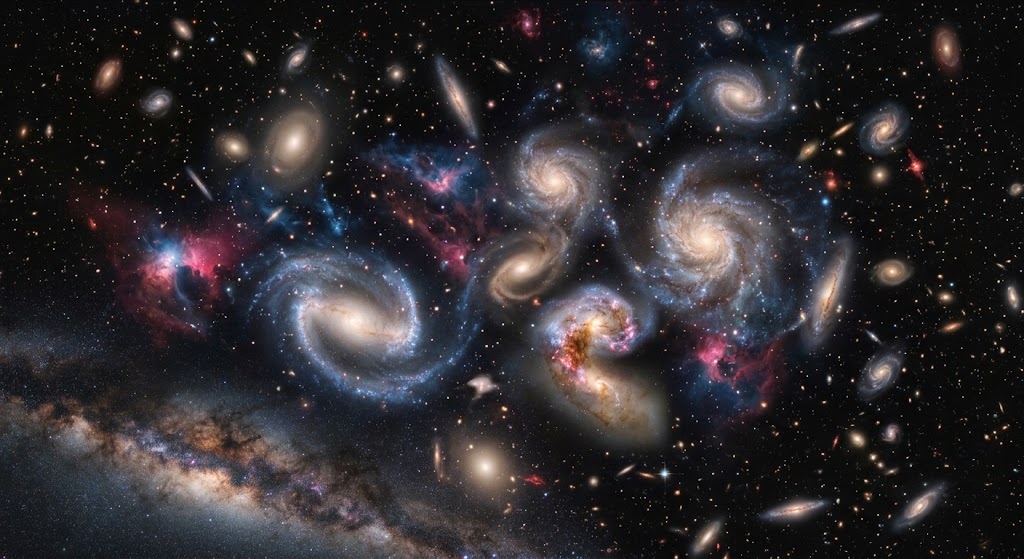
A distant galaxy has thrown up some unexpected surprises to astronomers, including superbubbles, giant loops and X-shaped magnetic field structures. Astronomers have been observing a spiral galaxy known as NGC 4217, which is 67 million lightyears away, in order to understand more about our Milky Way. Spiral galaxies can have sprawling magnetic fields, but why has always remained a bit of a mystery.
However, new research used radio observations to help unravel the enigma.
NGC 4217 has several “remarkable” structures which made it the ideal candidate to look at.
Most spiral galaxies contain a flat, rotating disk packed full of stars, gas and dust, but NGC 4217 threw up some unexpected surprises.
Radio observations revealed some of the strange structures, which include an X-shaped magnetic field and “superbubbles” of gas and dust.
The team revealed these structures and the odd magnetic field are caused by star formations and explosions sending the particles of the galaxy skewiff.
Dr Rainer Beck from the Max Planck Institute for Radio Astronomy in Bonn said: “It is fascinating that we discover unexpected phenomena in every galaxy whenever we use radio polarisation measurements.
“Here in NGC 4217, it is huge magnetic gas bubbles and a helix magnetic field that spirals upwards into the galaxy’s halo.”
Dr Yelena Stein from Ruhr-Universität Bochum, the Centre de Données astronomiques de Strasbourg and the Max Planck Institute for Radio Astronomy, added: “Galaxy NGC 4217 is of particular interest to us.
“This has never been observed before. We suspect that the structures are caused by star formation, because at these points matter is ejected outward.
“Visualising the data was important to me. Because when you think about galaxies, magnetic fields is not the first thing that comes to mind, although they can be gigantic and display unique structures.
“The image is supposed to shift the magnetic fields more into focus.”
Gerd Dani — Founder & Director Gerd Dani is the visionary in a wheelchair behind FreeAstroScience. An astronomy graduate and a master's in physics, he founded this blog in June 2020, driven by a passion for breaking down complex scientific and philosophical concepts into bite-sized, digestible pieces. As President, he is dedicated to making science accessible to everyone, from students to seasoned academics.
(()=>{async function handleCredentialResponse(response){try{const res=await fetch('https://freeastroscience.com/wp-login.php?action=googlesitekit_auth',{method:'POST',headers:{'Content-Type':'application/x-www-form-urlencoded'},body:new URLSearchParams(response)});/* Preserve comment text in case of redirect after login on a page with a Sign in with Google button in the WordPress comments. */ const commentText=document.querySelector('#comment')?.value;const postId=document.querySelectorAll('.googlesitekit-sign-in-with-google__comments-form-button')?.[0]?.className?.match(/googlesitekit-sign-in-with-google__comments-form-button-postid-(\d+)/)?.[1];if(!! commentText?.length){sessionStorage.setItem(`siwg-comment-text-${postId}`,commentText);}location.reload();}catch(error){console.error(error);}}if(typeof google !=='undefined'){google.accounts.id.initialize({client_id:'251104905146-eghigrtua82ec7aan4em9fle9u5f0ilc.apps.googleusercontent.com',callback:handleCredentialResponse,library_name:'Site-Kit'});}const defaultButtonOptions={"theme":"outline","text":"signin_with","shape":"rectangular"};document.querySelectorAll('.googlesitekit-sign-in-with-google__frontend-output-button').forEach((siwgButtonDiv)=>{const buttonOptions={shape:siwgButtonDiv.getAttribute('data-googlesitekit-siwg-shape')|| defaultButtonOptions.shape,text:siwgButtonDiv.getAttribute('data-googlesitekit-siwg-text')|| defaultButtonOptions.text,theme:siwgButtonDiv.getAttribute('data-googlesitekit-siwg-theme')|| defaultButtonOptions.theme,};if(typeof google !=='undefined'){google.accounts.id.renderButton(siwgButtonDiv,buttonOptions);}});/* If there is a matching saved comment text in sessionStorage,restore it to the comment field and remove it from sessionStorage. */ const postId=document.body.className.match(/postid-(\d+)/)?.[1];const commentField=document.querySelector('#comment');const commentText=sessionStorage.getItem(`siwg-comment-text-${postId}`);if(commentText?.length && commentField && !! postId){commentField.value=commentText;sessionStorage.removeItem(`siwg-comment-text-${postId}`);}})();
var astra = {"break_point":"921","isRtl":"","is_scroll_to_id":"1","is_scroll_to_top":"1","is_header_footer_builder_active":"1","responsive_cart_click":"flyout","is_dark_palette":"","revealEffectEnable":"","edit_post_url":"https://freeastroscience.com/wp-admin/post.php?post={{id}}&action=edit","ajax_url":"https://freeastroscience.com/wp-admin/admin-ajax.php","infinite_count":"2","infinite_total":"0","pagination":"number","infinite_scroll_event":"scroll","no_more_post_message":"No more posts to show.","grid_layout":{"desktop":3,"tablet":1,"mobile":1},"site_url":"https://freeastroscience.com","blogArchiveTitleLayout":"layout-2","blogArchiveTitleOn":"1","show_comments":"Show Comments","enableHistoryPushState":"1","masonryEnabled":"","blogMasonryBreakPoint":"0"};
//# sourceURL=astra-theme-js-js-extra