The Casimir effect is a small attractive force that acts between two close parallel uncharged conducting plates. It is caused by quantum vacuum fluctuations of the electromagnetic field.
The effect was predicted by the Dutch physicist Hendrick Casimir in 1948. According to quantum theory, the vacuum contains virtual particles which are in a continuous state of fluctuation. Casimir realised that between two plates, only those virtual photons whose wavelengths fit a whole number of times into the gap should be counted when calculating the vacuum energy. The energy density decreases as the plates are moved closer together, which implies that there is a small force drawing them together.
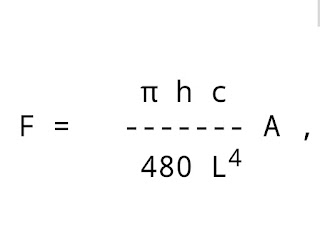
The attractive Casimir force between two plates of area A separated by a distance L can be calculated to be
( Formula is shown in image)
where h is Planck’s constant and c is the speed of light.
The tiny force was measured in 1996 by Steven Lamoreaux. His results were in agreement with the theory to within the experimental uncertainty of 5%.
Particles other than the photon also contribute a small effect, but only the photon force is measurable. All bosons such as photons produce an attractive Casimir force, whereas fermions make a repulsive contribution. If electromagnetism were supersymmetric, “fermionic photinos” would exist, whose contribution would exactly cancel that of the photons, so there would be no Casimir effect. The fact that the Casimir effect exists shows that if supersymmetry exists in nature, it must be a broken symmetry
According to the theory, the total zero point energy in the vacuum is infinite when summed over all the possible photon modes. The Casimir effect comes from a difference of energies in which the infinities cancel. The energy of the vacuum is a puzzle in theories of quantum gravity since it should act gravitationally and produce a large cosmological constant, causing spacetime to curl up. The solution to the inconsistency is expected to be found in a theory of quantum gravity.

Gerd Dani — Founder & Director Gerd Dani is the visionary in a wheelchair behind FreeAstroScience. An astronomy graduate and a master's in physics, he founded this blog in June 2020, driven by a passion for breaking down complex scientific and philosophical concepts into bite-sized, digestible pieces. As President, he is dedicated to making science accessible to everyone, from students to seasoned academics.
(()=>{async function handleCredentialResponse(response){try{const res=await fetch('https://freeastroscience.com/wp-login.php?action=googlesitekit_auth',{method:'POST',headers:{'Content-Type':'application/x-www-form-urlencoded'},body:new URLSearchParams(response)});/* Preserve comment text in case of redirect after login on a page with a Sign in with Google button in the WordPress comments. */ const commentText=document.querySelector('#comment')?.value;const postId=document.querySelectorAll('.googlesitekit-sign-in-with-google__comments-form-button')?.[0]?.className?.match(/googlesitekit-sign-in-with-google__comments-form-button-postid-(\d+)/)?.[1];if(!! commentText?.length){sessionStorage.setItem(`siwg-comment-text-${postId}`,commentText);}location.reload();}catch(error){console.error(error);}}if(typeof google !=='undefined'){google.accounts.id.initialize({client_id:'251104905146-eghigrtua82ec7aan4em9fle9u5f0ilc.apps.googleusercontent.com',callback:handleCredentialResponse,library_name:'Site-Kit'});}const defaultButtonOptions={"theme":"outline","text":"signin_with","shape":"rectangular"};document.querySelectorAll('.googlesitekit-sign-in-with-google__frontend-output-button').forEach((siwgButtonDiv)=>{const buttonOptions={shape:siwgButtonDiv.getAttribute('data-googlesitekit-siwg-shape')|| defaultButtonOptions.shape,text:siwgButtonDiv.getAttribute('data-googlesitekit-siwg-text')|| defaultButtonOptions.text,theme:siwgButtonDiv.getAttribute('data-googlesitekit-siwg-theme')|| defaultButtonOptions.theme,};if(typeof google !=='undefined'){google.accounts.id.renderButton(siwgButtonDiv,buttonOptions);}});/* If there is a matching saved comment text in sessionStorage,restore it to the comment field and remove it from sessionStorage. */ const postId=document.body.className.match(/postid-(\d+)/)?.[1];const commentField=document.querySelector('#comment');const commentText=sessionStorage.getItem(`siwg-comment-text-${postId}`);if(commentText?.length && commentField && !! postId){commentField.value=commentText;sessionStorage.removeItem(`siwg-comment-text-${postId}`);}})();
var astra = {"break_point":"921","isRtl":"","is_scroll_to_id":"1","is_scroll_to_top":"1","is_header_footer_builder_active":"1","responsive_cart_click":"flyout","is_dark_palette":"","revealEffectEnable":"","edit_post_url":"https://freeastroscience.com/wp-admin/post.php?post={{id}}&action=edit","ajax_url":"https://freeastroscience.com/wp-admin/admin-ajax.php","infinite_count":"2","infinite_total":"0","pagination":"number","infinite_scroll_event":"scroll","no_more_post_message":"No more posts to show.","grid_layout":{"desktop":3,"tablet":1,"mobile":1},"site_url":"https://freeastroscience.com","blogArchiveTitleLayout":"layout-2","blogArchiveTitleOn":"1","show_comments":"Show Comments","enableHistoryPushState":"1","masonryEnabled":"","blogMasonryBreakPoint":"0"};
//# sourceURL=astra-theme-js-js-extra