What Secrets Does UGC 5460 Hide? Discover the Face-On Barred Spiral in Ursa Major
Have you ever wondered what stories a distant galaxy could tell if we could see it face-to-face? Welcome, friends, to FreeAstroScience.com, where we break down the universe’s wonders for everyone. Today, we’re diving into UGC 5460—a galaxy that’s not just another smudge in the sky, but a cosmic stage for exploding stars, a hungry black hole, and the drama of galactic life. Whether you’re a seasoned stargazer or just curious about what’s out there, stick with us to the end. You’ll see how one galaxy can change the way we think about the universe—and maybe even ourselves.
Table of Contents
- What Is UGC 5460 and Where Can We Find It?
- What Makes the NGC 3079 Group Special?
- Why Are Barred Spiral Galaxies So Important?
- How Does UGC 5460 Look Up Close?
- What Powers the Heart of UGC 5460?
- What Did Hubble See in UGC 5460?
- What Happened When Stars Exploded in UGC 5460?
- What Do These Supernovae Tell Us About UGC 5460?
- UGC 5460: Key Facts and Tables
- What Can We Learn from UGC 5460?
- References
UGC 5460: The Face-On Barred Spiral That Lets Us Peek Into Galactic Secrets
What Is UGC 5460 and Where Can We Find It?
UGC 5460—also known as PGC 29469 and IRAS F10048+5205—isn’t just a string of catalog numbers. It’s a barred spiral galaxy sitting about 61.4 ± 4.4 million light-years away in the constellation Ursa Major. If you want to point your telescope, its coordinates are RA 10h 08m 09.1731s, Dec +51° 50′ 41.583″. With a diameter of nearly 44,000 light-years and an apparent V-band magnitude of 13.9, it’s not visible to the naked eye, but it’s a treasure trove for astronomers. Classified as SB(rs)d, UGC 5460 is a classic barred spiral, and its nearly face-on orientation gives us a rare, detailed look at its structure and activity.
What Makes the NGC 3079 Group Special?
Galaxies rarely live alone. UGC 5460 is part of the NGC 3079 Group (also called LGG 188), a small but lively family of six galaxies. The group’s main players include NGC 3079 (the heavyweight, with an active nucleus and starburst winds), NGC 3073, MCG 9-17-9, and our star, UGC 5460. These galaxies aren’t just neighbors—they interact, tugging on each other with gravity, pulling out long tails of gas, and even connecting with bridges of hydrogen. The group sits about 50–61 million light-years from us, making it a perfect laboratory for studying how galaxies grow, collide, and change each other’s fate.
Why Are Barred Spiral Galaxies So Important?
Barred spiral galaxies like UGC 5460 aren’t rare—they make up about 65–70% of all spiral galaxies in our cosmic neighborhood. The Milky Way itself is a barred spiral! What sets them apart is the bright, elongated bar of stars slicing through the center, with spiral arms unfurling from the ends. These bars aren’t just pretty—they act like cosmic conveyor belts, funneling gas toward the center, sparking new stars, and sometimes feeding the monster black holes lurking in the core. Famous examples? Think NGC 1300 and NGC 1365. Bars form when the disk of a galaxy becomes unstable, often nudged by gravity or internal dynamics. Over time, they shape the galaxy’s evolution, driving both starbursts and the quieting of star formation.
How Does UGC 5460 Look Up Close?
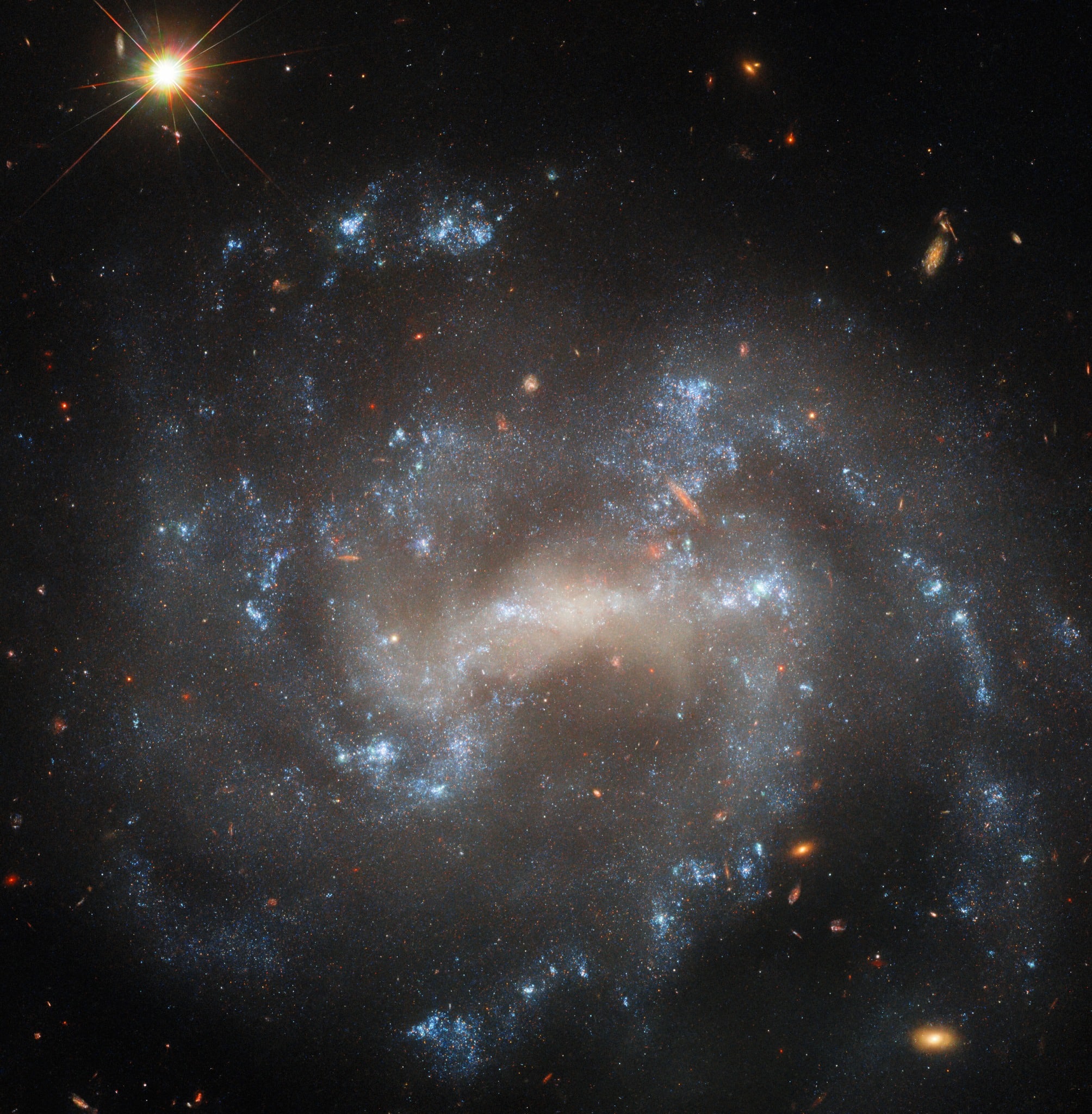
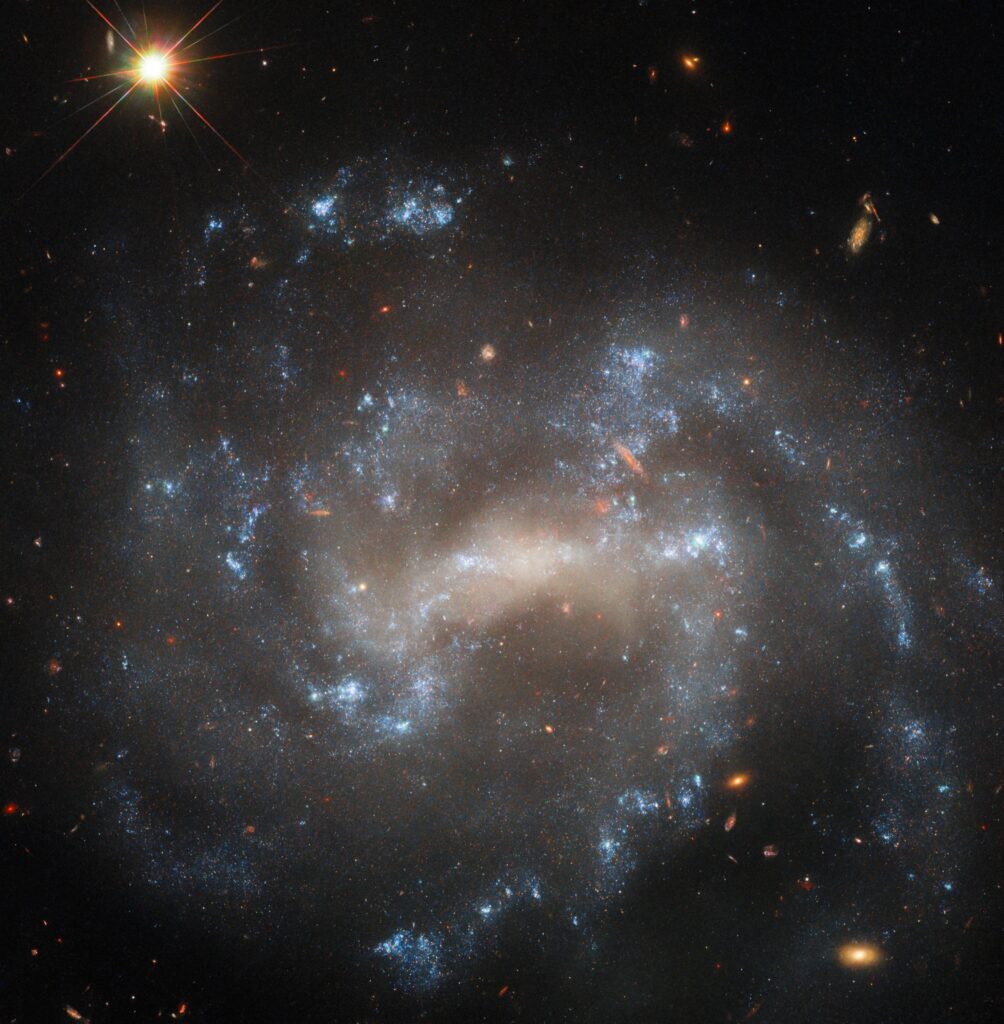
Thanks to its face-on tilt, UGC 5460 gives us a front-row seat to its cosmic show. At the center, we see a bright, oval-shaped disk—a pale yellowish hub glowing with old stars. From this core, tightly wound, irregular spiral arms stretch outward, dotted with numerous bright, bluish-white star clusters. These clusters are nurseries for hot, young stars, lighting up the arms like city lights on a dark map. The galaxy’s structure is a bit messy, with arms that don’t follow perfect symmetry, hinting at past interactions or ongoing internal drama. This messiness is what makes UGC 5460 so fascinating—it’s a living, changing system, not a static postcard.
What Powers the Heart of UGC 5460?
At the center of UGC 5460, astronomers have spotted something extraordinary: a compact region blazing with energy that can’t be explained by stars alone. This is the signature of an active galactic nucleus (AGN). AGNs are powered by supermassive black holes—millions or even billions of times the mass of our Sun—devouring gas and dust. As matter spirals in, it heats up and emits light across the spectrum, from radio waves to X-rays. We spot AGNs by their non-stellar emission: strong, sometimes variable light, broad and narrow emission lines in their spectra, and powerful X-ray or ultraviolet signals. UGC 5460’s AGN is listed as a candidate in the SIMBAD database, but its exact type—whether it’s a Seyfert galaxy or a LINER—remains a mystery. What’s clear is that something massive and hungry is at work in its core.
What Did Hubble See in UGC 5460?
The Hubble Space Telescope has turned its sharp eye on UGC 5460, capturing images in infrared, visible, ultraviolet, and X-ray light. These multiwavelength views reveal the galaxy’s central bar, its winding arms, and the star clusters scattered throughout. Hubble’s data comes from three observing programs, each focused on catching supernovae in action. The result? A high-resolution portrait that lets us study the galaxy’s structure, star formation, and the energetic processes at its core. For astronomers, it’s like having a cosmic microscope pointed at one of the universe’s most interesting neighborhoods.
What Happened When Stars Exploded in UGC 5460?
UGC 5460 isn’t just a quiet spiral—it’s a stage for cosmic fireworks. In the last decade, two supernovae have lit up its arms:
- SN 2011ht (Type IIn-P): Discovered on September 29, 2011 by Tom Boles, this explosion started faint (magnitude 16.9–17.0) but brightened to about 13.9 over 55 days. Its light curve plateaued for 120 days, and its spectrum showed narrow hydrogen lines with broad wings—signs of a dense shell of gas around the star. The UV brightness shot up by 7 magnitudes, and X-rays poured out at 1.0 × 1039 erg/s. The environment was low in metals, and the star that exploded was either a modest 8–10 solar masses (electron-capture supernova) or a massive >25 solar masses (fallback supernova). Some astronomers wonder if it was a true supernova or a “luminous blue variable” impostor. Hubble is still watching for clues.
- SN 2015as (Type IIb): Found on November 15, 2015 by Ken’ichi Nishimura, this supernova’s explosion date is pegged at November 6 (±2 days). It peaked at magnitude 14.74 (absolute –16.82), but didn’t show an early light curve bump. Its spectrum shifted from hydrogen-rich to helium-rich, with P Cygni He I lines appearing about 30 days after the blast. The star that died was likely in a binary system, stripped of most of its hydrogen before exploding. It was a low-luminosity event, with about 0.07–0.08 solar masses of radioactive nickel and 1.1–2.2 solar masses of ejecta.
What Do These Supernovae Tell Us About UGC 5460?
Supernovae are more than cosmic fireworks—they’re signposts of a galaxy’s life. SN 2011ht and SN 2015as show us that UGC 5460 is still making massive stars, and those stars are dying in dramatic ways. Type IIn supernovae (like SN 2011ht) happen when a massive star explodes inside a dense shell of gas it shed before dying. The result? Narrow hydrogen lines and a long, bright plateau in the light curve. Type IIb supernovae (like SN 2015as) start with hydrogen in their spectra, but soon switch to helium as the thin hydrogen envelope is blown away. These are “stripped-envelope” supernovae, often from stars in binary systems. The fact that both types have appeared in UGC 5460 tells us it’s a galaxy with active star formation, a mix of stellar ages, and a low-metallicity environment that shapes how stars live and die. Every supernova enriches the galaxy with new elements, fueling the next generation of stars and planets.
What Can We Learn from UGC 5460?
UGC 5460 isn’t just a distant galaxy—it’s a cosmic classroom. By studying its face-on spiral arms, its active nucleus, and its spectacular supernovae, we get a front-row seat to the forces that shape galaxies everywhere. We see how bars drive gas to the center, how black holes light up the core, and how massive stars live fast and die young, seeding the galaxy with new elements. UGC 5460 reminds us that the universe is alive with change, drama, and discovery. At FreeAstroScience, we believe that understanding galaxies like this keeps our minds sharp and our curiosity burning. Don’t let your reason fall asleep—keep asking questions, keep exploring, and come back soon for more cosmic stories explained in simple terms.
References
- NASA/IPAC Extragalactic Database (NED): UGC 5460
- SIMBAD Astronomical Database: UGC 5460
- NASA Hubble: Barred Spiral in Ursa Major
- Mauerhan et al. 2013, SN 2011ht: Type IIn-P Supernova
- Gangopadhyay et al. 2018, SN 2015as: Type IIb Supernova
- ESA Hubble: Barred Spiral in Ursa Major
- Barred Spiral Galaxies: Formation and Evolution
- NASA Hubble: Barred Spiral Galaxies