When a Giant Falls: What the New Glenn Explosion Tells Us About the Race to the Moon
Have you ever watched a dream go up in flames in less than ten seconds?
Welcome, dear reader. We’re glad you’re here with us at FreeAstroScience.com, where we break down hard science into words anyone can grasp. What happened on the night of May 28, 2026, at Cape Canaveral wasn’t just an industrial accident. It was a wake-up call for the entire American space program, for Jeff Bezos, and for anyone counting on a permanent human presence on the Moon before 2030. Stay with us until the last paragraph. We promise you’ll walk away understanding not only what blew up, but why it matters to you, to NASA, and to the next decade of lunar exploration.
📑 Table of Contents
- What exactly happened on the LC-36A pad?
- What’s a static fire test, and why is it so risky?
- Why did the New Glenn explode?
- How does this hit NASA’s Artemis plans?
- What’s next for Blue Origin and the New Glenn?
- The New Glenn timeline at a glance
- Final thoughts
- FAQ
What exactly happened on the LC-36A pad?
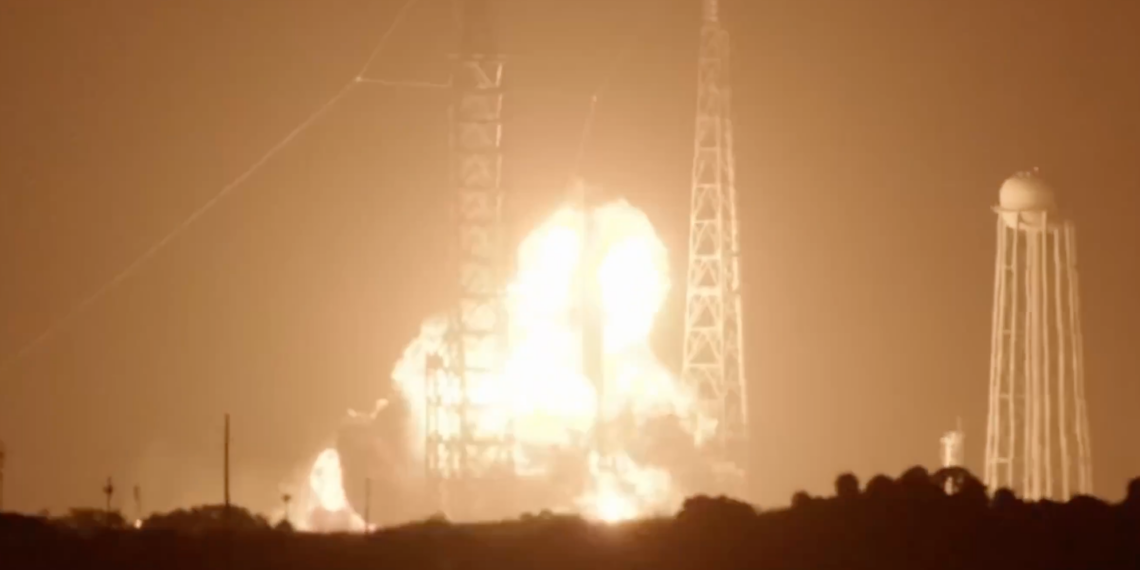
At 9:00 PM local time on May 28, 2026 (3:00 AM Italian time on May 29), the first stage of the fourth New Glenn rocket—nicknamed “No, It’s Necessary”—was sitting on Launch Complex 36-A at Cape Canaveral, Florida ]. The 98-meter-tall vehicle was fully stacked, with its second stage already in place .
Then the seven BE-4 engines lit up. And something went catastrophically wrong.
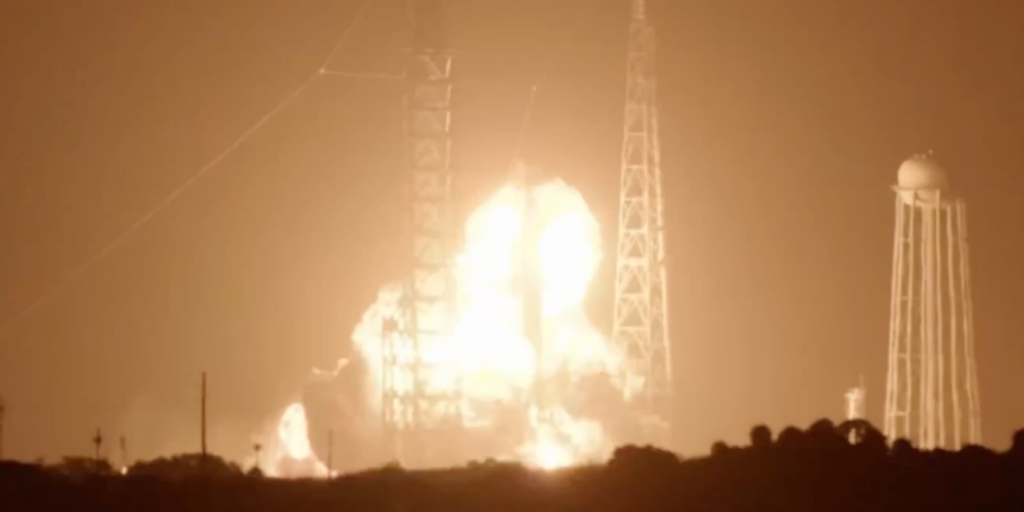
A fire spread fast at the base of the booster. Seconds later, the upper stage began tilting and falling. The methane and liquid oxygen tanks ignited, generating an enormous fireball and a mushroom-shaped cloud visible all along the Space Coast . Witnesses also spotted high-velocity debris trails, a sign that pressurized tanks had ruptured and been thrown out.
No one was hurt. But the booster, the upper stage, and a big chunk of the launch infrastructure—including a lightning tower that collapsed—are gone.
Many observers compared the blast to the explosion of the Soviet N1 rocket in 1969. Strong words. And probably accurate.
What’s a static fire test, and why is it so risky?
Let’s slow down for a second. A static fire test (also called a hot fire test) is a routine pre-flight check. Engineers fire up the rocket’s engines at full power while the vehicle stays bolted to the pad. No liftoff. The goal? Verify that engines, plumbing, software, and structural components all behave as expected before launch day .
Think of it as revving a Ferrari’s engine in the garage with the handbrake on. You want to hear the music before you hit the highway.
Static fires are normally safe. SpaceX, ULA, and Blue Origin run them all the time. But when something fails during one of these tests, the consequences can be brutal—because the rocket is fully fueled and sitting next to expensive ground infrastructure. The 2016 SpaceX Falcon 9 explosion at Cape Canaveral comes to mind. That one took over a year to recover from .
Why did the New Glenn explode?
Honest answer: we don’t know yet. Jeff Bezos himself posted on X that it’s still too early to pinpoint the root cause . Blue Origin is investigating alongside the U.S. Space Force.
Here’s what we can say based on the available footage and reports:
- The anomaly happened right at engine ignition, the most delicate moment of the test .
- The fire started at the base of the rocket, near the seven BE-4 engines .
- The propellant combination—liquid methane and liquid oxygen—ignited after the upper stage tipped over .
- Debris patterns suggest pressurized tank rupture .
Worth remembering: this isn’t the New Glenn’s first stumble. The third flight, back in April 2026, also failed. On that mission, one of the upper stage BE-3U engines didn’t reach full power because of abnormal thermal conditions. The AST SpaceMobile satellite onboard never made it to orbit . The fourth flight was supposed to be the comeback. It became the worst incident in the program’s history.
How does this hit NASA’s Artemis plans?
Here’s where the story gets bigger than Blue Origin.
Just two days before the explosion—on May 26, 2026—NASA had announced a $188 million contract awarding Blue Origin the job of developing transport systems to deliver rovers and scientific gear to the lunar polar region . The New Glenn isn’t only a commercial launcher. It’s a backbone of the Artemis program and of NASA’s Moon Base strategy .
NASA Administrator Jared Isaacman didn’t sugarcoat it. On X, he admitted that “developing new heavy-lift launch capabilities is extraordinarily difficult” and warned that updates on Artemis and Moon Base impacts will follow soon .
What’s actually at stake?
- Artemis III was already pushed to mid-2027, and it’ll no longer land humans on the Moon. Instead, it’ll test docking maneuvers in low Earth orbit between the Orion capsule and the lunar lander system .
- The astronaut crew for Artemis III is set to be announced on June 9, 2026 .
- The Blue Moon Mk1 lander, part of the Moon Base 1 mission, was supposed to launch in autumn 2026 .
- New Glenn is also the chosen vehicle for future crewed Blue Moon landers .
Every month of New Glenn downtime cascades onto rovers, landers, and the entire Artemis schedule. That’s not opinion. That’s how supply chains work.
What’s next for Blue Origin and the New Glenn?
Bezos has already said the company will rebuild. “It’s worth it,” he wrote . The 48 Amazon Leo internet satellites that were meant to fly on this mission are safe—they were sealed inside the fairing in a separate integration building, far from the pad .
But here’s an interesting twist. Some sources suggest Blue Origin might skip ahead and move directly to the New Glenn 9×4 version (nine engines on the first stage, four on the second) instead of rebuilding the current 7×2 configuration . That would be a bold call. It could either save time or delay things further, depending on how mature the 9×4 design actually is.
If pad LC-36A damage turns out to be as severe as early reports suggest, we’re looking at months—possibly more than a year—of reconstruction before any New Glenn flies again .
The New Glenn timeline at a glance
| Date | Event | Outcome |
|---|---|---|
| April 19, 2026 | Third New Glenn launch (BE-3U upper stage anomaly) | ❌ AST SpaceMobile satellite lost |
| May 26, 2026 | NASA awards $188M contract to Blue Origin for lunar rovers | ✅ Major win |
| May 28, 2026 (9:00 PM ET) | Static fire test of fourth New Glenn at LC-36A | 💥 Booster, upper stage and pad damaged |
| June 4, 2026 (planned) | Original launch date for 48 Amazon Leo satellites | ⏸️ Indefinitely postponed |
| June 9, 2026 | Artemis III crew announcement | 🚀 On schedule |
| Autumn 2026 (planned) | Blue Moon Mk1 launch — Moon Base 1 mission | ⚠️ At risk |
| Mid-2027 (planned) | Artemis III launch (LEO docking test) | ⚠️ Possibly delayed |
A quick math note: how big was that fireball?
The first stage of the New Glenn carries roughly 1,140 tonnes of liquid methane and liquid oxygen when fully fueled. The chemical energy released by burning methane is given by:
CH₄ + 2 O₂ → CO₂ + 2 H₂O + ΔH
ΔH ≈ −891 kJ/mol
Even a fraction of that energy released suddenly explains why the explosion was visible from miles away .
Final thoughts
Space is hard. We say it almost as a cliché, but nights like May 28, 2026, remind us why the cliché exists. Rockets are flying chemistry experiments holding hundreds of tonnes of cryogenic fuel under pressure. When something fails, it fails loud.
Blue Origin will rebuild. NASA will recalibrate. Artemis will probably slip again. But here’s what we want you to take home: progress in spaceflight has never been linear. The Apollo program lost three astronauts in 1967. SpaceX blew up Falcon 9s before becoming the workhorse of low Earth orbit. The New Glenn will likely return.
This article was written for you by FreeAstroScience.com, where we break down complex scientific principles into language anyone can follow. Our mission? Keep your mind switched on, always. Because the sleep of reason breeds monsters—and a curious public is the best defense against bad science, bad policy, and bad decisions.
Come back to visit us. Bring your questions. We’ll keep doing the work.
Frequently Asked Questions
1. Was anyone injured during the New Glenn explosion?
No. Officials confirmed there were no injuries at Cape Canaveral and no threat to the public . The static fire test was unmanned, as is standard practice.
2. What fuel does the New Glenn use, and is it more dangerous than other propellants?
The first stage burns liquid methane (CH₄) and liquid oxygen (LOX) . It’s actually considered cleaner and safer than older hypergolic fuels. The danger comes from the sheer quantity stored under cryogenic pressure, not from the fuel chemistry itself.
3. Will this delay Artemis III?
Possibly. NASA Administrator Jared Isaacman said impacts on Artemis and Moon Base programs will be communicated soon . Artemis III was already scheduled for mid-2027, with the crew announcement on June 9, 2026 .
4. Were the Amazon Leo satellites destroyed?
No. The 48 Amazon Leo satellites were already encapsulated inside the fairing, which was stored in a separate integration building far from the launch pad .
5. How long could it take to rebuild Launch Complex 36-A?
Hard to say without a damage assessment. As a reference point, when SpaceX’s Falcon 9 exploded on a similar pad in 2016, it took more than a year to restore the site .
📚 References
- Brugnoni, S. (May 29, 2026). Razzo di Blue Origin esploso nei test sulla rampa di lancio: cosa potrebbe essere successo al New Glenn. Geopop. Read article
- Maglione, M. (May 29, 2026). Il primo stadio del New Glenn di Blue Origin è esploso sul pad di lancio. AstroSpace.it. Read article
- Edwards, B. (May 28, 2026). Jeff Bezos Blue Origin rocket destroyed during test. What is static fire? Florida Today. Read article