A Letter From Fertilia, Where the Moon Walks on Water
Sun, salt, mirto, and a Sardinian night that quietly rewires your soul.
Hello, friends. I’ve missed you.
I’m writing to you from Valmarì, on the Fertilia waterfront, and the truth is I’ve been a little selfish with my silence these past few days. The Sardinian sun has been hammering down without mercy, the sea is the kind of glass-clear blue that makes you doubt your own eyes, and I’ve surrendered. Completely.
So consider this my postcard — the long version.
The Place That Almost Wasn’t
Before I tell you about the mirto and the moon, let me tell you where I am. Because Fertilia is not just another pretty seaside village.
It’s a small place of about two thousand people, tucked into the north-west corner of Sardinia, between the sea and a lagoon, just five kilometres from the airport that now serves as the island’s tourist gateway . From the outside, you’d think it’s been here forever. It hasn’t.
Fertilia was built in the 1930s . A whole village, willed into existence.
Under a Fascist-era development programme, families from the Province of Ferrara — far up in northern Italy — were resettled here to populate the new town . That’s literally where the name comes from: Ferrara meets fertile. The story actually starts earlier, in 1898, with the draining of the Calik pond carried out under forced labour, followed by working-class settlements along the road between Alghero and Porto Conte .
Of all the “cities of the Ventennio,” Fertilia is the one that has stayed closest to its original rural soul . You feel that. It hasn’t been polished into a postcard. It still smells faintly of fishing nets and tomato gardens.
A village between sea and lagoon, holding the memory of singular events in its very name .
The Sea That Knows How to Hold You
Now — the water.
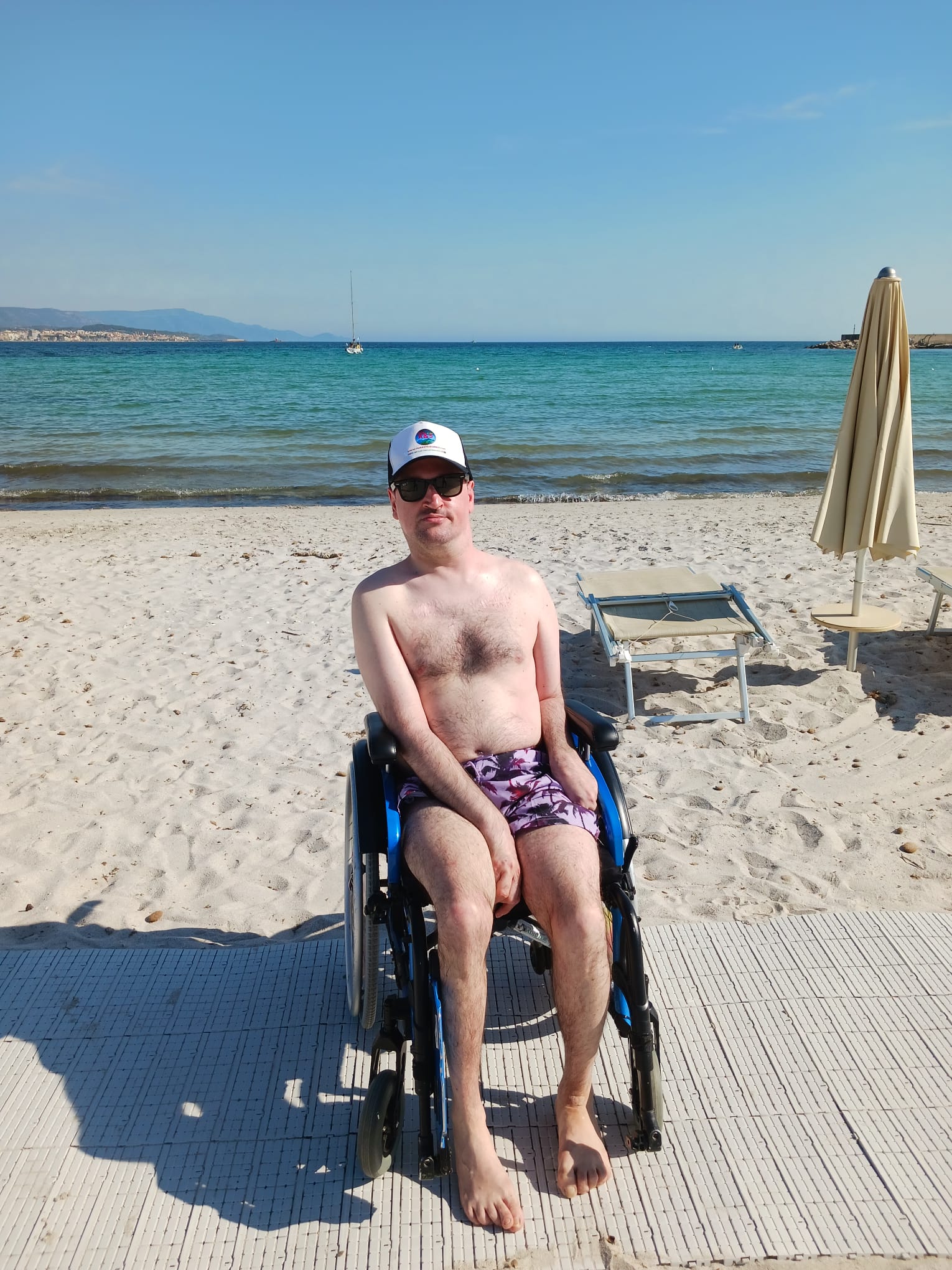
La Fertilia Beach is the kind of place you’d design if a child asked you to draw the perfect beach: shallow, calm, soft-bottomed, lined with little resorts, tailored almost on purpose for families and for people like me who need things to be a bit gentler . For someone who navigates the world from a wheelchair, that matters more than I can say.
I float here with my inner tube. That’s it. That’s the whole programme.
The water lifts me, and for a few minutes the dystonia that defines so much of my daily life simply… loosens its grip. The sea doesn’t care that my legs don’t always cooperate. It just holds me. There’s something deeply scientific and deeply spiritual happening at once: buoyancy is just Archimedes’ principle, the upward push of displaced fluid — but try explaining that to a body that suddenly feels weightless after years of fighting gravity. I’ll simplify the physics for you here, because the feeling is what matters: water gives back what land takes away.
I close my eyes. Salt on my lips. Sun on my face. A small laugh escapes me, and I don’t even know why.
Mirto, or: How an Afternoon Should End
By late afternoon, the heat softens and someone — bless them — pours me a small glass of Sardinian mirto.
If you’ve never tried it, picture a dark, almost ink-purple liqueur made from the berries of the myrtle bush, served ice-cold. It tastes like the macchia after rain — herbal, sweet, a bit wild, with a finish that reminds you that yes, you are absolutely on an island. Sardinians don’t really drink mirto. They observe a small ritual with it.
I sip slowly. The waterfront hums with that particular evening sound: clinking glasses, scooters in the distance, gulls arguing about dinner.
This, I think, is what rest is supposed to feel like.
And Then the Moon Arrives
The evening, though — the evening is the headline.
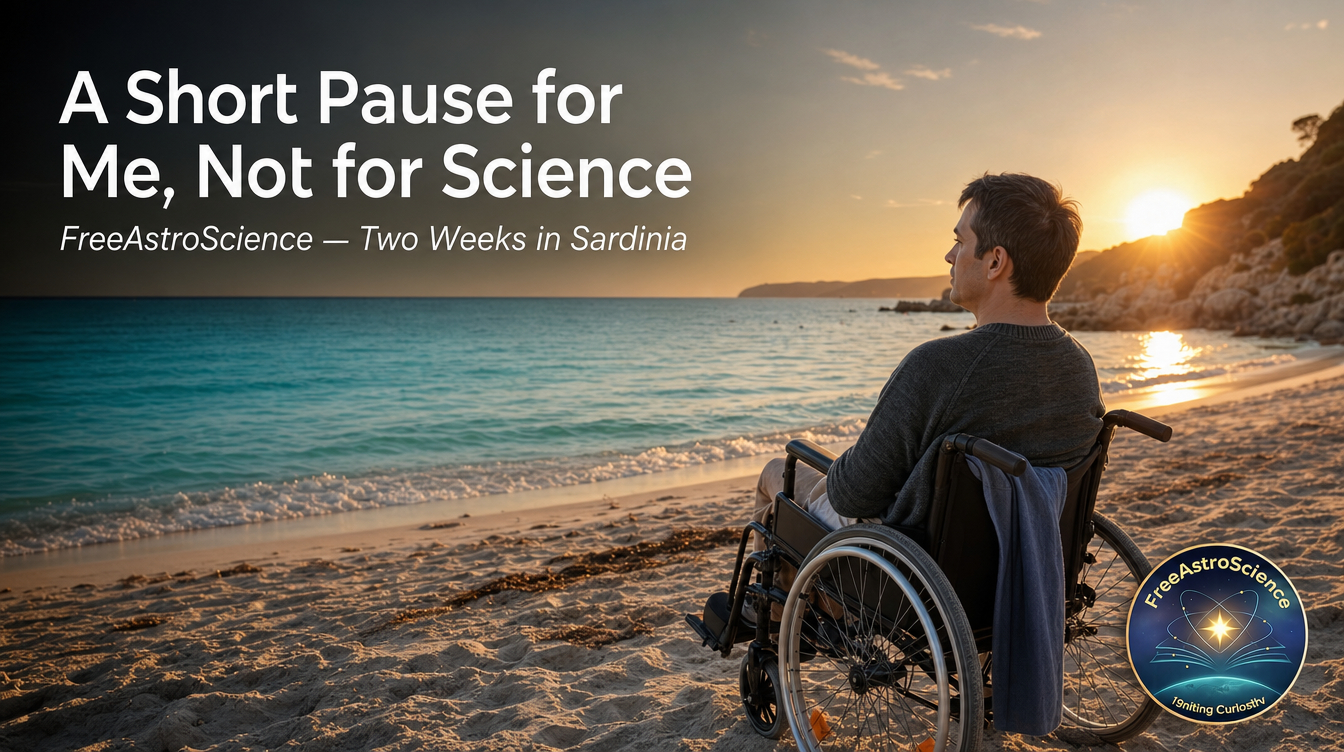
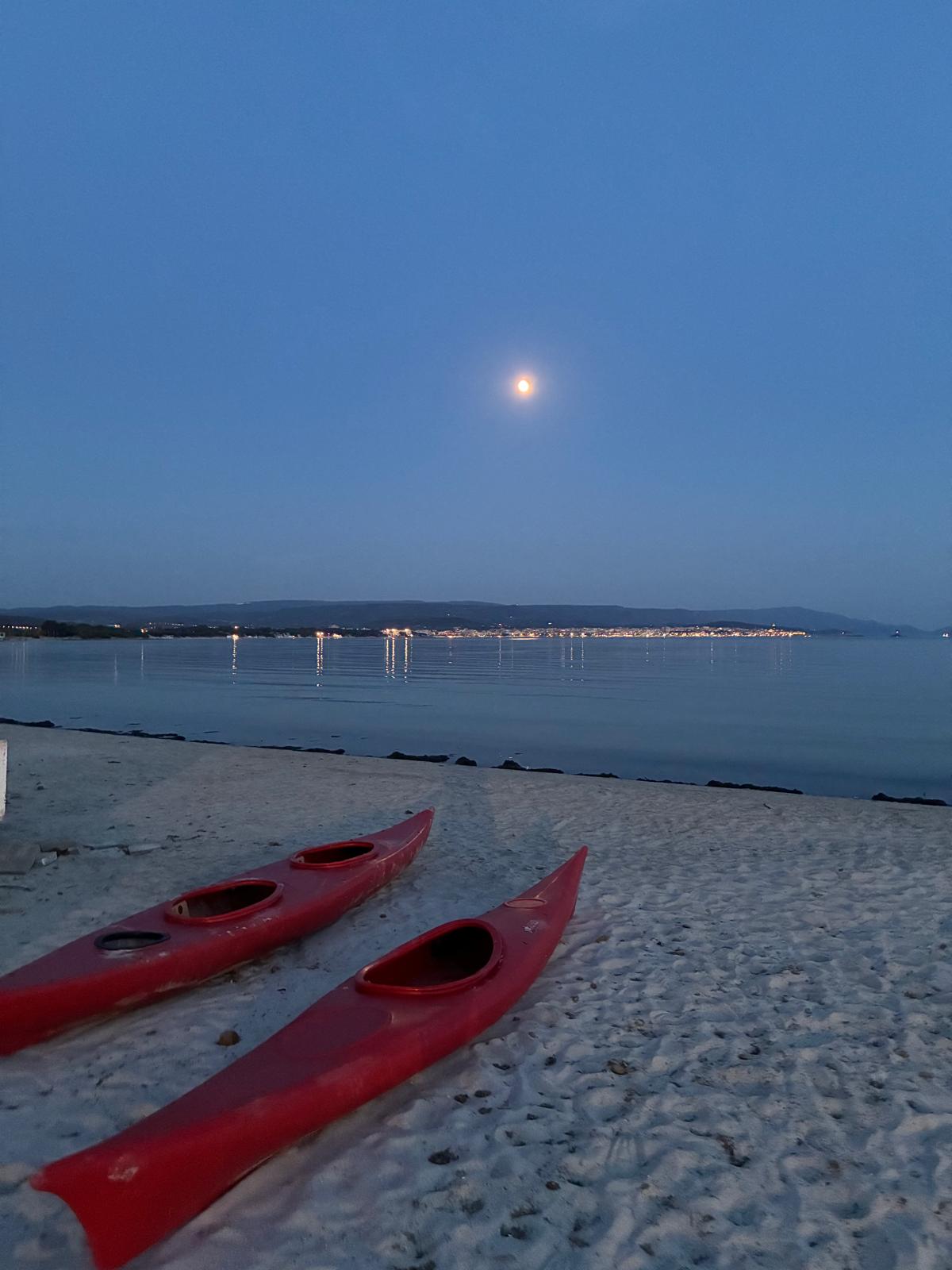
The moon climbs high over the bay tonight, and her light spills across the water in a long silver road that seems to lead straight to my chair. The lights of distant Alghero shimmer on the surface like dropped coins. Two red kayaks rest on the white sand in front of me, waiting for tomorrow. The sky still holds that deep blue that only exists for about twenty minutes a day, somewhere between sunset and full night.
I watch the moonlight dance on the sea and I can’t stop the astronomer in me from showing up.
That light, the one painting the bay right now, left the Sun about eight minutes ago, bounced off the lunar surface 384,000 kilometres away, and travelled another 1.3 seconds to reach my eyes here on this beach. I’m not seeing the moon. I’m seeing the moon as it was a second and a third ago. Every reflection is a tiny time machine. (I told you I’d simplify the science — that’s about as gentle as I can make it.)
And yet, knowing the physics doesn’t shrink the magic. It enlarges it.
What This Place Keeps Teaching Me
I came here tired. Honestly. The kind of tired that doesn’t show up on a blood test.
Fertilia has been doing what it has always done — quietly, patiently. It has been holding me. A village that was conjured out of marshland by people who had nothing, populated by families uprooted from another corner of Italy, surviving on agriculture and fishing , now offering its waterfront to a wheelchair-bound astronomer from Albania who washed up here for a few days of peace.
If that isn’t proof that beautiful things can grow from difficult ground, I don’t know what is.
Never give up. I keep coming back to those three words. Not as a slogan, but as a field observation. The lagoon was drained. The village was built. The families settled. The vines grew. The mirto fermented. The kayaks were dragged onto the sand. The moon rose. None of that was guaranteed. All of it required someone, somewhere, refusing to quit.
Tomorrow I’ll get back in the water. Tomorrow there will be more sun, more salt, more silly laughter. And in a few days I’ll be back at my desk in Emilia-Romagna, writing to you about black holes and exoplanets and whatever else the universe decides to throw at us next.
But tonight I just wanted you to be here with me.
The moon is high. The sea is calm. The mirto is gone.
And I am, as always, profoundly glad you exist on the other end of this screen. See you very soon.
— Gerd, from the Fertilia waterfront