
Have you ever wondered what our Sun looked like 4.9 billion years ago —
wild, young, and blowing fierce winds across a galaxy that hadn’t yet
heard of us? What if the answer was captured in a single X-ray image,
glowing 120 light-years away?
Welcome to FreeAstroScience.com, where complex science becomes
something you feel, not just something you read. We explain the universe in plain
language, because we believe knowledge belongs to everyone — and because, as
Francisco Goya once reminded us, the sleep of reason breeds monsters.
We’re glad you’re here. Read this one to the end.
It’s worth it.
Our Sun Had a Wild Youth — and We Just Saw Its Living Twin
On February 23, 2026, NASA released something that stopped
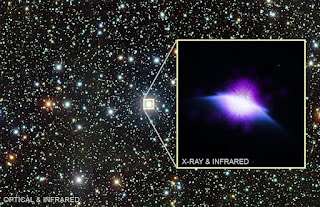
astronomers mid-sentence: the first X-ray image of a wind-blown bubble —
an astrosphere — surrounding a star that’s almost identical to our
own Sun, just billions of years younger. That star is called
HD 61005, and it sits about
120 light-years from Earth in the constellation Puppis.
Think of it this way. You’ve always known your grandmother as the calm,
settled person she is today. Then someone hands you a photograph of her at
twenty — full of fire, running fast, bending the world to her will.
That’s what HD 61005 is to our Sun. Same mass. Same temperature.
Very different moment in life.
The result was published in The Astrophysical Journal by a team
led by Carey Lisse of Johns Hopkins University, with
co-authors Scott Wolk (Harvard-Smithsonian Center for
Astrophysics) and Brad Snios (formerly CfA, now at MITRE).
And after more than three decades of searching, astronomers finally got
their picture.
What Exactly Is an Astrosphere?
Every star — including our Sun — constantly sheds a stream of charged
particles called a stellar wind. Our Sun sends this stream
racing through the solar system at speeds of 400 to 800 km/s. Eventually,
that wind smashes into the cold gas of interstellar space. At the collision
point, a giant bubble forms.
Around our Sun, we call that bubble the heliosphere.
It wraps our entire solar system, extends well beyond Neptune, and acts as
a cosmic shield — blocking most of the high-energy
galactic cosmic rays that race through the Milky Way. Without it,
Earth’s atmosphere would take a constant, brutal battering from particles
traveling close to the speed of light.
Around other stars, the same structure gets a different name:
the astrosphere. Same physics. Same protective function.
Just a different star at the center. Astronomers had seen astrospheres
around massive hot stars, dying stars, and newborn protostars. But around
an ordinary, Sun-like star? For decades — nothing.
it from the outside. This new Chandra result about a similar star’s
astrosphere teaches us about the shape of the Sun’s, and how it has changed
over billions of years as the Sun evolves and moves through the galaxy.”
— Carey Lisse, Johns Hopkins University, lead author
Who Is HD 61005 — the “Moth”?
HD 61005 earned its nickname the hard way. Look at it through an
infrared telescope and you see two graceful, swept-back wings of dust
spreading out from the central star. It looks exactly like a moth caught
mid-flight. Those wings aren’t decorative — they’re made of rocky and icy
debris left over after the star formed, much like our solar system’s
Kuiper Belt.
The “wings” are swept back because the star is actively plowing through a
dense cloud of interstellar gas at about 10 km/s.
Observations with NASA’s Hubble Space Telescope confirmed that the
interstellar matter surrounding HD 61005 is roughly
1,000 times denser than the gas around our Sun.
That’s an extraordinarily thick cosmic neighborhood to live in.
You won’t spot HD 61005 with the naked eye from Earth — it’s just
below the visibility threshold. But a decent pair of binoculars and a clear
southern-hemisphere sky will get you there. It’s sitting in
Puppis, the old ship’s stern.
🔭 Quick Facts: The Moth — HD 61005
- Distance from Earth: ~120 light-years
- Constellation: Puppis (southern sky)
- Age: ~100 million years old
- Mass & temperature: Similar to our Sun
- Stellar wind speed: ~3× faster than solar wind
- Stellar wind density: ~25× denser than solar wind
- Surrounding ISM density: ~1,000× denser than around the Sun
- Astrosphere diameter: ~200 AU
- Bubble shape: Roughly spherical
- Debris disk analog: “Moth wings” — similar to our Kuiper Belt
How Does HD 61005 Compare to Our Sun?
Numbers lay it out cleanly. Here’s how our Sun stacks up against
HD 61005 across the properties that matter most for understanding
this discovery:
| Property | Our Sun | HD 61005 — The Moth |
|---|---|---|
| Age | ~5 billion years | ~100 million years |
| Mass | 1 M☉ (reference) | Similar (~1 M☉) |
| Surface temperature | ~5,778 K | Similar (~5,500–5,800 K) |
| Stellar wind speed | 400–800 km/s | ~3× faster |
| Stellar wind density | Reference | ~25× denser |
| Surrounding gas (ISM) density | ~1 particle/cm³ | ~1,000× denser |
| Protective bubble diameter | Heliosphere (~100 AU) | Astrosphere (~200 AU) |
| Distance from Earth | 1 AU = 150 million km | ~120 light-years |
| Debris disk structure | Kuiper Belt | “Moth wings” dust disk |
| Detected by Chandra? | Heliosphere (from inside) | Astrosphere — first full image |
How Did Chandra Finally Capture It?
Here’s the fundamental challenge: astrospheres around ordinary stars don’t
shine. They’re cold, diffuse, and quiet in visible light. You’d never see
one in a standard photograph. But at the exact point where a stellar wind
crashes into interstellar gas, the collision heats the material to millions
of degrees, and it starts radiating in X-rays.
That’s where NASA’s Chandra X-ray Observatory — orbiting
Earth since July 1999 — becomes irreplaceable. Chandra has the sharpest
X-ray vision of any telescope ever launched. And for HD 61005, four
conditions lined up perfectly:
-
A powerful stellar wind — creating high-energy collisions
at the astrosphere boundary -
Unusually dense surrounding gas — amplifying the X-ray
glow at the wind-gas interface -
Relative proximity — at 120 light-years, the signal
was detectable rather than lost in cosmic noise -
Patient observation — a nearly
19-hour Chandra stare in 2021 collected enough photons
to resolve the extended structure
The result was the first extended X-ray image of an astrosphere
around a Sun-like star. Not a single point of light — a genuine structure,
with shape and spatial extent. A bubble. Caught in the act of being alive.
Putting 200 AU in Perspective
HD 61005’s astrosphere has a diameter of roughly
200 AU — where 1 AU is the Earth-Sun distance of
~150 million km. Let’s put that in real numbers:
200 AU × 150,000,000 km/AU = 30,000,000,000 km
30 billion kilometres — roughly 200× the Earth-Sun distance,
and about 2× the diameter of our own heliosphere (~100 AU).
Our heliosphere extends to about 100 AU from the Sun —
so HD 61005’s bubble is roughly twice as wide, even inside a
much denser and more hostile gas environment. That’s a testament to the
raw power of a young star’s wind.
Why Does a Young Star Blow So Hard?
Young stars are ferocious. They spin faster, carry stronger magnetic fields,
and fling charged particles into space far more aggressively than older,
calmer stars. It’s a bit like comparing a 20-year-old sprinter to a
60-year-old marathoner — both extraordinary, but drawing on very
different energy reserves.
HD 61005’s wind travels roughly 3 times faster than
our solar wind and is about 25 times denser. What does
that mean for the energy hitting the astrosphere boundary? The kinetic
energy of a flowing gas scales with density times the square of velocity:
E kinetic ∝ ρ × v2
Where ρ = wind particle density, v = wind speed.
For HD 61005 vs. the Sun: ρ ≈ 25×, v ≈ 3×
→ E ≈ 25 × 32 = 25 × 9 =
∼225× more energetic than our solar wind today.
That ~225-fold boost in wind energy is what made the X-ray glow bright
enough for Chandra to detect. And it tells us something profound about
ourselves: our early Sun was almost certainly just as fierce.
We were the Moth once.
off, but also by the wind it sends out into space that can affect our
satellites and potentially astronauts traveling to the Moon or Mars.
This image of the astrosphere around HD 61005 gives us important
information about what the Sun’s wind may have been like early in
its evolution.”
— Scott Wolk, Center for Astrophysics | Harvard & Smithsonian
What Does This Mean for Life on Earth?
Here’s a thought that genuinely stops you. Lead researcher Carey Lisse
pointed out something startling: if our Sun were sitting in the same
dense galactic gas cloud as HD 61005, our heliosphere would
shrink to extend only as far as the orbit of Saturn.
That’s roughly 9.5 AU — compared to the heliosphere’s
current reach of ~100 AU.
A tenfold reduction in our cosmic shield would have real consequences.
Far more galactic cosmic rays would pour into the inner solar system.
Earth’s upper atmosphere would absorb a higher radiation dose. We don’t
yet fully understand what that would mean for biology and climate over
geological timescales — but it’s not a comfortable scenario.
Flip the scenario the other way: if HD 61005 were located here,
in the Sun’s calm neighborhood, its astrosphere would balloon to
10 times wider than our current heliosphere — a
bubble roughly 1,000 AU across. Its fierce wind would barely notice
the thin local gas.
out to the orbit of Saturn if we were in the part of the galaxy where the
Moth is located, or, conversely, that the Moth would have an astrosphere
10 times wider than the Sun’s if it were located here.”
— Carey Lisse, lead researcher, Johns Hopkins University
Our Galaxy Moves — and So Does Our Shield
Our Sun isn’t standing still. It orbits the galactic center at roughly
230 km/s, completing one full circuit every ~225 million
years. Along the way, it crosses regions of varying gas density —
including denser clouds much like the one HD 61005 is
plowing through right now. Scientists believe our Sun has likely passed
through such environments several times in its history.
Each time that happened, our heliosphere would have shrunk and deformed,
just as we now observe HD 61005’s astrosphere doing today. Those
passages may have had effects on Earth’s climate, cosmic ray exposure,
and even — speculatively — on the pace of evolution. We don’t yet have
all the answers. But this discovery gives us a new, concrete starting point.
Why Did the Search Take 30 Years?
Astronomers have hunted for astrospheres around Sun-like stars since the
1990s. They found them around hot, massive O- and B-type
stars — those blow such violent winds that the X-ray glow is easy to pick
out. They found them around dying red giants and around infant protostars
still wrapped in their birth clouds. But a plain, middle-aged star like
the Sun? Nothing. Decades of nothing.
As Lisse put it at the
25 Years of Science with Chandra symposium in December 2024:
“We don’t see them around average, everyday stars that might host life.
For 20 years, we’ve been looking for this effect, and haven’t seen it.”
The problem was always signal strength — ordinary stellar winds simply
don’t produce enough X-ray emission to stand out above the detector noise.
HD 61005 checked every single box: young and energetic, embedded in
a dense gas cloud, close enough to Earth, and observable with Chandra’s
unmatched resolution. It wasn’t luck. It was two decades of patience,
careful target selection, and the willingness to stare at one star for
19 straight hours.
HD 61005, the dusty ‘Moth’ was born around the flame.”
— Brad Snios, co-author (MITRE)
A Timeline of the Discovery
-
1990s
Astronomers begin searching for astrospheres around Sun-like stars.
Decades of unsuccessful attempts with multiple observatories follow. -
2007–2008
HD 61005 is nicknamed “the Moth” after Hubble images reveal its
dramatic wing-shaped dust disk, swept back by the star’s motion through
a dense interstellar gas cloud at ~10 km/s. -
2014
A brief 1-hour Chandra observation picks up the
first hints of X-ray emission from HD 61005’s core — a tantalizing
clue that something brighter might be waiting. -
2021
A nearly 19-hour Chandra observation collects
enough X-ray photons to resolve the extended astrospheric structure.
The bubble is real. The bubble is seen. -
February 23, 2026
NASA officially announces the discovery. The paper is published in
The Astrophysical Journal, authored by Carey Lisse
(Johns Hopkins), Scott Wolk (Harvard-Smithsonian CfA), and
Brad Snios (MITRE). The astronomy community calls it a
30-year quest finally answered.
We Were the Moth Once
What strikes us most about this discovery isn’t just the physics —
it’s the mirror it holds up to everything we are. HD 61005 is blowing
a bubble of hot gas into the galaxy, shielding its small system from
cosmic radiation, carrying dusty wings of future planets, racing through
space on a path only time will reveal. Sound familiar?
That’s us, 4.9 billion years ago. Our Sun was just as fierce. Our
heliosphere was just as wild. And somewhere out there, on a planet
we haven’t found yet, maybe the chemistry of life was already stirring
beneath the light of that young, blazing star.
Every discovery like this one is an invitation — to ask harder questions,
to refuse easy comfort, to keep your mind wide open and working.
At FreeAstroScience.com, we believe the universe rewards
curiosity above everything else. We don’t want you to switch off that
curiosity. Ever. Because the sleep of reason breeds monsters.
Come back to
FreeAstroScience.com
often. There’s always another bubble out there, waiting to be discovered —
and we’ll be here to help you understand it.