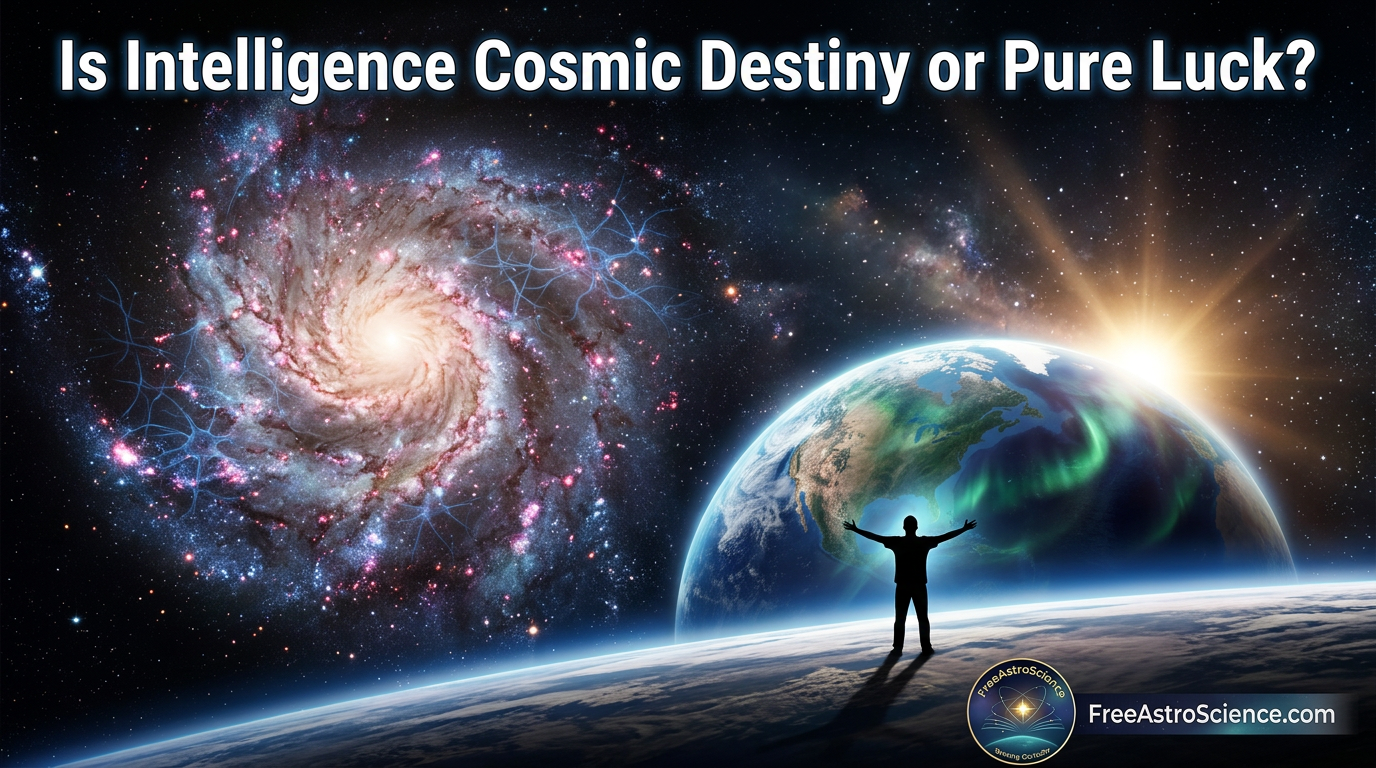
Could the Universe have always been heading toward a mind that would one day look back and ask why it exists?
Welcome to FreeAstroScience.com‚ the place where we take the most daunting questions in science and make them feel like a conversation between friends. Whether you’ve been reading us for years or you just stumbled here at an unlikely hour, we’re genuinely glad you’re with us.
Today, we’re wrestling with something that has kept philosophers, physicists, and biologists up at night for decades: is intelligence inevitable in the Universe? Not just life‚ but thinking life. Minds that write music, point telescopes at distant galaxies, and feel the weight of their own existence.
This question doesn’t have a tidy answer. But that’s exactly why it’s worth asking. Read with us to the end ‚Äî we promise the journey is worth every word.
Table of Contents (click to toggle)
- What Do Stars Have to Do With Thinking?
- Did Life Have to Happen?
- Why Did Intelligence Take So Long to Emerge?
- Does Evolution Always Converge on Minds?
- Can Thermodynamics Actually Explain Intelligence?
- What Does the Fermi Paradox Tell Us?
- Is Our Intelligence Rare or Universal?
- A Universe That Thinks About Itself — Conclusion
- References & Sources
Is Intelligence Written Into the Laws of the Universe?
Few questions hit harder than this one. Across 13.8 billion years of cosmic history, matter went from a hot, featureless plasma to something that composes symphonies and wonders about its own origins. That arc — from nothing to thinking — deserves more than a casual glance.
Let’s trace it from the very beginning.
What Do Stars Have to Do With Thinking? ⭐
Here’s something that genuinely stops us every time we reflect on it. The carbon atoms inside your neurons ‚Äî right now, as you read this sentence ‚Äî were forged inside a dying star billions of years ago. The nitrogen in your DNA. The oxygen in your lungs. All of it, stellar debris.
That’s not a metaphor. That’s astrophysics.
After the Big Bang, approximately 13.8 billion years ago, the Universe contained almost exclusively hydrogen (~75%) and helium (~24%). There were no carbon atoms, no water molecules, no organic chemistry. The raw materials for life simply didn’t exist.
Then gravity took over. It pulled those vast clouds of gas together into the first generation of stars. Inside those stellar furnaces, nuclear fusion hammered lighter nuclei into heavier ones — carbon (C), oxygen (O), nitrogen (N), phosphorus (P), and more. When those early, massive stars died as supernovae, they scattered those elements across space. New stars formed from the enriched dust. Planets coalesced. And on at least one of those planets, the chemistry grew complicated enough to produce us.
This sequence wasn’t optional. Without it, the atoms required for biology don’t exist. Intelligence, in the deepest sense, begins not in the brain ‚Äî but in the physics of stellar nucleosynthesis.
Why the Laws Had to Be Just Right
The laws of physics had to cooperate at every step. Change the gravitational constant slightly, and stars never ignite. Adjust the electromagnetic force, and atoms don’t bond into stable molecules. Tweak the strong nuclear force, and carbon never fuses in stellar cores.
Scientists call this the fine-tuning problem. The fundamental constants of the Universe — gravity, electromagnetism, the speed of light — appear calibrated to allow complexity to arise. Whether you read design or extraordinary luck into that fact, the numbers are hard to dismiss. Our Universe behaves as if it was configured, right down to its constants, to eventually produce something like us.
Did Life Have to Happen? üߨ
Having the right elements doesn’t guarantee life, of course. Getting from a mix of carbon, hydrogen, oxygen, and nitrogen to a self-replicating molecule is one of science’s most celebrated unsolved puzzles.
And yet, on Earth, it happened fast. Our planet formed roughly 4.5 billion years ago. The earliest microbial fossils ‚Äî microscopic stromatolites from Western Australia ‚Äî date to about 3.7 billion years ago. That means life appeared within less than one billion years of Earth’s formation. Geologically speaking, that’s close to instantaneous.
This speed is a big hint. It suggests that, under the right conditions, simple life might not be all that rare. The Nobel laureate Ilya Prigogine showed in 1977 through his theory of dissipative structures that open systems receiving a continuous flow of energy can spontaneously self-organize — they build internal order while exporting entropy to their surroundings. Life, in this framework, may be what happens when chemistry gets pushed hard enough by a nearby star. The origin of life, far from being a miracle, might be a thermodynamic expectation.
Recent work on the Thermodynamic Dissipation Theory for the Origin of Life extends this further. It argues that early molecules evolved to dissipate solar UV radiation more efficiently ‚Äî and that self-replication was simply the most effective dissipation strategy available. Life didn’t fight nature. It followed it.
Why Did Intelligence Take So Long to Emerge? ü߆
Here’s where our story slows down ‚Äî dramatically.
Simple life appeared within a billion years. Complex, reflective intelligence? That took an extra 3.5 billion years. Let that number settle in. For most of Earth’s history ‚Äî over two-thirds of the time our planet has existed ‚Äî bacteria ran the show. Single-celled organisms, no brains, no nervous systems, no societies.
Multi-cellular life only appeared around 600–800 million years ago. The first primates evolved roughly 55 million years ago. Our species, Homo sapiens, stepped onto the scene a mere 300,000 years ago — a cosmic eyeblink in the 4.5-billion-year story of Earth.
The gap between “alive” and “thinking” is enormous. And it tells us something sobering: physics alone doesn’t guarantee intelligence. It provides the ingredients. But evolution had to turn the dial, step by agonizing step, across deep time.
The Real Bottleneck: Why Would Evolution Bother?
Bacteria don’t need intelligence. They’ve dominated Earth for over 3 billion years using the simplest possible strategies. Evolution doesn’t aim for complexity ‚Äî it rewards survival. And for most organisms in most environments, keeping it simple is the winning move.
So why did intelligence emerge at all? Most likely, because in certain environments — ones that are complex, rapidly changing, and full of social challenges — the ability to model the future and outwit other agents becomes a powerful survival advantage. When the environment turns unpredictable, a brain pays off. When social dynamics grow complex, communication and cooperation give an edge.
Intelligence, in this sense, isn’t destiny. It’s a contingent bet that certain environments made worth winning.
Does Evolution Always Converge on Minds? üëÅÔ∏è
This is one of our favourite arguments in this entire debate. And it’s genuinely stunning.
Evolution is undirected. There’s no goal, no plan, no destination. Natural selection simply rewards what works, right now, in this environment. And yet ‚Äî evolution keeps reinventing the same solutions, completely independently, on separate branches of the tree of life.
Eyes evolved at least 40 times independently across the animal kingdom. Wings appeared separately in birds, bats, insects, and the long-extinct pterosaurs. Complex social structures arose in ants, bees, dolphins, elephants, and primates — species with entirely different evolutionary histories. Tool use independently appeared in humans, crows, sea otters, and octopuses.
Scientists call this convergent evolution: the tendency for unrelated species to develop similar traits when facing similar environmental challenges. It’s evolution’s way of saying: some solutions are so good, we keep rediscovering them.
Could Intelligence Be a Cosmic Attractor?
Evolutionary biologist Simon Conway Morris at the University of Cambridge has spent his career studying convergence. His argument is compelling: evolution doesn’t wander aimlessly. It follows paths that certain pressures make almost inevitable. And intelligence ‚Äî the ability to model the world, solve novel problems, and communicate ‚Äî may be one of those paths.
On Earth alone, high-level cognition evolved independently in dolphins, elephants, corvids (crows and ravens), great apes, and even octopuses. If intelligence keeps emerging in wildly different lineages on a single planet, might it do the same on worlds orbiting other stars?
Some researchers now describe intelligence as a cosmic attractor — a solution space that evolution tends to approach given sufficient time, energy, and environmental pressure. Not guaranteed. Not inevitable by physics alone. But deeply favoured by the logic of survival in complex systems.
| Trait | Species / Groups | Independent Evolutions |
|---|---|---|
| Camera-like eyes | Vertebrates, cephalopods, box jellyfish | ‚â• 40 |
| Powered flight wings | Birds, bats, insects, pterosaurs | 4+ |
| Complex social behaviour | Ants, bees, dolphins, primates, crows | Multiple |
| Tool manufacture / use | Humans, crows, sea otters, octopuses | Multiple |
| High-level cognition | Elephants, dolphins, great apes, corvids | Multiple |
Can Thermodynamics Actually Explain Intelligence? ‚ö°
Let’s get a little more physics-focused here. We’ll keep it grounded.
The Second Law of Thermodynamics states that the total entropy — the disorder — of an isolated system always increases over time. Hot coffee cools. Neat rooms become messy. Stars burn out. Everything trends toward equilibrium.
Life appears to break this rule. A living cell builds complex proteins and maintains internal order. But it doesn’t actually violate the Second Law ‚Äî it circumvents it locally by being an open system. Life consumes energy from its environment, builds order inside, and exports even more disorder (heat) outward. Net entropy still increases. The Universe is still winning.
The Maths Behind the Chaos
Boltzmann Entropy:
S = kB × ln(W)
S = entropy of the system (Joules / Kelvin)
kB = Boltzmann constant = 1.380649 × 10⁻²³ J/K
W = number of possible microstates (configurations) of the system
This formula, written by Ludwig Boltzmann in 1877, tells us that entropy is simply a measure of how many ways a system can be arranged. A highly ordered system has few possible arrangements — low W, low S. A disordered system has many — high W, high S.
Life maintains low entropy locally by constantly consuming energy. The human brain ‚Äî roughly 1.4 kilograms, about 2% of body weight ‚Äî burns approximately 20 watts of power, consuming around 20% of the body’s total energy budget. It’s the most energy-hungry organ we have, relative to its size. And what does it spend that energy on? Modeling reality. Planning. Communicating. Predicting.
In a 2024 analysis published on thermodynamics and intelligence, physicist Dr. Arman Nassirtoussi argued that intelligence doesn’t resist entropy ‚Äî it’s a direct consequence of it. A smarter organism exploits energy gradients more efficiently. It finds food, avoids predators, and builds alliances better than its competitors. Intelligence, viewed thermodynamically, is the Universe’s way of processing energy more cleverly.
Life is a dissipative structure. Intelligence may be the most sophisticated dissipative structure that dissipative structures have ever produced.
What Does the Fermi Paradox Tell Us? üî≠
If intelligence is so natural, so thermodynamically sensible, and so convergently probable — then where, in the name of all physics, is everyone?
This is the Fermi Paradox, posed by physicist Enrico Fermi in 1950. In a casual lunchtime conversation at Los Alamos National Laboratory, he asked what seemed a simple question: “Where is everybody?” The Milky Way contains roughly 100 billion stars. About 10% of them likely host planets in habitable zones. Given billions of years of cosmic time, intelligent civilizations should have appeared, spread, and left unmistakable signatures across the galaxy. And yet ‚Äî we hear silence.
| Symbol | Meaning | Best Estimate |
|---|---|---|
| R* | Rate of star formation in the Milky Way | ~1–3 / year |
| fp | Fraction of stars with planetary systems | ~1.0 |
| ne | Habitable planets per star system | ~0.2–0.4 |
| fl | Fraction where life actually emerges | Unknown |
| fi | Fraction of life that develops intelligence | Unknown |
| fc | Fraction that develops communication tech | Unknown |
| L | Lifetime of a communicating civilisation | Unknown |
The Drake Equation (1961):
N = R* × fp × ne × fl × fi × fc × L
N = number of communicating civilisations detectable right now in the Milky Way
The problem with the Drake Equation isn’t the maths ‚Äî it’s the unknowns. We still don’t know fl, fi, or L with any confidence. Even tiny values for those factors could make N equal to 1 ‚Äî meaning us, alone in our galaxy.
Fermi himself offered three stark hypotheses: interstellar travel is physically impossible; other civilisations judge it not worth the effort; or technological civilisations don’t last long enough to communicate. Each answer is unsettling in its own way. None of them, so far, has been ruled out.
Is Our Intelligence Rare or Universal? üåå
We’ve reached the most honest part of this piece. We don’t know.
Two visions of the Universe pull us in opposite directions, and both are scientifically serious.
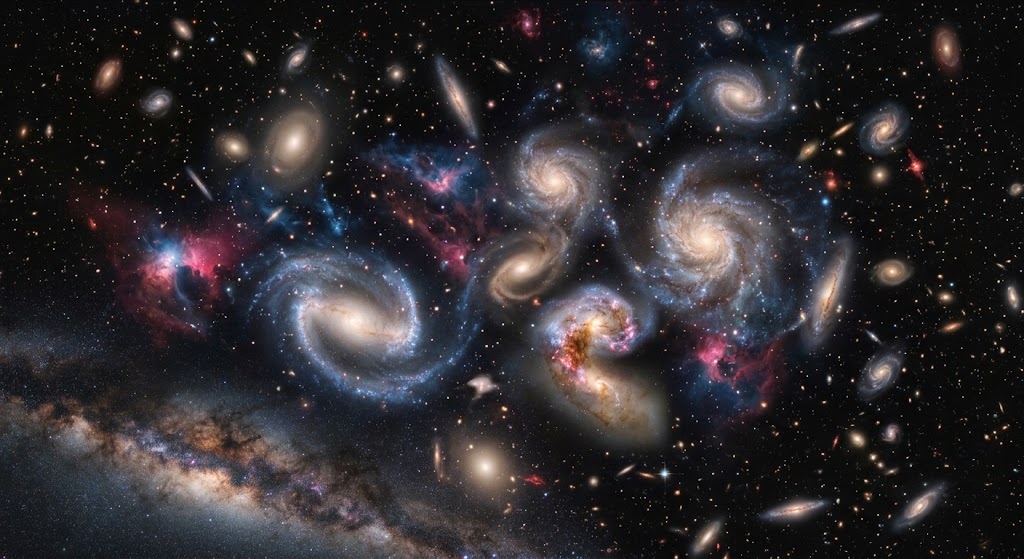
Vision One: The Cosmic Zoo. Intelligence is a near-inevitable product of physics, chemistry, and convergent evolution. In a Universe containing an estimated 2 trillion galaxies, each housing hundreds of billions of stars, minds should be abundant. A 2016 paper in the International Journal of Astrobiology argued for what its authors called a “Cosmic Zoo” ‚Äî a Universe teeming with complex life, if only the origin of life itself proves easy enough.
Vision Two: The Rare Earth. Life might be common. Intelligence is not. Our kind of thinking emerged after a staggering chain of contingencies ‚Äî a stable G-type star, a large Moon stabilising Earth’s axial tilt, plate tectonics recycling nutrients across geological time, a protective Jupiter deflecting comets, mass extinctions clearing ecological space ‚Äî and critically, an asteroid impact 66 million years ago that ended the dinosaurs and opened the door for mammals to diversify. Remove one link in that chain, and perhaps we never exist.
What If Both Are True at Once?
Here’s the thought that keeps us genuinely awake. What if simple life is common across the cosmos, but intelligence is extraordinarily rare? What if the Universe is full of bacteria on a billion ocean worlds ‚Äî and thinking minds appear only once every hundred million years, in a single galaxy, by an improbable chain of events?
If that’s true, then you ‚Äî reading this right now ‚Äî are among the most unlikely things the Universe has ever produced. Not a common outcome. A rare expression of cosmic possibility. 13.8 billion years of star births, planetary formation, extinction events, and evolutionary pressure all converging on this singular moment: matter aware of itself.
That doesn’t make us arrogant. It makes us responsible. And it makes the act of curiosity ‚Äî of asking why ‚Äî one of the most profound things in the known Universe.
| Aspect | Cosmic Zoo Hypothesis | Rare Earth Hypothesis |
|---|---|---|
| Simple life | Very common across the cosmos | Possibly common, but uncertain |
| Complex / intelligent life | Probable given enough time & convergence | Extremely rare; requires many lucky steps |
| Fermi silence explained by | Distance, physics, or civilisation lifespan | Intelligence genuinely doesn’t appear often |
| Our significance | One of many minds in the Universe | A rare and precious cosmic accident |
A Universe That Thinks About Itself üå†
We started with a question: could the Universe have always been heading toward intelligence? After tracing the arc from stellar nucleosynthesis to thermodynamic self-organisation, from convergent evolution to the Fermi Paradox, we arrive at a deeply honest answer: we don’t know yet. And that’s not a failure. That’s science.
What we do know is this. Intelligence doesn’t appear despite the laws of physics. It emerges from them ‚Äî built from star-forged atoms, driven by energy gradients, shaped by billions of years of evolutionary pressure, and dependent on a chain of improbable contingencies that may be unique to us or may be replicated across the cosmos. Either way, the result is equally breathtaking.
If intelligence is abundant, then somewhere out there, other minds are looking at the same stars we see, asking the same questions. We’re not alone in our wondering. If intelligence is rare, then we carry a weight and a wonder that’s all the heavier for its uniqueness. We are, as Carl Sagan put it, “a way for the cosmos to know itself.” Neither interpretation is small. Both should fill us with awe.
Here at FreeAstroScience.com, this is why we exist. We take the most intimidating principles in science ‚Äî from stellar nucleosynthesis to thermodynamic theory ‚Äî and turn them into something you can carry in your mind on a Tuesday afternoon. We believe science isn’t an elite club. It belongs to everyone.
We also protect you from something that matters more than ever: misinformation. In a world drowning in noise, easy answers, and pseudo-science, FreeAstroScience is your anchor to evidence-based, carefully verified knowledge. We don’t simplify to the point of distortion ‚Äî we simplify to the point of clarity. That’s a promise we take seriously.
And we ask one thing in return: never turn off your mind. Keep it active. Keep it questioning. As Goya’s painting reminded us centuries ago, the sleep of reason breeds monsters. Stay curious. Stay awake to the world around you.
Come back to FreeAstroScience.com whenever you want to understand the Universe a little better. We’ll be here ‚Äî with the next question, the next discovery, and the same genuine love for the cosmos we hope you’ve come to expect from us.
References & Sources
- üìÑ [1] Madden, I. (March 2026). Is Intelligence Inevitable in the Universe? How Evolution and the Laws of Physics Shape the Emergence of Intelligent Life. Medium ‚Äî Curious Matter. medium.com
- üìÑ [2] Carboni, D. (December 2025). Informational Inevitability: The Deep Chained Nexus from Cosmos to Consciousness. PhilArchive. philarchive.org
- üìÑ [3] Lineweaver, C.H. & Chopra, A. (2016). The Cosmic Zoo: The (Near) Inevitability of the Evolution of Complex, Macroscopic Life. International Journal of Astrobiology. PMC
- üìÑ [4] Nassirtoussi, A.R. (December 2024). How Entropy Gives Rise to Intelligence. LinkedIn Pulse
- üìÑ [5] Frank, A. et al. (2022). Intelligence as a Planetary Scale Process. International Journal of Astrobiology. Cambridge Core
- üìÑ [6] SETI Institute. The Fermi Paradox. seti.org
- üìÑ [7] Frontiers in Complex Systems. (2025). Toward a Thermodynamic Theory of Evolution. Frontiers
- üìÑ [8] Britannica. (2026). Fermi Paradox ‚Äî Definition, Resolutions, SETI & Facts. britannica.com
- üìÑ [9] Wikipedia. Fermi Paradox. wikipedia.org