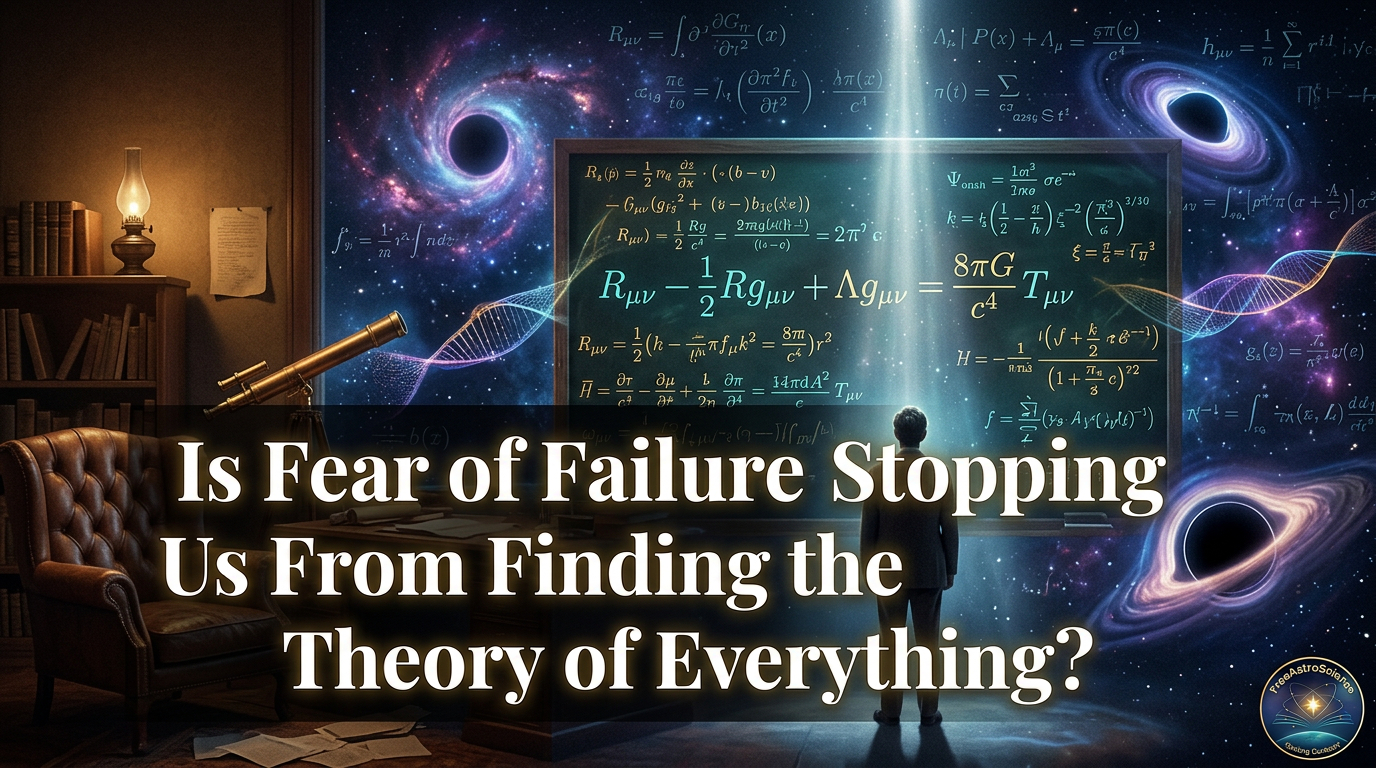
Are We Too Afraid to Find the Answer to Everything?
Welcome to FreeAstroScience.com, where we believe that science should be for everyone, not just for those with a PhD or a lab coat. Here, we break down the most complex ideas in physics into stories you can follow, no matter your background. Today, we’re asking a question that’s haunted the world’s brightest minds for over a century: Is the fear of failure stopping us from finding the ultimate answer to the universe?
We’re not just talking about equations and chalkboards. We’re talking about the human side of science—the doubts, the risks, the moments when even geniuses like Einstein felt alone. We’ll walk through the history, the heartbreaks, and the hope that still drives physicists to chase the Theory of Everything.
Stick with us to the end. You’ll see why keeping your mind awake matters—because, as we say at FreeAstroScience, the sleep of reason breeds monsters.
Table of Contents
- What Is the Theory of Everything?
- How Did the Golden Age of Physics Cast a Shadow?
- Why Did the Next Generation Turn Away?
- Which Theories Compete for the Ultimate Answer?
- What Milestones Did We Miss?
- Why Is the Math So Hard?
- How Does Fear Shape Modern Physics?
- Who Had the Courage to Defy the Odds?
- Why Do Physicists Avoid Saying “Theory of Everything”?
- What Would It Take to Break the Cycle?
- Conclusion: Can We Dare to Dream Again?
What Is the Theory of Everything?
Imagine a single equation that explains every force, every particle, every event in the universe. That’s the dream behind the Theory of Everything (ToE). It’s not just a catchy phrase. It’s the holy grail of physics—a framework that would unite the four fundamental forces:
- Gravity (holds planets and stars together)
- Electromagnetism (makes your phone work)
- Strong nuclear force (binds protons and neutrons)
- Weak nuclear force (responsible for radioactive decay)
Right now, we have two main theories. Quantum mechanics rules the tiny world of atoms and particles. General relativity describes the smooth, bending fabric of space and time. But when we try to use both at once—like inside a black hole or at the instant of the Big Bang—they clash. The math breaks down. It’s like trying to fit a square peg in a round hole.
At the Planck scale (about 10^-35 meters, 10^-43 seconds), both theories fail. We need a new idea—a ToE—to explain what happens when the universe is both incredibly small and incredibly dense. Without it, we can’t truly understand black holes, the Big Bang, dark matter, or dark energy. We’re missing the final piece of the cosmic puzzle.
How Did the Golden Age of Physics Cast a Shadow?
The early 1900s were wild for physics. Einstein, Planck, Bohr, and Heisenberg turned the world upside down. Suddenly, atoms weren’t little billiard balls. Space and time could bend. Light could act like a wave and a particle. It was a revolution.
But even as they changed everything, some of these giants paid a heavy price for chasing the biggest questions.
Einstein’s Lonely Quest
After his triumphs, Einstein spent the last 30 years of his life searching for a unified field theory—a way to combine gravity and electromagnetism. He wrote to Max Born in 1926, “God does not play dice.” He just couldn’t accept the randomness of quantum mechanics. But as the years passed, his colleagues moved on. They saw his quest as hopeless. Some even called his work “sterile”. Einstein died in 1955, still scribbling equations, still searching, but mostly alone.
Eddington and Weyl: From Fame to Ridicule
Arthur Eddington was a hero in 1919 for proving Einstein right about gravity bending starlight. But when he tried to build a “Fundamental Theory” using numerology and cosmic constants, his peers laughed him off. His final book was published after his death and quickly forgotten.
Hermann Weyl, a brilliant mathematician, tried to unify gravity and electromagnetism with his 1918 gauge theory. It was ahead of its time, but even Einstein rejected it. Weyl’s ideas would only be appreciated decades later.
David Hilbert: The Mathematician’s Mathematician
David Hilbert, another giant, worked alongside Einstein on the math of general relativity and tried his hand at unification. His mathematical tools are still used today, but his unification attempts didn’t pan out.
These stories aren’t just history lessons. They’re warnings. The message was clear: chase the ultimate answer, and you might end up alone, ridiculed, or forgotten.
Why Did the Next Generation Turn Away?
After seeing what happened to Einstein, Eddington, and Weyl, the next wave of physicists took a different path. Richard Feynman, Julian Schwinger, and Sin-Itiro Tomonaga focused on problems they could actually solve. They built quantum electrodynamics (QED), invented Feynman diagrams, and won Nobel Prizes.
Instead of chasing the impossible, they mapped out the subatomic world. This led to the Standard Model—a theory that explains three of the four forces (everything except gravity). Particle physics boomed. Labs filled with new discoveries. But the dream of a Theory of Everything? It was left on the shelf.
Gravity, the odd one out, stayed stubbornly separate. The message was clear: stick to what works, and you’ll be rewarded. Go after the big, risky questions, and you might end up like Einstein—brilliant, but alone.
Which Theories Compete for the Ultimate Answer?
Today, the search for a Theory of Everything is alive, but it’s a crowded field. Let’s compare the main contenders:
| Theory | Key Idea | Main Figures | Strengths | Weaknesses |
|---|---|---|---|---|
| String Theory / M-Theory | Particles are tiny vibrating strings; extra dimensions (10 or 11); all forces unified as different string vibrations | Edward Witten, Juan Maldacena, Brian Greene | Mathematically elegant; includes gravity; unifies all forces; led to new math | No testable predictions; 10500 possible solutions; no experimental evidence |
| Loop Quantum Gravity | Space is made of tiny loops (spin networks); spacetime is quantized; no background geometry | Lee Smolin, Carlo Rovelli, Abhay Ashtekar | Background-independent; predicts quantized space; resolves some singularities | Doesn’t include all forces; hard to connect to particle physics; few testable predictions |
| Causal Dynamical Triangulations | Spacetime built from simple building blocks (simplexes); preserves causality; spacetime emerges from quantum rules | Renate Loll, Jan Ambjørn, Jerzy Jurkiewicz | Shows emergence of 4D spacetime; uses computer simulations; preserves time’s arrow | Still incomplete; hard to connect to known physics; mostly computational |
| Other Approaches | Causal Set Theory, Asymptotic Safety, Group Field Theory, Quantum First models | Rafael Sorkin, Martin Reuter, others | Fresh perspectives; sometimes more testable | Less developed; not widely accepted |
What Milestones Did We Miss?
Physics isn’t just about big ideas. It’s about testing them. And here, the search for a Theory of Everything has hit some painful roadblocks:
- Supersymmetry (SUSY): For decades, physicists predicted that every particle has a heavier “superpartner.” The Large Hadron Collider (LHC) was supposed to find them. It didn’t. The simplest SUSY models are now ruled out.
- Proton Decay: Grand Unified Theories (GUTs) say protons should eventually fall apart. Experiments like Super-Kamiokande have watched for decades. No proton decay. The lower bound is now over 10^34 years.
- Higgs Boson: Discovered on July 4, 2012. It completed the Standard Model, but didn’t open the door to new physics as many hoped.
- Quantum Gravity: No direct evidence yet. No sign of spacetime “pixels” or extra dimensions.
Each disappointment makes it harder for physicists to take risks. The fear of failure grows.
Why Is the Math So Hard?
Let’s get a bit technical—but don’t worry, we’ll keep it clear. The heart of the problem is that quantum mechanics and general relativity just don’t mix.
Einstein’s Field Equations
Einstein’s equations describe how mass and energy bend spacetime:
(Einstein’s field equations: geometry = energy/matter)
The Planck Scale
At the Planck length and time, both theories break down:
tP = √(ħG / c5) ≈ 5.391 × 10-44 s
(Planck length and time: where quantum gravity rules)
The Non-Renormalizability Problem
When we try to quantize gravity like the other forces, the math gives infinite answers that can’t be “renormalized” (fixed). That’s why physicists need new ideas.
How Does Fear Shape Modern Physics?
It’s not just the math that’s tough. The culture of physics can be even harsher.
Publish or Perish
Today, physicists are judged by how many papers they publish, not how bold their ideas are. Peter Higgs, who predicted the Higgs boson, said, “Today I wouldn’t get an academic job. It’s as simple as that. I don’t think I would be regarded as productive enough.” He published fewer than 10 papers after his big discovery.
The Beauty Trap
Sabine Hossenfelder, in her book Lost in Math, argues that physicists are chasing mathematical “beauty” instead of testable ideas. Lee Smolin, in The Trouble with Physics, calls string theory a “monoculture” where groupthink rules. Peter Woit, in Not Even Wrong, says string theory’s lack of falsifiability has turned it into an intellectual orthodoxy.
Funding and Groupthink
Funding committees are often dominated by string theorists. Between 1,000 and 5,000 researchers work on string theory worldwide. Alternative ideas struggle to get support. Young physicists are told to “play it safe” if they want a career.
Who Had the Courage to Defy the Odds?
Despite the risks, some physicists have dared to go against the grain.
Wolfgang Pauli and the Neutrino
In 1930, Wolfgang Pauli faced a crisis. Experiments seemed to break the law of energy conservation. He proposed a new particle—the neutrino—but doubted it could ever be detected. He wrote, “I have done a terrible thing, I have postulated a particle that cannot be detected.” He even bet a case of champagne it would never be found. Twenty-six years later, Reines and Cowan detected the neutrino. Pauli’s reply? “Everything comes to him who knows how to wait”.
Garrett Lisi’s E8 Theory
In 2007, Garrett Lisi, a physicist without a university job, posted a paper claiming to unify all forces using the E8 Lie group (248 dimensions). The media called him the “surfer dude” with a Theory of Everything. Experts quickly pointed out flaws, but Lisi kept working, undeterred by criticism.
David Bohm and Hugh Everett III
David Bohm’s “pilot wave” theory and Hugh Everett’s “many-worlds” interpretation were dismissed as “theology” and “hopelessly wrong.” Bohm was forced into exile. Everett left physics. Decades later, their ideas gained respect.
Schrödinger’s Cat
Erwin Schrödinger, who helped invent quantum mechanics, created the famous “cat” thought experiment to show how weird quantum rules could be. He was pushing back against the Copenhagen orthodoxy he helped create.
Why Do Physicists Avoid Saying “Theory of Everything”?
Words matter. Today, many physicists avoid the phrase “Theory of Everything.” They prefer “quantum gravity” or “unification.” It’s not just modesty. It’s a sign of caution—a way to avoid the ridicule and career risks that haunted Einstein and Eddington. The field has learned to be careful, sometimes too careful.
What Would It Take to Break the Cycle?
So, what’s the way out? Some say we need senior physicists—those with secure jobs and reputations—to lead big, risky collaborations. They can afford to fail. But we also need the boldness of youth, the fresh ideas that come from not knowing what’s “impossible.”
Lee Smolin, Carlo Rovelli, and Sabine Hossenfelder all call for more pluralism and freedom in physics. We need to reward risk, not just safe bets. Funding should support a diversity of ideas, not just the dominant trend.
New mathematical tools are emerging—like q-desic equations and Finsler geometry. Maybe these will help. Maybe not. But history shows that today’s “crazy” idea can become tomorrow’s foundation. Pauli waited 26 years for his neutrino. Weyl’s gauge theory was rejected, then became central to quantum field theory decades later.
Conclusion: Can We Dare to Dream Again?
The search for a Theory of Everything isn’t just a technical puzzle. It’s a human story—of ambition, fear, and the courage to keep asking “why?” The obstacles are real: the math is hard, the institutions are cautious, and the fear of failure is everywhere.
But if we want to find the ultimate answer, we can’t let fear win. We need to keep our minds awake, to question, to risk, to dream. That’s the mission of FreeAstroScience.com: to remind you that the sleep of reason breeds monsters. Stay curious. Stay bold. And come back soon to keep your mind alive.
References & Further Reading
- Theory of Everything – Wikipedia
- Sabine Hossenfelder, Lost in Math (2018)
- Lee Smolin, The Trouble with Physics (2006)
- Peter Woit, Not Even Wrong (2006)
- Quanta Magazine – Physics
- Scientific American – The Multiverse Hypothesis Explained
- FreeAstroScience.com
Written for you by FreeAstroS breeds monsters.