Artemis II: Humanity’s Bold Return to the Moon After 50 Years
Have you ever looked up at the Moon and wondered — when will we go back?
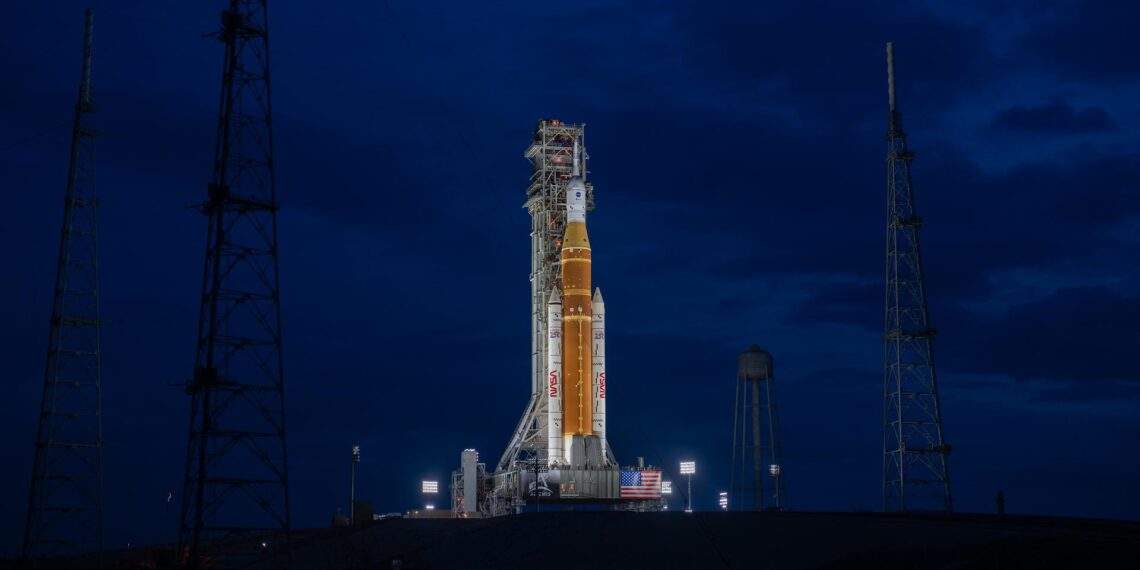
Welcome to FreeAstroScience.com, where we explain complex scientific principles in simple terms. We’re Gerd Dani, writing from the helm of Free AstroScience — Science and Cultural Group — and today, we’re covering one of the most exciting space events of our lifetime. After more than half a century since the last Apollo astronaut left the lunar surface, four brave humans are about to fly toward the Moon aboard NASA’s Artemis II mission. The countdown has begun. The rocket stands ready. And we’re all about to witness history.
This isn’t science fiction. It’s happening right now — with a launch targeted for April 1, 2026.
Whether you’re a lifelong space enthusiast or someone who simply looks up on a clear night and feels a spark of wonder, this article is for you. Stick with us to the very end. We’ve broken down every detail — the crew, the science, the trajectory, the risks, and the future of lunar exploration — so you can follow this historic moment with clarity and confidence. Because at FreeAstroScience, we believe the sleep of reason breeds monsters. Let’s keep our minds awake together.
📑 Table of Contents
- 1. What Is Artemis II and Why Does It Matter?
- 2. Who Are the Four Astronauts Flying to the Moon?
- 3. How Does the Launch Sequence Work?
- 4. What Trajectory Will Orion Follow?
- 5. What Science Experiments Are on Board?
- 6. What If the April 1 Launch Doesn’t Happen?
- 7. How Has the Artemis Program’s Future Changed?
- 8. Artemis II Mission Timeline at a Glance
- 9. Conclusion
What Is Artemis II and Why Does It Matter?
Let’s cut straight to the heart of it. Artemis II is NASA’s first crewed mission beyond low Earth orbit since Apollo 17 in December 1972. That’s more than fifty years of silence beyond our planet’s backyard. Now, four astronauts will ride the Space Launch System (SLS) rocket and the Orion capsule toward the Moon in a journey lasting roughly ten days .
But here’s what we need to be clear about: Artemis II won’t land on the Moon. Not yet.
This is a test flight — a bold, dangerous, and absolutely necessary one. Its purpose? To verify that the Orion capsule and the SLS rocket can perform safely with humans aboard in the harsh conditions of deep space . Think of it as a dress rehearsal before the main act. Every sensor, every system, every life-support function will be pushed to its limits while real human lives depend on the outcome.
And the stakes go far beyond this single flight. Artemis II sits inside a much larger vision — the Artemis program — which aims to establish a permanent, sustainable human presence on the Moon. We’re talking about a lunar base, regular crewed missions, and eventually, the infrastructure that could one day support trips to Mars .
The outcome of Artemis II will directly shape the timeline and technology choices for everything that follows — starting with Artemis III and Artemis IV .
Who Are the Four Astronauts Flying to the Moon?
Every great mission has its crew. And this one is special — not only for what they’ll do, but for what they represent.
Reid Wiseman — Commander
A seasoned NASA astronaut with experience aboard the International Space Station (ISS), Wiseman leads this mission. He’ll be the person making the final calls when it counts .
Victor Glover — Pilot
Also a NASA astronaut and veteran of spaceflight, Glover will serve as the mission’s pilot. He’s already proven himself on the ISS, and now he’s heading toward the Moon .
Christina Koch — Mission Specialist
Koch holds the record for the longest single spaceflight by a woman. She knows what it’s like to live in space for extended periods, and she’ll bring that experience to Artemis II .
Jeremy Hansen — Mission Specialist (Canadian Space Agency)
Here’s where it gets even more interesting. Hansen is a Canadian astronaut, representing the Canadian Space Agency (CSA). His presence marks the first time a non-American astronaut will fly on a lunar mission .
Together, this crew will be the first humans since the Apollo era to travel beyond low Earth orbit. They’ll test Orion’s systems, perform manual maneuvers, and verify operational procedures in real-time deep-space conditions .
And there’s a symbolic dimension here that we shouldn’t overlook. Artemis II will be the first Moon-bound mission to include a woman and a non-U.S. astronaut. That’s a statement about where space exploration is headed — toward a more international and inclusive future .
Oh, and one more passenger: RISE, the mission’s mascot. RISE will also serve as a zero-gravity indicator — when you see it floating inside the capsule on camera, you’ll know the crew has reached microgravity.
How Does the Launch Sequence Work?
Space launches aren’t like flipping a switch. They’re carefully orchestrated events, and Artemis II is no exception. Here’s how it will unfold.
The countdown begins approximately 49 hours before launch. Teams across multiple control centers activate and start checking every system on the SLS rocket and the Orion capsule .
At about T-minus 10 hours, they’ll authorize propellant loading — filling the tanks with liquid oxygen and liquid hydrogen. Four hours before launch, the astronauts will board the capsule.
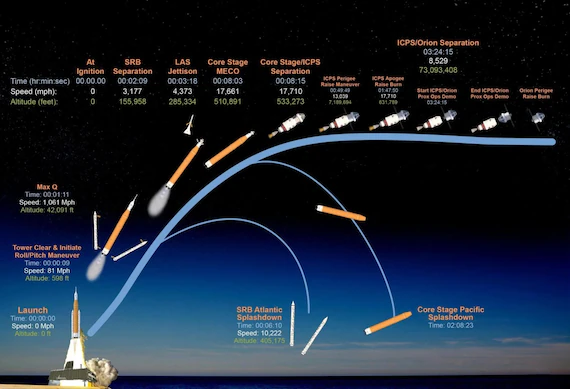
In the final minutes, the rocket switches to internal power and enters the automated launch sequence. At T-0, the four RS-25 main engines ignite alongside the solid rocket boosters, which provide the bulk of the initial thrust .
Here’s the timeline once the rocket leaves the pad:
- ~2 minutes: Solid rocket boosters separate
- ~8 minutes: First stage engine cutoff; the vehicle reaches a suborbital trajectory
- ~50 minutes: The Interim Cryogenic Propulsion Stage (ICPS) fires to place Orion into a highly elliptical Earth orbit
- A second burn pushes the capsule to approximately 77,000 km from Earth
- ~3 hours post-launch: Orion separates from the upper stage and begins proximity maneuver tests
During these proximity tests, the astronauts will manually control the capsule — a critical step to verify navigation and control systems . After completing those checks, Orion sets course for the Moon.
What Trajectory Will Orion Follow?
This is one of the most elegant parts of the mission design. Artemis II uses a free-return trajectory. In simple terms, this means that if something goes wrong — if the engines fail, if a critical system breaks — the spacecraft will still loop around the Moon and come back to Earth automatically, carried by gravity alone .
It’s the same safety concept NASA used during Apollo 13. When that mission suffered an explosion on the way to the Moon, the free-return path brought the crew home. Artemis II builds on that same principle.
The transfer maneuver toward the Moon happens about one and a half days after launch. The journey to the Moon takes approximately four days, with trajectory corrections along the way .
The lunar flyby itself will bring Orion to a distance between 6,000 and 9,000 kilometers from the Moon’s surface, depending on the exact launch time and date .
🌙 Free-Return Trajectory — Why It Matters
A free-return trajectory is a flight path that uses the Moon’s gravity to bring a spacecraft back to Earth without requiring any additional engine burns. If anything goes wrong during the mission, this trajectory acts as a built-in safety net.
Think of it like rolling a ball around a curved hill — once you set it in motion with the right angle and speed, gravity does the rest.
After the flyby, the Moon’s gravity will redirect Orion back toward Earth. The return takes several more days. Near Earth, the service module separates, the capsule enters the atmosphere protected by its heat shield, and parachutes deploy for a splashdown in the ocean. Total mission time: roughly nine to ten days .
What Science Experiments Are on Board?
You might think a test flight means no science. You’d be wrong. Artemis II carries several experiments — and they’re designed to answer questions we’ve been asking for decades about what happens to the human body in deep space.
ARCHeR — Sleep, Stress, and Brain Performance
ARCHeR is a study that uses wearable devices to track the astronauts’ sleep patterns, stress levels, and cognitive performance throughout the mission . Deep space isn’t like the ISS. The radiation environment is different. The psychological isolation is more intense. ARCHeR will help us understand how the crew’s minds hold up under those conditions.
Immune Biomarkers — Monitoring the Body’s Defenses
Scientists will track changes in the astronauts’ immune systems — watching for shifts caused by radiation exposure and isolation in deep space . This data will be compared with pre-flight and post-flight measurements.
AVATAR — Organs on a Chip
This one is genuinely remarkable. AVATAR uses microchips containing living human cells to simulate how tissues and organs behave in space . These “organs-on-a-chip” can reveal the effects of microgravity and radiation on specific body systems — without putting additional crew members at risk.
Standard Measures Protocol
Throughout the mission, every physiological parameter you can imagine will be recorded — before, during, and after the flight . Heart rate, blood pressure, bone density, muscle function — all of it.
Radiation Monitoring
Radiation is one of the greatest threats in deep space. Artemis II carries onboard sensors and personal dosimeters to measure exactly how much radiation the crew receives at every stage of the mission .
And during the lunar flyby, the crew will have a chance to observe and photograph the Moon’s surface, helping scientists study lunar geology and plan future landing sites .
What If the April 1 Launch Doesn’t Happen?
Space is unforgiving, and launch schedules bow to physics — not calendars. The April 1 date at 18:24 local Florida time (00:24 on April 2 in Italy) is the first available window. But NASA has already planned backup windows from April 1 through April 6, plus one more opportunity on April 30 .
Why can’t they just launch whenever they want? Because the free-return trajectory demands a precise alignment between Earth and the Moon . If that geometry isn’t right, the safety guarantee of the free-return path falls apart.
| Date (Florida Time) | Status | Notes |
|---|---|---|
| April 1, 18:24 ET | Primary | First opportunity |
| April 2 | Backup | Evening Florida time |
| April 3 | Backup | Evening Florida time |
| April 4 | Backup | Evening Florida time |
| April 5 | Backup | Evening Florida time |
| April 6 | Backup | Last in early-April window |
| April 30 | Final April Option | If all earlier windows are missed |
If the flight slips by a day or two, the mission profile stays mostly the same — still about ten days, still the same phases . But a longer delay could push the launch to a new window weeks later, while engineers wait for orbital conditions to line up again .
How Has the Artemis Program’s Future Changed?
Here’s where the story takes a dramatic turn. In the weeks leading up to Artemis II, NASA announced a major restructuring of the entire Artemis program .
The biggest change? The Lunar Gateway — a small space station that was supposed to orbit the Moon — has been put on pause . NASA is redirecting those resources, international partners, and private-sector contracts toward something more direct: building a permanent human outpost on the Moon’s surface .
The new goals are ambitious and concrete:
- Astronauts on the Moon by 2028
- Construction of a permanent lunar base starting by 2030
- A nuclear fission reactor on the Moon by the end of the decade
The plan unfolds in three phases:
Phase 1 — A dramatic increase in robotic missions and landers heading to the surface. Programs like CLPS (Commercial Lunar Payload Services), lunar rovers, and a new class of vehicles called MoonFall Drones — designed to hop across the surface and map the terrain — will lead the way .
Phase 2 — Heavier infrastructure arrives: energy systems, telecommunications, surface vehicles, and crewed missions every six months .
Phase 3 — Continuous human presence on the Moon, with extraction and use of local resources — water ice, oxygen, and hydrogen .
And the mission lineup has been completely reshuffled:
- Artemis III (early 2027): Now a test mission in low Earth orbit with one or two Human Landing System (HLS) landers — candidates haven’t been selected yet
- Artemis IV: This will be the mission that actually returns humans to the lunar surface — not Artemis III as originally planned
- Artemis V: Part of the new architecture aimed at delivering the first elements of the lunar base
This is a seismic shift. The dream hasn’t gotten smaller — it’s gotten more focused.
Artemis II Mission Timeline at a Glance
| Time / Phase | Event |
|---|---|
| T−49 hours | Official countdown begins; systems checks activated |
| T−10 hours | Propellant loading authorized (LOX and LH₂) |
| T−4 hours | Crew boards Orion capsule |
| T−0 | RS-25 engines + solid boosters ignite — LIFTOFF 🚀 |
| T+2 min | Solid rocket boosters separate |
| T+8 min | Core stage engine cutoff; suborbital trajectory reached |
| T+50 min | ICPS first burn — highly elliptical orbit achieved |
| ICPS 2nd burn | Capsule pushed to ~77,000 km from Earth |
| T+~3 hours | Orion separates from upper stage; proximity tests begin |
| ~1.5 days | Trans-lunar injection burn — Orion heads for the Moon |
| ~Day 4–5 | Lunar flyby at 6,000–9,000 km from the surface 🌙 |
| ~Day 9 | Service module separation; atmospheric reentry |
| ~Day 9–10 | Parachute deployment and ocean splashdown 🌊 |
All times and phases are approximate and based on a nominal April 1 launch .
A New Chapter for All of Us
Let’s step back for a moment and take in the full picture.
Artemis II isn’t just a rocket launch. It’s proof that we haven’t given up on the Moon — and on the idea that humans belong out there, exploring, questioning, and reaching for what seems impossible. Four astronauts — including the first woman and the first non-American on a lunar-class mission — are about to travel farther from Earth than any human in over fifty years .
They’ll test the spacecraft that will carry future crews to the lunar surface. They’ll run experiments that could shape how we protect human bodies in deep space. And they’ll do all of it on a free-return trajectory, knowing that gravity itself is their safety net .
The road here wasn’t easy. There were delays, redesigns, and tough decisions — including a complete overhaul of the Artemis program’s future roadmap . But here we are. The SLS is on the pad. The Orion capsule is loaded. And the crew is ready.
What happens next will echo for decades.
We wrote this article for you — yes, you — because at FreeAstroScience.com, we believe that understanding the universe shouldn’t require a PhD. We break down complex ideas so everyone can follow along. We want to educate you to never turn off your mind, to keep it active at all times. Because the sleep of reason breeds monsters — and the waking mind builds spaceships.
Come back to FreeAstroScience.com. There’s always more to learn, more to question, and more to wonder about. The Moon is waiting. And so are we.
📚 References & Sources
- Maglione, M. (2026, March 31). Ecco tutto quello che c’è da sapere sulla missione Artemis II. AstroSpace.it. https://www.astrospace.it
- NASA Artemis Program Overview. https://www.nasa.gov/artemis
- NASA Artemis II Mission Page. https://www.nasa.gov/artemis-ii