What If Quantum Gravity Drove the Universe’s First Breath?
Have you ever wondered what happened at the very beginning — not just the Big Bang, but the physics behind it? What if the answer to the universe’s explosive birth and the mystery of quantum gravity turned out to be the same thing?
Welcome to FreeAstroScience, where we explain complex science in terms that make sense — because we believe the sleep of reason breeds monsters, and keeping your mind active is the best antidote. We’re here today to walk you through one of the most exciting ideas in modern physics: a new theory, freshly published in Physical Review Letters in March 2026, that ties together the rapid expansion of the early universe and the elusive dream of quantum gravity.
If that sounds ambitious, it is. But stay with us. By the end of this article, you’ll understand why physicists are calling this a potential game-changer — and why the proof might arrive within our lifetimes.
Let’s get into it.
📖 Table of Contents
- The Three Pillars That Don’t Agree
- Why Can’t We Combine All Three?
- What Is Quadratic Quantum Gravity?
- The Ghost Particle Problem
- How Does This Theory Explain Cosmic Inflation?
- The Math Behind the Idea
- How Does It Compare to Starobinsky Inflation?
- Can We Actually Test This?
- What Does This Mean for the Future of Physics?
The Three Pillars That Don’t Agree
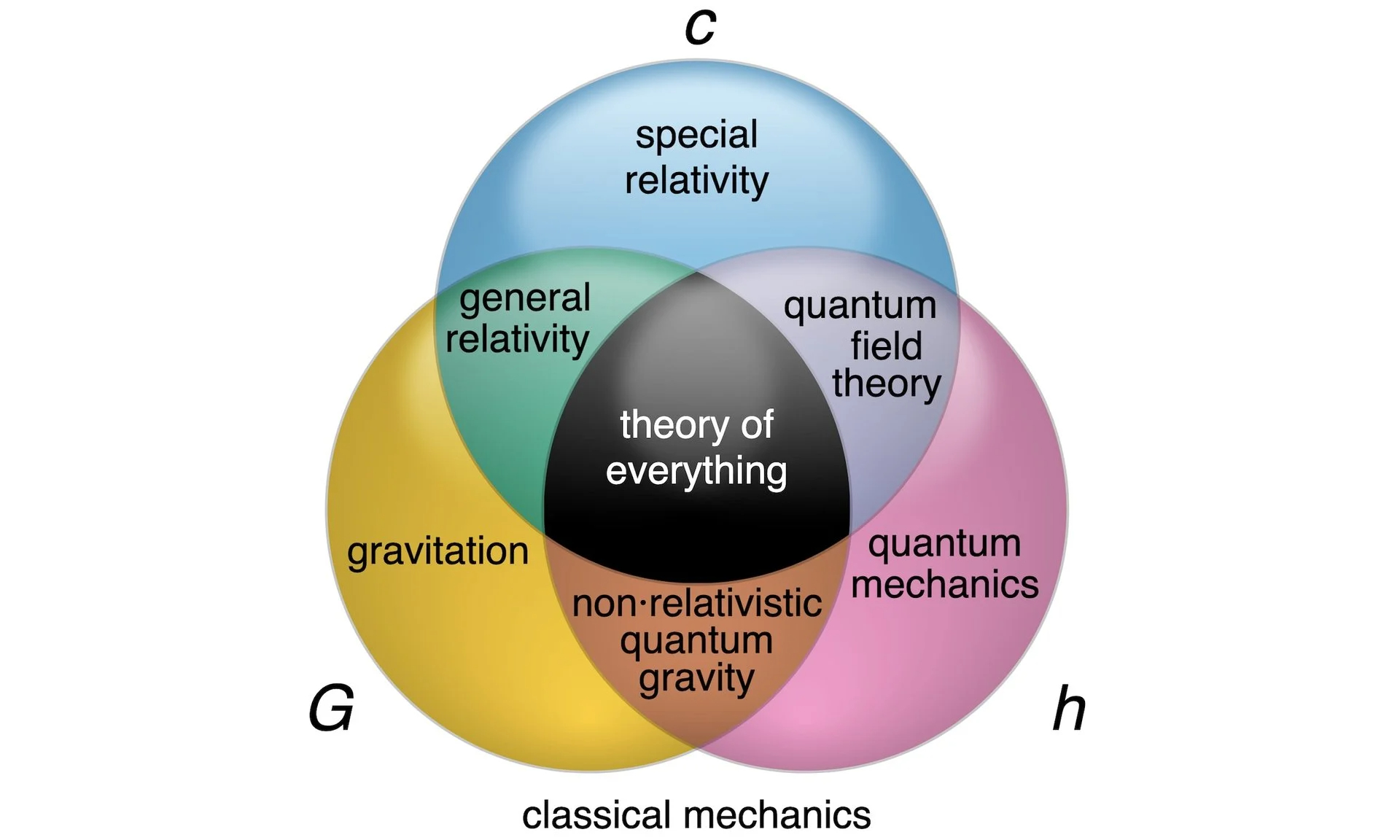
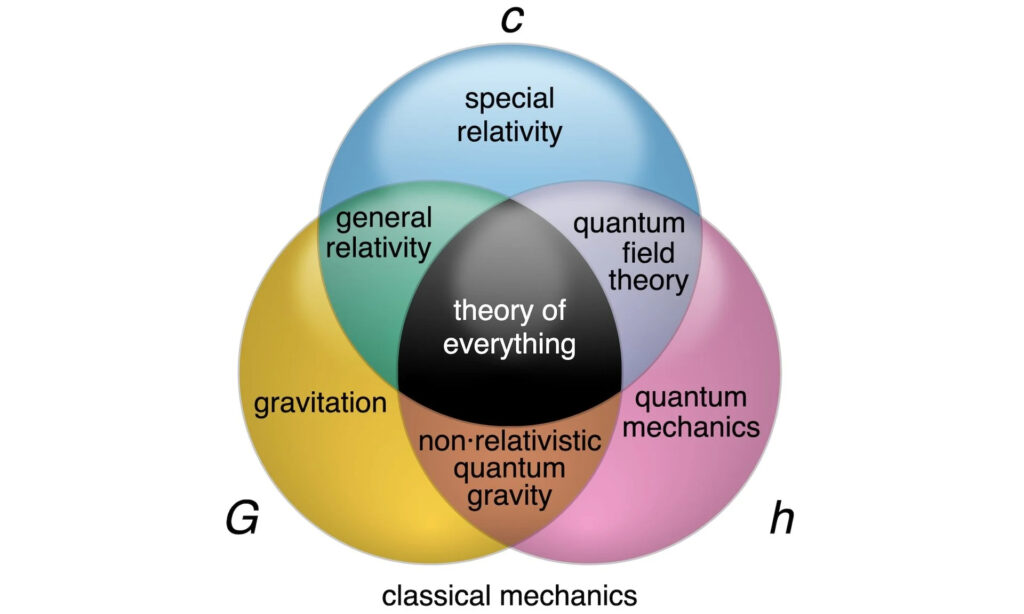
Modern cosmology rests on three great theories: special relativity, Newtonian gravity, and quantum mechanics. Each one is backed by mountains of experimental evidence. Each one works brilliantly in its own domain. And each one, frustratingly, contradicts the other two .
Think of it this way. Quantum mechanics describes the tiny — atoms, molecules, the fuzzy world of subatomic particles governed by the electromagnetic, strong, and weak forces. Newton’s gravity describes the huge — galaxies wheeling through space, black holes swallowing light, planets tracing their elliptical paths. Special relativity describes the stage itself — space and time, the background through which everything moves and interacts .
Here’s the interesting part: we can combine any two of them. Connect special relativity with gravity, and you get general relativity — Einstein’s masterpiece describing how mass warps spacetime. Connect special relativity with quantum mechanics, and you get quantum field theory, the framework behind particle physics. Connect quantum mechanics with Newtonian gravity, and you get weak quantum gravity, which tells us how atoms behave in Earth’s gravitational field .
But all three at once? That’s where everything falls apart.
Why Can’t We Combine All Three?
The short answer is something physicists call the renormalization problem.
Here’s the longer answer, in plain language. Special relativity tells us that matter can become energy and energy can become matter — that’s Einstein’s famous E = mc². Quantum mechanics tells us that particles can pop in and out of existence as “virtual particles,” flickering into being within the bounds of quantum uncertainty .
When you combine those two ideas, these virtual particles carry energy, which creates more virtual particles. If you try to calculate the total energy of all these virtual particles, you get infinity. That’s… not great.
Physicists handle this through a mathematical technique called renormalization. You cancel out the infinite virtual energies, keeping only the relative differences that actually matter. It works beautifully in quantum field theory .
But add gravity to the mix, and it all collapses. The energy of those virtual particles should warp spacetime itself — and without a fixed spacetime background, the cancellation trick stops working . This is why we’ve struggled for decades to build a theory that unifies all three pillars.
What Is Quadratic Quantum Gravity?
Not all approaches to quantum gravity hit this wall. One approach — called quadratic quantum gravity (QQG) — actually can be renormalized .
The idea, originally traced back to K.S. Stelle’s 1977 work, is surprisingly elegant. You take Einstein’s field equations and add quadratic curvature terms — specifically, the square of the Ricci scalar (R²) and the contraction of the Weyl tensor with itself (C²) .
In mathematical terms, the action of quadratic gravity looks like this:
Squadratic gravity = − ∫ d4x √(−g) [ R² / ξ + C² / (2λ) ]
Those two coupling constants — ξ (xi) and λ (lambda) — control the strength of the quadratic corrections. When you include these terms, the theory becomes renormalizable, meaning you can handle the infinities that plague other quantum gravity approaches .
The trade-off? This addition brings two new fields into the theory beyond the familiar massless graviton of general relativity:
- A massive spin-0 field from the R² term (which can act as the inflaton — the particle driving inflation)
- A massive spin-2 field from the C² term — and this one is a ghost
The Ghost Particle Problem
Let’s talk about ghosts. Not the Halloween kind — the physics kind.
A “ghost” particle carries negative kinetic energy. This leads to an unbounded Hamiltonian, which, in plain English, means the energy has no floor — it can drop without limit. That’s a deeply uncomfortable feature for any physical theory .
These ghost particles don’t show up in particle physics experiments. That’s made quadratic quantum gravity unpopular for years. Maybe the ghosts are simply too massive to appear in our current accelerators — but that made the theory seem untestable .
Or so we thought.
Here’s where the new paper changes the conversation. The authors — Ruolin Liu, Jerome Quintin, and Niayesh Afshordi from the University of Waterloo, Perimeter Institute, and partner institutions — propose something different. Instead of treating the ghost as a fatal flaw, they argue that the theory becomes strongly coupled at a specific scale, and at that point, both the ghost degrees of freedom and general relativity emerge naturally . Think of it like how quarks and gluons in QCD get “confined” inside protons and neutrons — the ghosts in QQG may get confined to ultra-high energies we’ll never directly probe.
How Does This Theory Explain Cosmic Inflation?
This is the heart of the paper, and it’s a beautiful idea.
In the very early universe — at unimaginably high energies near the Big Bang — quadratic quantum gravity stands alone. There’s no general relativity yet. The theory is “pure,” and at those extreme energy scales, it’s asymptotically free . That means its coupling constants shrink toward zero as energies increase, just like the strong nuclear force does in quantum chromodynamics (QCD).
On a homogeneous, isotropic background (which describes the early universe), the Weyl tensor contribution vanishes. So the action reduces to pure R² gravity, which is scale-invariant — any constant-curvature spacetime, including de Sitter space (an exponentially expanding universe), is a valid solution .
But here’s the clever twist. Quantum effects break this exact scale invariance. As the couplings run with energy — governed by the beta functions of the renormalization group — the theory isn’t exactly R² gravity anymore. This broken symmetry, called a quantum conformal anomaly, triggers slow-roll inflation .
In other words: the quantum running of gravity’s own coupling constants naturally drives cosmic inflation. No need for a separate, ad hoc inflaton field. The inflationary mechanism emerges from the fundamental structure of the theory itself.
The scenario plays out like this:
- Birth: The universe may start from a “no-boundary” Euclidean manifold — a smooth, finite origin with no singularity
- Inflation: The RG running of ξ drives a slow-roll inflationary phase
- Exit: As ξ decreases and crosses zero (the “tachyon divide”), inflation ends and a kinetic-dominated phase (kination) begins
- Reheating: The theory approaches strong coupling, general relativity emerges, and the standard hot Big Bang radiation era takes over
It’s a complete story — from quantum gravity to the cosmos we observe today.
The Math Behind the Idea
For those who want the technical details, here are the key equations that make this work.
The Beta Functions
The renormalization group flow of the QQG couplings ξ and λ is governed by these beta functions :
βξ = dξ/d(ln μ) = − [1/(4π)²] · (ξ² − 36λξ − 2520λ²) / 36
βλ = dλ/d(ln μ) = − [1/(4π)²] · [(1617 + 90N)λ − 20ξ] · λ / 90
Here, μ is the physical running scale, and N counts the matter field content according to:
N = (1/60)·Nscalar + (1/5)·Nvector + (1/20)·Nfermion
The Inflationary Potential
When transformed to the Einstein frame (where standard gravitational intuition applies), the scalar field’s potential during inflation takes the form :
V(φ) ≈ (35 λ₀² μ₀⁴) / (128π² λtH) · [1 − √6 / (λtH · φ/μ₀)]
This potential falls into the “brane inflation” class, but — and this is remarkable — it’s the first time this specific form has been derived from a UV-complete theory .
Key Observational Predictions
The spectral index and tensor-to-scalar ratio predicted by this model are :
| Observable | QQG Prediction | Starobinsky Prediction |
|---|---|---|
| Spectral index (ns) | ≈ 1 − 4/(3𝒩) | ≈ 1 − 2/𝒩 |
| Tensor-to-scalar ratio (r) | ≈ (8/3)·(2/(λ²tH·𝒩⁴))^(1/3) | ≈ 12/𝒩² |
| Minimum r (to avoid strong coupling) | ≥ 0.01 | No such bound |
Here, 𝒩 represents the number of e-folds of inflation (typically 50–60), and λtH is the ‘t Hooft–like coupling defined as λ₀N/(4π)² .
That minimum tensor-to-scalar ratio of r ≥ 0.01 is a hard prediction. It’s the theory drawing a line in the sand and saying: test me.
How Does It Compare to Starobinsky Inflation?
Starobinsky inflation has been the gold standard of inflationary models since Alexei Starobinsky proposed it in 1980. It uses the R + R² action — basically, general relativity plus the R² correction — to drive inflation .
For decades, Starobinsky’s model matched observations perfectly. But recent data is starting to challenge it. A combination of constraints from the Planck satellite, the Atacama Cosmology Telescope (ACT), the South Pole Telescope (SPT), BICEP/Keck, and DESI baryon acoustic oscillation measurements now slightly disfavors Starobinsky inflation .
The new data prefers larger values of the spectral index ns. That’s exactly where the QQG model sits.
As the paper states: “Such data combination… prefers larger ns values, putting Starobinsky inflation in slight tension with observations but placing our QQG model in a favorable position” .
There’s a key conceptual difference, too. In Starobinsky inflation, gravity stays weakly coupled throughout. The ghost particles and the instabilities they bring require some other mechanism to keep them contained. In the QQG scenario, gravity becomes strongly coupled at a specific scale — and that strong coupling naturally confines the ghost degrees of freedom, much like how the strong force confines quarks .
It’s a more radical proposal, sure. But it’s also more self-consistent.
Can We Actually Test This?
This is what makes the paper genuinely exciting, not just theoretically clever.
The model predicts a minimum level of background gravitational waves created during the inflationary period. These primordial gravitational waves are encoded in the tensor-to-scalar ratio r, and the QQG model predicts r ≥ 0.01 .
Current observatories can’t quite detect gravitational waves this small. But future missions can. The LISA (Laser Interferometer Space Antenna) mission, planned by the European Space Agency, and next-generation CMB experiments like the Simons Observatory are designed to probe exactly this range .
So the model isn’t just a pretty piece of mathematics. It makes a clear, falsifiable prediction: if future experiments measure r and find it below 0.01, this theory is wrong. If they find it at or above 0.01, it’s a strong signal that quadratic quantum gravity may be the right path forward.
That’s science at its best — bold enough to be proven wrong.
The viable parameter space, according to the authors, requires :
• ‘t Hooft coupling: 0.1 ≲ λtH ≲ 1
• Number of matter fields: N ~ 10⁵ to 10⁶
• E-folding number: 𝒩 = 50 ± 10
That large number of matter fields (N ~ 10⁵ to 10⁶) might seem extreme. But in many beyond-the-Standard-Model theories and holographic settings, large N is a standard assumption .
What Does This Mean for the Future of Physics?
Let’s step back and appreciate what’s happening here.
For decades, quantum gravity and cosmic inflation have been studied as separate problems. Inflation is something cosmologists worry about. Quantum gravity is something string theorists and loop quantum gravity researchers chase. The two communities talk past each other more often than they’d like to admit.
This paper says: What if they’re the same problem?
The authors — Liu, Quintin, and Afshordi — have shown that a specific, UV-complete theory of quantum gravity can naturally produce inflationary expansion in the early universe. Not as an afterthought. Not by bolting on extra fields. But as a direct consequence of how the theory’s own coupling constants evolve with energy .
Several open questions remain, and the authors are honest about them:
- Two-loop corrections: The current results use 1-loop beta functions. Going to higher-loop order would test how stable these predictions are .
- The Weyl tensor’s role: While C² vanishes on the smooth background, it does affect perturbations. Understanding its full impact — including ghost stability — is an important next step .
- Reheating details: How exactly does the universe transition from the kinetic-dominated phase to the standard radiation era? The strong-coupling window needs closer examination .
- Combined observational analysis: Data from Planck, BICEP, SPT, the Simons Observatory, and eventually LISA could collectively probe the predicted parameter space .
We’re standing at a threshold. Not the finish line, but a genuinely new starting point.
Wrapping It Up
Let’s recap what we’ve covered.
Modern physics has three great theories that each work on their own but refuse to play nicely together. The renormalization problem has blocked unification for decades. Quadratic quantum gravity offers one of the few known paths past that blockade — at the cost of introducing ghost particles that nobody’s ever seen.
A March 2026 paper by Liu, Quintin, and Afshordi, published in Physical Review Letters, shows that this very theory can naturally drive cosmic inflation in the early universe. The quantum running of the coupling constants breaks scale invariance just enough to produce a slow-roll inflationary phase — no separate inflaton needed. As inflation ends, general relativity emerges as the theory becomes strongly coupled, and the ghost degrees of freedom get confined.
Best of all, the theory makes a testable prediction: a minimum tensor-to-scalar ratio of r ≥ 0.01, within reach of upcoming gravitational-wave observatories and CMB experiments.
Is this the theory of quantum gravity? We don’t know yet. But it’s a theory that tells us exactly how to check — and in science, that’s the highest compliment a theory can earn.
Here at FreeAstroScience.com, we believe in making the universe’s biggest ideas accessible to everyone. Complex science, explained simply. Because the sleep of reason breeds monsters — and the best way to keep those monsters at bay is to never stop asking questions, never stop learning, and never stop looking up.
Come back soon. The universe isn’t done surprising us.
📚 References & Sources
- Koberlein, B. (2026, March 31). “A New Theory Connects Early Cosmic Inflation and Quantum Gravity.” Universe Today. universetoday.com
- Liu, R., Quintin, J., & Afshordi, N. (2026). “Ultraviolet Completion of the Big Bang in Quadratic Gravity.” Physical Review Letters, 136(11), 111501. DOI: 10.1103/6gtx-j455
- Stelle, K. S. (1977). “Renormalization of Higher-Derivative Quantum Gravity.” Physical Review D, 16(4), 953.
- Starobinsky, A. A. (1980). “A new type of isotropic cosmological models without singularity.” Physics Letters B, 91(1), 99–102.
- Buccio, D., Donoghue, J. F., Menezes, G., & Percacci, R. (2024). Physical Review Letters, 133, 021604.
Written by Gerd Dani for FreeAstroScience.com — Science and Cultural Group. Where complex scientific principles find simple words.