A collaborative team of South African and Indian astronomers has conducted a comprehensive analysis of the galaxy group known as IC 1262 galaxy group. By utilizing archival data from the Chandra X-ray Observatory and the Giant Metrewave Radio Telescope (GMRT), the researchers have uncovered new details regarding the metal enrichment processes within this system. This study provides significant insights into the complex dynamics of the intragroup medium and enhances our understanding of the physical processes occurring in such environments.
The architecture of the IC 1262 galaxy group
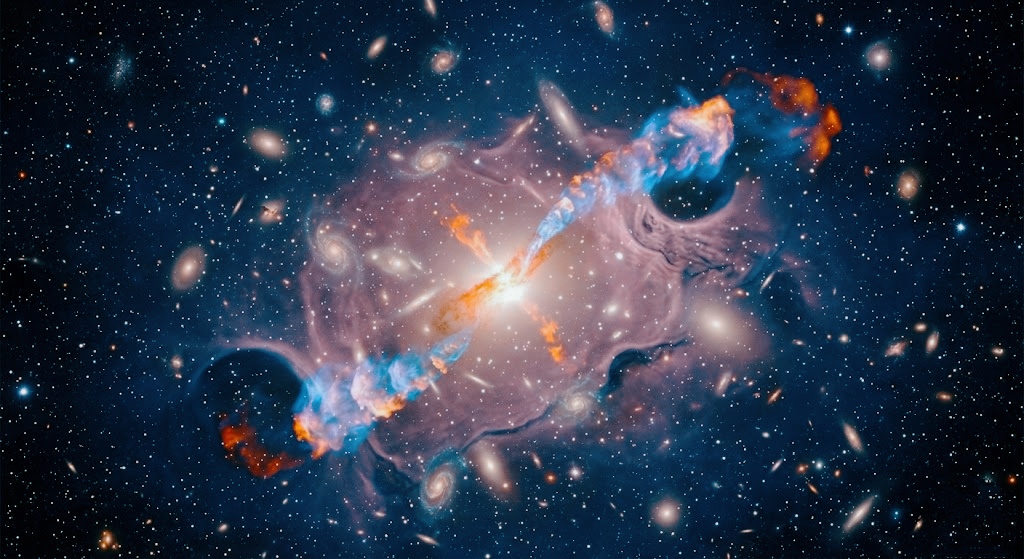
IC 1262 is a rich galaxy group situated at a redshift of 0.032, characterized by its brightest central galaxy. The system exhibits a highly complex structure within its hot gas, featuring prominent cold fronts extending both eastward and westward, as well as a large-scale radio jet. These features are indicative of ongoing, recurrent active galactic nucleus activity, which creates X-ray cavities filled with radio emission.
The recent investigation, spearheaded by Satish Shripati Sonkamble of the North-West University, focused on the underlying mechanisms responsible for metal distribution. The researchers explored the influence of radio jets, gas oscillations, and shock fronts in transporting metals throughout the intragroup medium. It is generally understood that these dynamic processes play a critical role in determining the chemical composition of the medium surrounding these galaxies.
To address these complex physical processes, the team utilized a substantial dataset, combining 120 kiloseconds of Chandra X-ray observations with low-frequency data from the GMRT at 325 MHz. This combination allowed for a high-resolution view of the interactions within the system. The methodological rigor applied in this study was essential for dissecting the interplay between the radio jets and the surrounding plasma.
Metal distribution and the role of cold fronts
The study revealed intriguing temperature variations across the cold fronts within the system. Contrary to expectations typically associated with shock fronts, the team observed higher temperatures on the X-ray-dim side of each cold front. This finding highlights the complex thermal structure maintained by the plasma in response to the dynamic environment of the galaxy group.
Quantitative analysis further demonstrated a significant discrepancy in chemical abundance. Gas located within the cold fronts was found to be 45 percent more enriched with metals compared to the gas situated outside these regions. Such a disparity suggests that the cold fronts are not merely structural boundaries but are actively involved in concentrating and trapping metallic elements.
Furthermore, researchers identified an abrupt decline in metallicity immediately beyond each cold front. This discontinuity in the abundance profile is consistent with the theory of gas oscillation, where central, metal-rich gas is displaced and forced into contact with the more metal-poor gas present at the group’s periphery. This mechanism effectively redistributes heavy elements throughout the broader intragroup medium.
Implications for understanding galaxy group evolution
The investigation also confirmed the presence of a shock front, a phenomenon previously hypothesized by earlier observations. Across this boundary, the team detected a substantial reduction in metallicity, with values dropping from approximately 0.45 to 0.22 solar metallicity at a projected distance of about 254,000 light-years to the south. This observation underscores the impact of energetic events on the chemical landscape of the group.
The researchers hypothesize that this specific decline in metallicity is likely a consequence of the eastern cold front traversing the intragroup medium. The movement of these structures effectively shapes the chemical profile of the environment, illustrating the long-term impact of hydrodynamical processes on galaxy group evolution. These findings provide a clear link between the observable structural features and the chemical history of the system.
In summarizing their work, the authors emphasize that these results significantly enhance our understanding of the physical processes underlying metal enrichment in galaxy clusters. By elucidating the complex interactions within the intragroup medium, this study offers a valuable framework for future research. The insights gained regarding IC 1262 will undoubtedly contribute to more accurate models of how elements are distributed across similar galactic structures in the universe.
The study is published on arXiv.