LIGO: The World’s Most Sensitive Ruler Listening to the Universe
Have you ever wondered if we can actually hear the universe? Not just see it with telescopes, but truly listen to the ripples in spacetime itself? Welcome to FreeAstroScience.com, where we break down the most mind-bending science into simple, clear ideas. Here, we believe that turning off your mind is never an option—because the sleep of reason breeds monsters. So, if you’re curious about how LIGO, the Laser Interferometer Gravitational-Wave Observatory, detects gravitational waves, you’re in the right place. Stick with us to the end, and you’ll see how humanity built a machine so sensitive it can measure a change smaller than a thousandth the width of a proton. Ready to have your mind stretched? Let’s get started.
Table of Contents
- What Are Gravitational Waves? Einstein’s Prediction from 1916
- How Does LIGO Detect Gravitational Waves? Step by Step
- Why Does the L-Shape and 4km Arm Length Matter?
- How Does LIGO Measure Such Small Changes? The Strain Formula
- How Does LIGO Filter Out Noise? Engineering the Impossible
- September 14, 2015: The Day We Heard the Universe
- GW170817: When Gold Was Born in a Cosmic Collision
- The 2017 Nobel Prize: Science’s Highest Honor for LIGO
- A Global Network: Who Else Is Listening?
- What’s Next for LIGO? O4 Done, O5 on the Horizon
- Global Gravitational-Wave Detector Comparison
- Mathematical Strain Formula
- Conclusion: Humanity’s New Sense
- References
What Are Gravitational Waves? Einstein’s Prediction from 1916
Let’s rewind to 1916. Albert Einstein, deep in the math of general relativity, predicted something wild: massive objects like black holes or neutron stars could send ripples through the very fabric of spacetime. These aren’t sound waves or light waves—they’re gravitational waves. Imagine tossing a stone into a pond. The ripples spread out, carrying energy. Now, swap the pond for the universe and the stone for colliding black holes. That’s what we’re talking about. For a century, these spacetime ripples were just a theory. No one could catch them—until LIGO came along.
How Does LIGO Detect Gravitational Waves? The Michelson Interferometer Step by Step
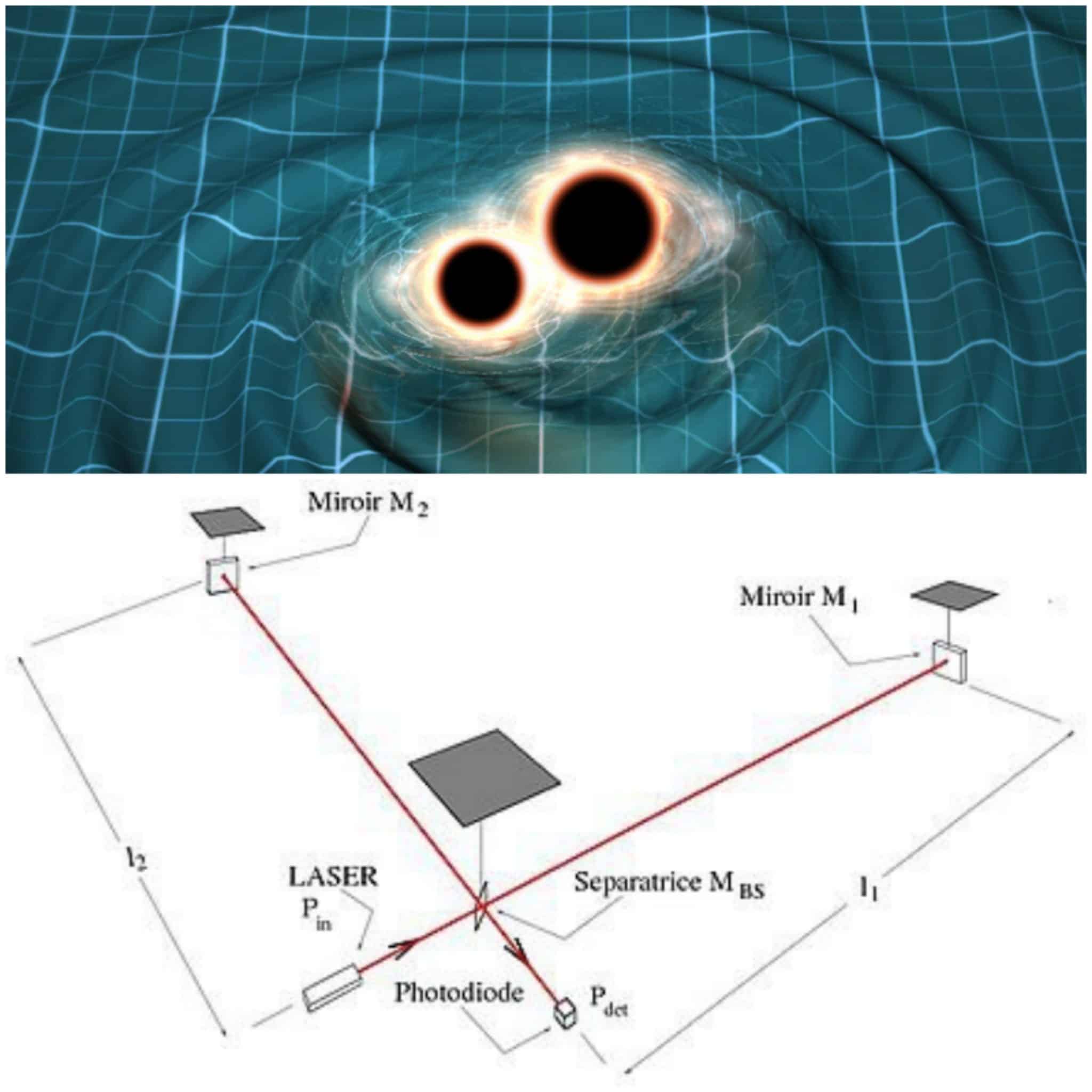
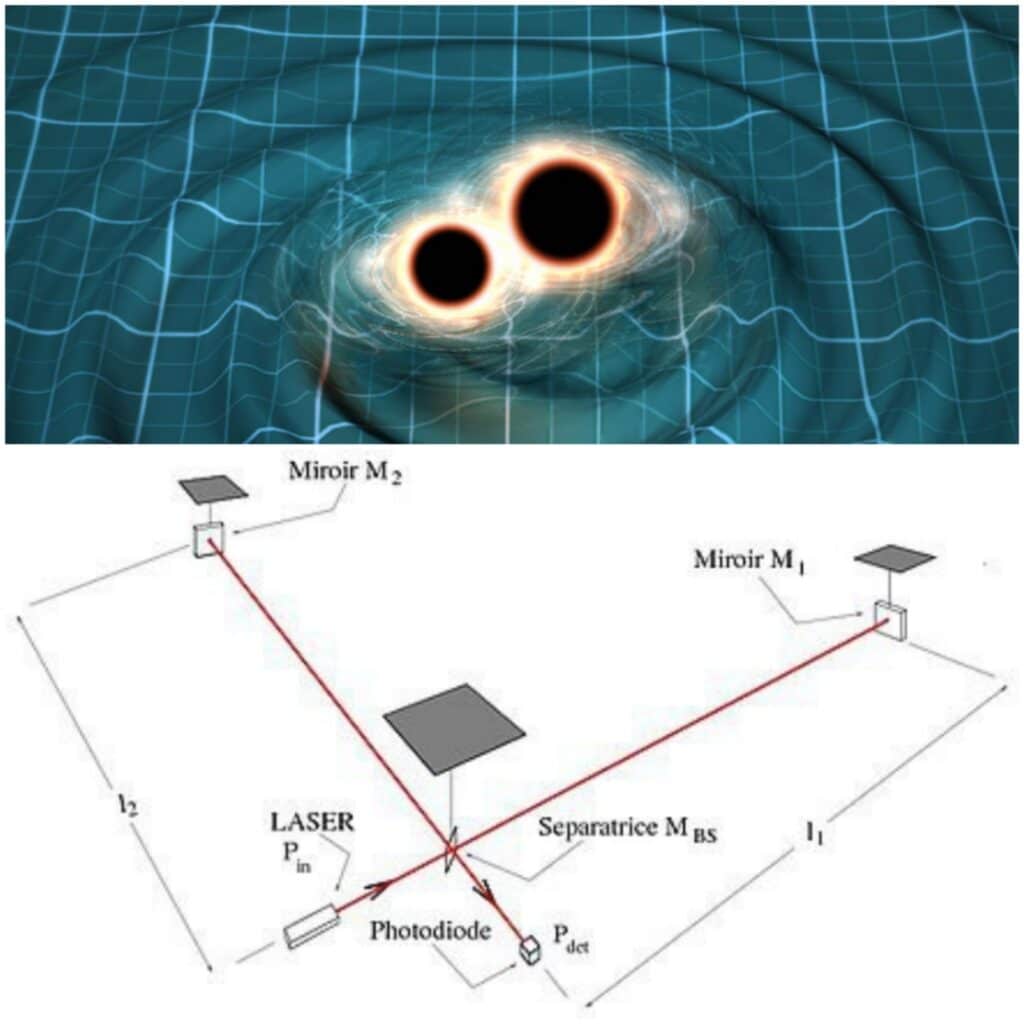
So, how does LIGO detect gravitational waves? Let’s walk through it step by step, like we’re building the world’s most sensitive ruler.
- Start with a laser. LIGO uses a powerful, ultra-stable laser—about 200 watts of pure light—shot down a 4-kilometer-long vacuum tube.
- Split the beam. At the heart of the L-shaped observatory sits a beam splitter. It sends half the light down one arm, half down the other, each at a right angle.
- Bounce, bounce, bounce. At the end of each arm, a mirror (so perfect it’s almost ghostly) reflects the light back. But here’s the trick: the light doesn’t just go down and back. It bounces between two mirrors in each arm—forming a Fabry-Pérot cavity—about 300 times. This makes the effective path length a whopping 1,200 kilometers!
- Reunite the beams. The two beams return to the splitter and combine. LIGO is tuned so that, under normal conditions, the light waves are out of phase—one’s crest matches the other’s trough. They cancel each other out. The photodetector sees nothing.
- Catch the ripple. When a gravitational wave passes, it stretches one arm and squeezes the other. The beams come back slightly out of sync. Suddenly, the photodetector sees a flash—a “chirp” signal. That’s the universe whispering to us.
This is LIGO gravitational wave detection explained in its purest form: a cosmic ear, listening for the faintest tremors in spacetime.
Why Does the L-Shape and 4km Arm Length Matter?
Why not just use a straight line? Gravitational waves are quadrupolar. That means as one direction stretches, the perpendicular direction squeezes. By arranging the arms at 90 degrees, LIGO maximizes its sensitivity. When a wave passes, one arm grows longer while the other shrinks. The longer the arms, the bigger the effect. At 4 kilometers each, LIGO’s arms are the longest of any interferometer on Earth. This design lets us catch even the tiniest spacetime ripples.
How Does LIGO Measure Such Small Changes? The Strain Formula
Here’s where things get wild. The change LIGO measures is called strain, written as h. It’s the ratio of the change in length (ΔL) to the original length (L):
Strain Formula:
h = ΔL / L ≈ 10-21
That’s less than one-thousandth the diameter of a proton. To put it in perspective, it’s like measuring the width of a human hair—across the entire Milky Way galaxy. That’s how sensitive LIGO is.
How Does LIGO Filter Out Noise? Engineering the Impossible
Measuring something so tiny isn’t just hard—it’s almost impossible. Every truck rumble, every gust of wind, even atoms jiggling in the mirrors, could drown out the signal. So, how does LIGO filter out noise?
- Ultra-high vacuum: The arms are giant tunnels, each 4 km long, with almost all air removed—pressure below 10-9 torr. That’s a trillionth of atmospheric pressure. No air molecules to scatter the laser.
- Suspended mirrors: Each 40 kg mirror hangs from four fused silica fibers, just 0.4 mm thick. This quadruple pendulum system acts like a shock absorber, isolating the mirrors from ground vibrations.
- Seismic isolation stacks: The mirrors sit on platforms that actively cancel out ground motion. The result? Residual motion at the mirror is less than 2 × 10-13 meters.
- Thermal and quantum noise reduction: The mirrors are made of ultra-pure fused silica, and the laser light is “squeezed” using a 300-meter filter cavity to reduce quantum uncertainty.
- Power recycling mirrors: These boost the circulating laser power up to 750 kW, making the signal stand out from the noise.
All this engineering lets LIGO measure the impossible—and hear the universe itself.
September 14, 2015: The Day We Heard the Universe
On September 14, 2015, at 09:50:45 UTC, both LIGO detectors—one in Hanford, Washington, the other in Livingston, Louisiana—caught a signal. It was a “chirp” lasting just 0.2 seconds. What was it? Two black holes, 29 and 36 times the mass of our Sun, spiraling together and merging 1.3 billion light-years away. The event was named GW150914. On February 11, 2016, the world heard the news: Einstein’s prediction was right. We had heard the universe for the first time.
GW170817: When Gold Was Born in a Cosmic Collision
Fast forward to August 17, 2017. LIGO and its European partner Virgo detected a new kind of signal—this time from two neutron stars colliding, 130 million light-years away. Just 1.7 seconds later, NASA’s Fermi satellite caught a short gamma-ray burst, GRB 170817A. Over 70 observatories worldwide scrambled to watch the aftermath. They saw a kilonova—a cosmic explosion that forges heavy elements like gold and platinum. The host galaxy, NGC 4993, became famous overnight. This was the dawn of multi-messenger astronomy: hearing and seeing the same cosmic event.
The 2017 Nobel Prize: Science’s Highest Honor for LIGO
In 2017, the Nobel Prize in Physics went to three visionaries: Rainer Weiss, who dreamed up the idea at MIT in 1972; Kip Thorne, who championed the theory at Caltech; and Barry Barish, who led the project to completion starting in 1994. But LIGO is more than just three names—it’s thousands of scientists, engineers, and dreamers working together. Their achievement changed science forever.
A Global Network: Who Else Is Listening?
LIGO isn’t alone. Around the world, other detectors join the hunt, forming a global network. This teamwork lets us pinpoint where in the sky a gravitational wave comes from—using triangulation—and follow up with telescopes and satellites. Here’s how the main players compare:
| Detector Name | Location | Arm Length | Key Features | Current Status |
|---|---|---|---|---|
| LIGO Hanford | Hanford, Washington, USA | 4 km | Advanced LIGO, quadruple pendulum, power recycling, Fabry-Pérot cavities | Upgrading after O4 |
| LIGO Livingston | Livingston, Louisiana, USA | 4 km | Advanced LIGO, identical to Hanford | Upgrading after O4 |
| Virgo | Pisa, Italy | 3 km | Active seismic isolation, European collaboration | Upgrading after O4 |
| KAGRA | Kamioka, Japan | 3 km | Underground, cryogenic mirrors, seismic quiet | Improving sensitivity |
| LIGO-India | Maharashtra, India | 4 km | Advanced LIGO design, under construction | Expected late 2020s |
| GEO600 | Hannover, Germany | 600 m | Testbed for new tech, squeezed light pioneer | Operational, R&D focus |
What’s Next for LIGO? O4 Done, O5 on the Horizon
The fourth observing run (O4) ran from May 2023 to November 18, 2025. During this time, LIGO and its partners more than doubled the number of confident gravitational wave detections. Now, the detectors are getting upgrades—tweaking lasers, improving mirror coatings, and pushing sensitivity even further. A short interim run (IR1) is planned for late October or mid-November 2026. After that, the fifth major run (O5) will begin, with even greater sensitivity. The hunt for spacetime ripples is just getting started.
Mathematical Strain Formula
Strain Sensitivity:
h = ΔL / L ≈ 10-21
(That’s less than 1/1000th the diameter of a proton over 4 km!)
Conclusion: Humanity’s New Sense
We’ve come a long way from Einstein’s chalkboard in 1916 to LIGO’s twin observatories listening for cosmic whispers. By measuring changes smaller than a proton’s width, we’ve opened a new sense—hearing the universe itself. We’ve caught black holes colliding, watched gold being born in neutron star mergers, and built a global network of detectors that lets us pinpoint these events across the sky. LIGO’s story is one of human curiosity, teamwork, and the refusal to accept “impossible.” At FreeAstroScience.com, we believe in keeping our minds active—because when reason sleeps, monsters wake. So, keep questioning, keep learning, and come back soon. The universe still has plenty to say.