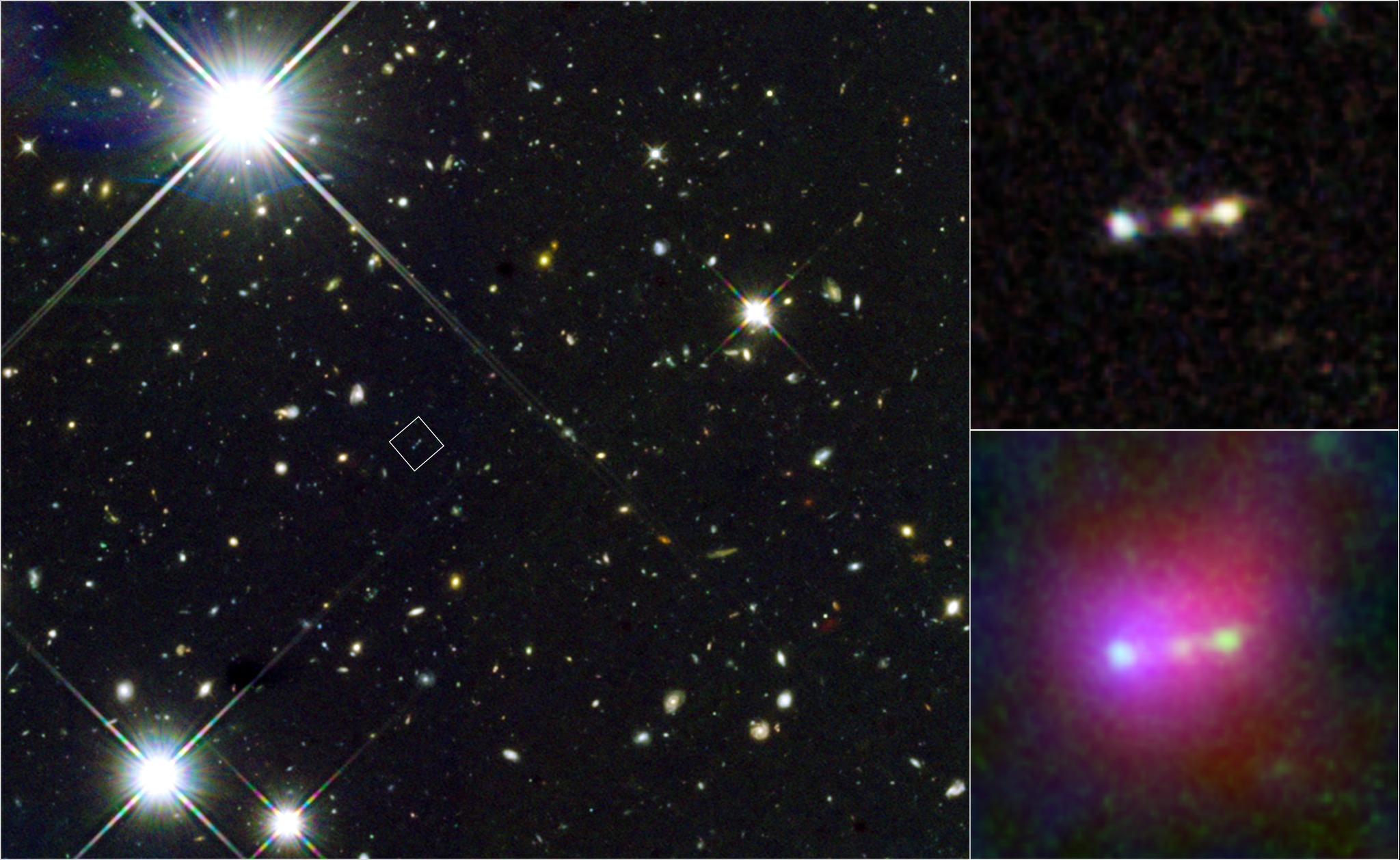
What if we told you that a single cloud of gas, drifting nearly 13 billion light-years away, could shake the very foundation of how we think galaxies were born? Welcome, dear reader, to FreeAstroScience.com — we’re so glad you’re here. Today, we want to take you on a journey to the edge of the observable universe, to meet a strange, glowing giant called Himiko. Stay with us until the very last line, because the story of this primordial blob isn’t just about a far-away object — it’s about how we, as curious humans, keep learning to read the diary of the cosmos. We promise: you’ll leave with a clearer picture of cosmic dawn, and a few questions worth keeping awake at night.
📖 Table of Contents
- What Is Himiko and Why Did It Stun Astronomers?
- How Did We Find a Blob Almost 13 Billion Light-Years Away?
- What Do the Numbers Really Tell Us?
- Why Does Redshift 6.6 Matter So Much?
- What Could Himiko Actually Be?
- Three Galaxies Hiding Inside One Bubble?
- Why Does Himiko Challenge the Standard Model?
- Conclusion
- References
What Is Himiko and Why Did It Stun Astronomers?
Picture a glowing fog of hydrogen, stretching across 55,000 light-years — about half the width of the Milky Way’s disk — but lit up when our universe was barely a toddler . That’s Himiko. Astronomers call it an “extended Lyman-Alpha blob,” and back in 2009 it became the most distant object of its kind ever seen .
The team named it after Queen Himiko, a mysterious shaman-ruler from ancient Japan. Fitting, right? Because almost nothing about this object follows the rules we expected.
Here’s the punchline: Himiko existed when the universe was only 800 million years old — just 6% of its present age . And yet it was already as big as a fully grown galaxy today.
How Did We Find a Blob Almost 13 Billion Light-Years Away?
The hunt began in the constellation Cetus, the Whale . A team led by Masami Ouchi, then a fellow at the Carnegie Observatories, was sifting through 207 distant galaxy candidates picked up by Japan’s Subaru Telescope in the Subaru/XMM-Newton Deep Survey Field .
One source looked wrong. Too bright. Too big. Suspicious.
“We hesitated to spend our precious telescope time by taking spectra of this weird candidate. We never believed that this bright and large source was a real distant object. We thought it was a foreground interloper contaminating our galaxy sample,” Ouchi recalled .
They took the spectrum anyway, using the Keck II / DEIMOS instrument and Carnegie’s Magellan/IMACS spectrograph . The result floored them: a textbook hydrogen Lyman-α signature shifted exactly where it should be for an object 12.9 billion light-years away .
Later, infrared eyes on the Spitzer Space Telescope and the United Kingdom Infrared Telescope, radio data from the Very Large Array (VLA), and X-ray imaging from XMM-Newton filled in the rest of the portrait . Spitzer in particular revealed a halo around Himiko much wider than what Hubble alone could see.
What Do the Numbers Really Tell Us?
Let’s lay the key data side by side. We built this little dashboard so you can scan it fast — even on your phone, even on a noisy train.
| Property | Value | Source instrument |
|---|---|---|
| Constellation | Cetus | Subaru wide-field survey |
| Redshift (z) | 6.6 | Keck/DEIMOS spectroscopy |
| Light-travel distance | ~12.9 billion light-years | Lyman-α line analysis |
| Age of universe at observation | ~800 million years | Cosmological model |
| Diameter | ~55,000 light-years | Subaru/Hubble imaging |
| Total mass (estimate) | ~40 billion solar masses | Multi-wavelength SED fit |
| Sky position (RA / Dec) | 02h 17m 57.57s / −05° 08′ 44.78″ | Hubble/WFC3 |
| Dominant emission | Hydrogen Lyman-α | Keck/DEIMOS |
Why Does Redshift 6.6 Matter So Much?
Redshift is a fancy name for a simple idea: as the universe stretches, the light traveling through it stretches too. Ultraviolet photons leaving Himiko shift all the way down into the infrared by the time they reach our telescopes .
Here’s the relation we use:
1 + z = λobserved / λemitted
For Himiko: 1 + 6.6 = 7.6 → light is stretched by a factor of ~7.6
That’s huge. The Lyman-α line, normally ultraviolet at 121.6 nm, arrives at our detectors near 924 nm, deep in the near-infrared . This is why Subaru’s optical survey could pick it up at all, and why radio velocity catalogs like SIMBAD list a recession of about 289,575 km/s .
z = 6.6 also drops Himiko right inside the reionization epoch — the cosmic dawn, between roughly 200 million and 1 billion years after the Big Bang . During this stretch, neutral hydrogen was being ripped apart by ultraviolet light from the very first stars and quasars . Himiko sits inside that turning point in cosmic history.
What Could Himiko Actually Be?
Honestly? Even the discovery team wasn’t sure. They proposed five competing scenarios :
- An ionized gas cocoon powered by a super-massive black hole.
- A primordial galaxy swallowing huge amounts of cold gas (gas accretion).
- A collision of two large young galaxies in a violent merger.
- A super-wind driven by furious starburst activity.
- A single, monstrous galaxy of about 40 billion solar masses.
The first spectra showed strong hydrogen but no clear signal from heavier elements like carbon — a hint that Himiko’s matter might be chemically primitive, barely touched by previous generations of stars . In some early data, carbon emission appeared up to 30 times weaker than in modern galaxies .
But follow-up studies told a different story. Star formation was already happening. The stellar mass turned out to be about an order of magnitude (10×) larger than other galaxies known at a similar epoch . So Himiko was forming stars — and lots of them.
Three Galaxies Hiding Inside One Bubble?
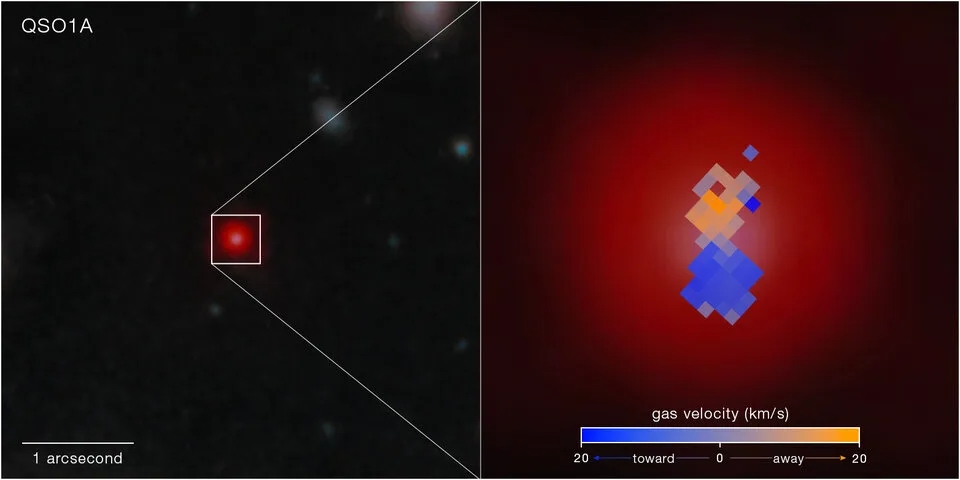
In 2013, a sharper look changed everything. Astronomers used the NASA/ESA Hubble Space Telescope together with the Atacama Large Millimeter/submillimeter Array (ALMA) to peek inside the blob .
Surprise: Himiko isn’t one object. It’s three primitive galaxies, snuggled inside the same enormous gas cloud, likely on a collision course that will fuse them into one massive system.
Suddenly the puzzle pieces clicked. The wild brightness, the giant Lyman-α halo, the rapid star formation — all of it makes more sense if we’re watching a triple merger caught red-handed during cosmic dawn. The collision squeezes vast clouds of gas, igniting bursts of new stars that pump out the ultraviolet photons we see redshifted into the infrared today.
Why Does Himiko Challenge the Standard Model?
Here’s where things get philosophically juicy.
The standard ΛCDM (concordance) model of cosmology says galaxies grow bottom-up: small clumps form first, then merge over billions of years into the giants we see today. Himiko, frankly, refuses to play along. As Carnegie’s Alan Dressler put it:
“If this was the discovery of a class of objects that are ancestors of today’s galaxies, there should be many more smaller ones already found — a continuous distribution. Because this object is, to this point, one-of-a-kind, it makes it very hard to fit it into the prevailing model of how normal galaxies were assembled. On the other hand, that’s what makes it interesting!”
So we’re left with two honest options:
- Himiko is a rare cosmic accident — a statistical outlier we just happened to spot.
- We’re missing something fundamental about how the first galaxies grew.
Either answer is exciting. The discovery of the merging trio inside the blob leans toward option one — but the question is far from closed.
We at FreeAstroScience.com find this kind of moment thrilling. Science isn’t a closed book; it’s a living conversation. And Himiko keeps insisting on having a say.
Conclusion
We started with a glowing fog and ended up at the edge of cosmology itself. Himiko, named for a queen wrapped in legend, turns out to be three baby galaxies hugging each other inside a 55,000-light-year halo of hydrogen, 12.9 billion light-years away . It existed when our universe was only 800 million years old — and it was already roughly 40 billion solar masses heavy . That’s not a comfortable fit for textbook galaxy formation, and that’s exactly why it matters.
What we love most about Himiko isn’t its size or its distance. It’s the reminder that the cosmos still has the power to embarrass our models — and to invite us to look again, harder, deeper, more humbly.
This article was written specifically for you by FreeAstroScience.com, where we work hard to translate complex scientific principles into language you can actually use. Our mission is simple: to encourage you never to switch off your mind, never to let curiosity sleep — because, as Goya warned us, the sleep of reason breeds monsters. Come back often. Bring your questions. The universe has plenty of answers, and even better questions, waiting for both of us.
— Gerd Dani, President, FreeAstroScience
References
- W. M. Keck Observatory — Mysterious Space Blob Discovered at Cosmic Dawn (April 22, 2009).
- ScienceDaily / Carnegie Institution — Mysterious Space Blob Discovered At Cosmic Dawn.
- Subaru Telescope / NAOJ — Press Release: Mysterious Space Blob Discovered at Cosmic Dawn (April 22, 2009).
- Science 2.0 — Himiko – Identify This Mystery Blob At The Cosmic Dawn.
- ESA/Hubble — Himiko (Hubble close-up view).
- Astronimus — Learn More about the Amazing Himiko Clouds.
- Ouchi et al., Discovery of a Giant Lyα Emitter Near the Reionization Epoch, The Astrophysical Journal, May 10, 2009. DOI: 10.1088/0004-637X/696/2/1164.