
What if the key to humanity’s future in space is hiding right above our heads — locked in ancient, lightless craters that haven’t seen a single ray of sunshine in over 3 billion years? Welcome back to FreeAstroScience.com, where we believe science belongs to everyone — not just the people in lab coats. Whether you’re reading this on a train, a couch, or a hospital bed, this article is written for you. Today we’re covering a landmark study just published in Nature Astronomy on April 7, 2026, that rewrites what we know about water ice on the Moon. This isn’t just another astronomy headline. It’s a map — a genuine roadmap — for where humanity might drink, breathe, and refuel on its first permanent lunar outpost. Stay with us all the way to the end. What you’ll find will surprise you.
The Moon Has Been Quietly Collecting Ice for Over 3 Billion Years
A new Nature Astronomy study just handed us a map — and a surprise.
For decades, scientists have known ice exists near the Moon’s poles. But the “how” and “why” always stayed frustratingly fuzzy. Why is ice plentiful in some craters and completely absent in neighboring ones? Did a giant comet dump it all there billions of years ago? Or has the Moon been patiently gathering water drop by frozen drop over deep geological time?
A brand-new study, published April 7, 2026, in Nature Astronomy (DOI: 10.1038/s41550-026-02822-9), has just delivered the clearest answer yet. And it changes the picture entirely.
<h2 id=”cold-traps”>What Exactly Are “Cold Traps” on the Moon?</h2>
Think of cold traps as nature’s deep freezers — except they’ve been running, completely undisturbed, for billions of years.
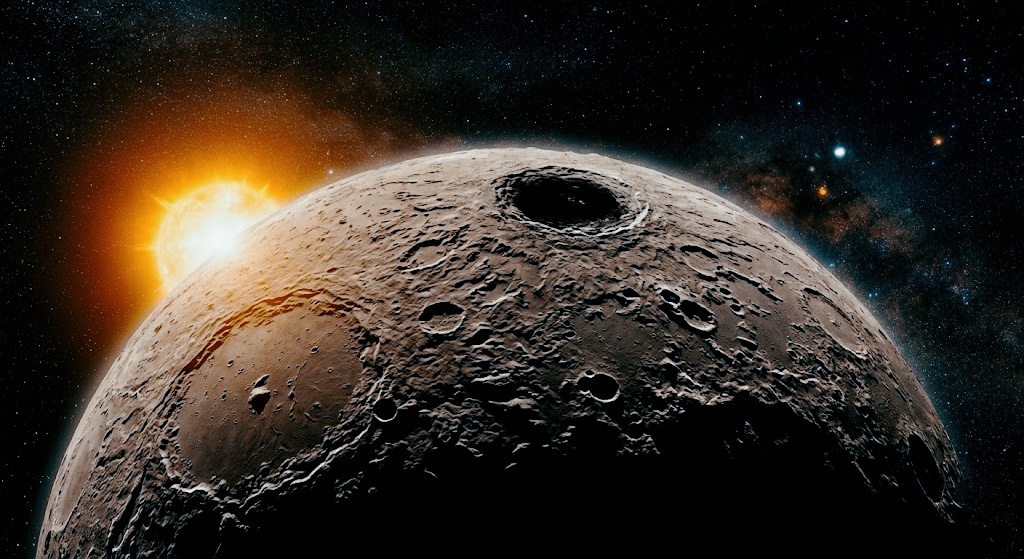
They’re craters near the lunar South Pole that sit in permanent darkness. The geometry of the Moon’s terrain means their floors never catch sunlight, not even for a single day over geological time. Temperatures there can plunge below −170°C (103 K). At those extremes, water molecules that land don’t evaporate — they just freeze and stay put, potentially forever.
NASA’s Lunar Reconnaissance Orbiter (LRO), launched in 2009, has been mapping these regions for years. Its LAMP instrument — the Lyman Alpha Mapping Project — scans ultraviolet reflectance across the lunar surface. Ice, even in thin patches, reflects UV light differently from dry regolith (the Moon’s rocky soil). That’s how scientists first started suspecting something frozen was hiding down there.
The total area of permanently shadowed regions (PSRs) near the lunar South Pole adds up to roughly 22,234 km² — an area roughly the size of New Jersey, cloaked in absolute, perpetual darkness.
<h2 id=”team”>Who Ran This Study — and How?</h2>
The research was led by Prof. Oded Aharonson of the Weizmann Institute of Science in Israel, who worked as a visiting scholar at the University of Colorado Boulder in 2025. He teamed up with Prof. Paul Hayne, a planetary scientist at CU Boulder’s Laboratory for Atmospheric and Space Physics (LASP), and Dr. Norbert Schörghofer of the Planetary Science Institute in Honolulu.
Their approach was, frankly, brilliant in its elegance.
The Moon’s axial tilt hasn’t always been what it is today. Over hundreds of millions of years, its orientation relative to Earth has shifted. A crater in permanent shadow right now may not have been dark 800 million years ago. The team ran a series of sophisticated computer simulations using temperature data from LRO’s Diviner instrument to model exactly how crater shadowing has evolved over geological time.
They effectively rewound the Moon’s entire 4.5-billion-year history — frame by frame — to identify which craters have been the coldest, darkest, and longest-lived. Then they compared those results to what LAMP had detected.
The match was striking.
<h2 id=”data”>What Did the Data Actually Show?</h2>
The craters that have been in complete shadow the longest are precisely where LAMP detected the strongest evidence of water ice.
“It looks like the moon’s oldest craters also have the most ice,” Prof. Hayne said. “That implies that the moon has been accumulating water more or less continuously for as much as 3 billion or 3.5 billion years.”
Let that sink in. Three and a half billion years of continuous water accumulation. That’s nearly three-quarters of Earth’s own age.
This single finding directly rules out the long-held idea that one massive comet delivered all the Moon’s water in a dramatic ancient impact. The age-to-ice correlation simply doesn’t fit that scenario. Instead, the evidence points toward a slow, patient, multi-source process — one that’s still happening today.
Why Isn’t the Ice Spread Evenly?
Before this study, scientists had no good answer for why some craters showed abundant ice while their neighbors appeared completely dry. The team’s work closes that gap.
Older cold traps have had more time to collect ice from multiple sources. Younger craters — even if they’re cold right now — haven’t been around long enough to build up significant deposits. The patchiness of ice distribution across the South Pole isn’t random. It’s a direct record of each crater’s individual history.
“What’s clear is that the ice has a patchy distribution,” Hayne noted. “It’s not concentrated in the same quantities in every crater. And there was no great explanation for that.” Now, there is.
<h2 id=”two-craters”>Two Craters, Two Very Different Stories</h2>
Here’s where things get genuinely unexpected.
Haworth Crater, positioned near the lunar South Pole, has likely been in unbroken shadow for more than 3 billion years. That makes it the top candidate for storing large, accessible ice deposits — and a prime target for future lunar missions.
Shackleton Crater, on the other hand, has long been the star of lunar exploration planning. Its rim sits directly at the South Pole and was even selected as an Artemis candidate landing site. But here’s the twist: while Shackleton has been in shadow for about 3.5 billion years, the new research shows it only became cold enough to actually trap ice around 500 million years ago.
That’s a critical distinction. Longer shadowing doesn’t automatically equal more ice. Temperature history matters just as much.
| Feature | Haworth Crater | Shackleton Crater |
|---|---|---|
| Location | Near lunar South Pole | Directly at South Pole |
| Diameter | ~51 km | ~21 km (13 miles) |
| Total time in shadow | >3 billion years | ~3.5 billion years |
| When cold enough for ice? | ~3 billion years ago | Only ~500 million years ago |
| Total ice accumulation time | ~3 billion years | ~500 million years |
| LAMP ice signal | ⭐ Very High | ⚠️ Moderate |
| Post-study Artemis priority | Top Candidate | Needs Reassessment |
<h2 id=”water-source”>How Did Water Actually Get to the Moon?</h2>
This is the question that keeps planetary scientists up at night.
The new study can’t name a single guilty party. But it does narrow the suspects down considerably. Three main sources remain on the table:
- Solar wind: The Sun constantly blasts charged particles outward across the solar system. A steady stream of hydrogen ions hits the lunar surface, and some of that hydrogen reacts with oxygen atoms already locked in the regolith to form water molecules. “Through the solar wind, a constant stream of hydrogen bombards the moon, and some of that hydrogen can be converted to water on the lunar surface,” Hayne explained.
- Ancient volcanism: Early in the Moon’s history, volcanic eruptions may have carried water vapor from deep inside the lunar interior all the way to the surface. That vapor then migrated toward the poles and froze in cold traps.
- Small comets and asteroids: Rather than one giant comet impact, billions of years of smaller strikes could have steadily delivered water-bearing material — a slow drizzle of cosmic ice across geological time.
What the data makes clear is that a single catastrophic delivery event didn’t write this story. The age-to-ice correlation points unmistakably toward a process that is still unfolding.
<h2 id=”chemistry”>Why Is Lunar Ice So Incredibly Valuable?</h2>
Let’s be honest — “water on the Moon” might sound like a dry science fact. It isn’t.
Water ice at the lunar South Pole could change everything about how humanity operates in space. Future astronauts could mine it for drinking water. They could split it into hydrogen and oxygen through electrolysis to produce rocket propellant. They could use it as a physical radiation shield. They could even extract breathable air from it.
The core chemistry is elegantly simple. Electrolysis runs an electric current through liquid water to break it apart:
⚗️ Key Reaction: Electrolysis of Water
Two molecules of water yield two molecules of hydrogen gas (rocket fuel) and one molecule of oxygen gas (breathable air). This reaction is the foundation of ISRU — In-Situ Resource Utilization — on the Moon.
Hydrogen and oxygen — extracted from Moon ice — are exactly what the most powerful rocket engines burn. Every kilogram of water you don’t have to launch from Earth could save roughly $10,000 in launch costs. At scale, that makes lunar ice not just scientifically interesting, but economically transformative.
For ice to remain stable on the Moon’s surface, temperatures must stay below approximately 110 K (−163°C). The permanently shadowed regions near the South Pole consistently meet that condition. The Moon has, in effect, been running its own natural cryogenic storage system for billions of years — and we’re only now learning where the best freezers are.
<h2 id=”artemis”>What Does This Mean for NASA’s Artemis Program?</h2>
This research doesn’t exist in isolation. It feeds directly into one of the most ambitious space programs currently running.
Future crewed Artemis missions are targeting the lunar South Pole precisely because of water ice. The strategy — called In-Situ Resource Utilization (ISRU) — means using local materials instead of hauling everything from Earth. That shift could make the difference between a short visit and a permanent presence.
The new study effectively gives mission planners a prioritized shopping list. Haworth Crater rises to the top. Shackleton, while still scientifically rich, needs to be reassessed as a primary ice-mining destination. Mission architectures built around Shackleton as the ice goldmine may need updating.
International programs are converging on the same goal. JAXA (Japan) and ISRO (India) are jointly developing the LUPEX (Lunar Polar Exploration) mission to hunt for ice near the South Pole. NASA is contributing its Neutron Spectrometer System (NSS) instrument to that mission. The lunar South Pole has become the most competed-over piece of real estate in the solar system.
“Finding water beyond Earth in liquid and usable form is one of the most important challenges in astronomy,” said Prof. Aharonson.
<h2 id=”instrument”>The Instrument That Will Give Us the Next Chapter</h2>
Prof. Hayne isn’t just studying the Moon from a distance. He’s building the tools to look closer.
He’s currently developing the Lunar Compact Infrared Imaging System — known as L-CIRiS — a new instrument that NASA plans to deploy near the lunar South Pole in late 2027. Infrared imaging can detect temperature differences with extraordinary precision, mapping the exact edges of cold traps and potentially identifying ice patches far too small for current instruments to resolve.
That 2027 deployment will mark a turning point. Scientists and mission planners will get the most detailed thermal map of the lunar South Pole ever produced. The answers we’re chasing — exactly how much ice is there, exactly where it sits — will come into focus.
The science is pointing the way. The instruments are being built. The missions are being planned.
<h2 id=”gold-standard”>The Gold Standard: Bringing Ice Home</h2>
All of this data, all these simulations, all this remote sensing — they’re pointing toward one defining moment.
A human hand (or a robotic arm) reaching into a permanently shadowed crater and pulling out a sample of actual lunar ice.
“Ultimately, the question of the source of the moon’s water will only be solved by sample analysis,” Hayne said. “We will need to go to the moon to analyze those samples there or find ways to bring them from the moon back to Earth.”
When that happens, scientists will compare the chemical composition of lunar ice with water on Earth — studying isotopic signatures that act like molecular fingerprints. Those fingerprints will reveal exactly where the Moon’s water came from. Was it solar wind? Ancient volcanic outgassing? A steady rain of small comets over the eons?
The answer has been frozen in those craters for up to 3.5 billion years. It’s waiting.
“The gold-standard proof of the existence of ice on the Moon would be a sample of it,” Aharonson said. “It would allow us to compare the chemical composition of water on the Moon with that on Earth, and to assess whether — and how — crewed lunar missions could make use of this resource.”
<h2 id=”conclusion”>Our Final Thoughts</h2>
Here at FreeAstroScience, we write about the cosmos because we believe the universe is one of the few things that puts all our differences in perspective. From our base in Bologna, looking up at the same Moon that billions of people have watched for all of human history, stories like this one feel genuinely electric.
This 2026 Nature Astronomy study tells us something profound: the Moon didn’t get its water in one dramatic moment. It collected it, patiently, over 3.5 billion years — from solar wind, from ancient volcanoes, from the slow bombardment of passing comets and asteroids. The oldest craters hold the most ice. The coldest shadows hold the deepest secrets. And Haworth Crater — not Shackleton — is now our best bet for finding that water in abundance.
For future Artemis astronauts, this matters enormously. Their drinking water, their rocket fuel, their breathable air — it may all come from these ancient frozen reservoirs. The Moon isn’t just a destination. It’s a resource base, a stepping stone, and a scientific archive all at once.
We at FreeAstroScience exist for exactly this reason: to protect you from misinformation, to break down complex science into something real and human, and to remind you that keeping your mind active isn’t just an intellectual exercise — it’s an act of resistance. As Francisco Goya warned us centuries ago, the sleep of reason breeds monsters. We don’t intend to let that happen.
Come back to FreeAstroScience.com. There’s always more to explore, more to question, and more to understand. The Moon is just the beginning.
📚 References & Sources
- Aharonson, O., Hayne, P. O., & Schörghofer, N. (2026). Lunar ice distribution correlated with cold trap age. Nature Astronomy. https://doi.org/10.1038/s41550-026-02822-9
- Phys.org (April 7, 2026). Water on the moon? New study narrows down the most likely locations. https://phys.org/news/2026-04-moon-narrows.html
- TechExplorist (2026). Water likely accumulated on the Moon slowly over billions of years. https://www.techexplorist.com/water-accumulated-moon-slowly-billions-years/102579/
- NASA Goddard / McClanahan, T. P. et al. (2024). Lunar Ice Deposits are Widespread. Planetary Science Journal. NASA Science
- Astronomy.com (2025). Why NASA is targeting the Moon’s South Pole for Artemis. https://www.astronomy.com/science/why-nasa-is-targeting-the-moons-south-pole-for-artemis/
- NASA (March 23, 2026). NASA’s Water-Hunting Tool Will Help Scout Moon’s South Pole — LUPEX / NSS instrument. https://www.nasa.gov/solar-system/moon/nasas-water-hunting-tool-will-help-scout-moons-south-pole/
- EarthSky / Anderson, P. S. (October 2024). Ice on the moon is widespread, new study shows. https://earthsky.org/space/ice-on-the-moon-permanently-shadowed-regions-lro/
- Nature (2026). Impacts into the lunar permanently shadowed regions. https://www.nature.com/articles/s44453-026-00032-1