Have you ever watched a spinning top slow down, wobble, stop — and then start turning the other way? It sounds like a science-fair trick. In March 2026, though, NASA announced that exact thing happened — not with a toy, but with a real comet barrelling through our solar system. For the first time in recorded human history, scientists confirmed a comet reversing its own spin direction. And yes, the implications stretch far beyond that one icy rock.
Welcome to FreeAstroScience.com. I’m Gerd Dani — astronomer, physicist, science blogger, and president of the Free Astroscience Science and Cultural Group. Here we strip complex science down to its core, because we believe you never need a PhD to appreciate the universe. FreeAstroScience exists to educate you, to keep your mind active at all times — because, as the great Goya warned, the sleep of reason breeds monsters. Today, we’re bringing you the full story of comet 41P/Tuttle-Giacobini-Kresák: a battered, kilometer-wide ball of ice that did something no comet had ever been seen doing before. Read on to the very end — this one builds to something genuinely mind-blowing.
📋 Table of Contents
- What Is Comet 41P/Tuttle-Giacobini-Kresák?
- How Did Scientists Discover the Spin Reversal?
- The Timeline: March to December 2017
- The Physics: Torque, Outgassing, and Angular Momentum
- Is Comet 41P Heading for Self-Destruction?
- How Old Data Led to a Brand-New Discovery
- The 2028 Return: Our Next Chance to Watch
- Our Final Thoughts
A Tiny, Doomed Comet That Reversed Direction — and Changed How We Understand Comet Life Cycles
What Is Comet 41P/Tuttle-Giacobini-Kresák?
Let’s start at the beginning. Comet 41P/Tuttle-Giacobini-Kresák — scientists just call it 41P — is a Jupiter-family comet. That label means Jupiter’s immense gravity yanked it from the outer solar system long ago and redirected it into a shorter, tighter orbit around the Sun. Its original home was the Kuiper Belt: a vast ring of frozen bodies sitting beyond Neptune’s orbit.
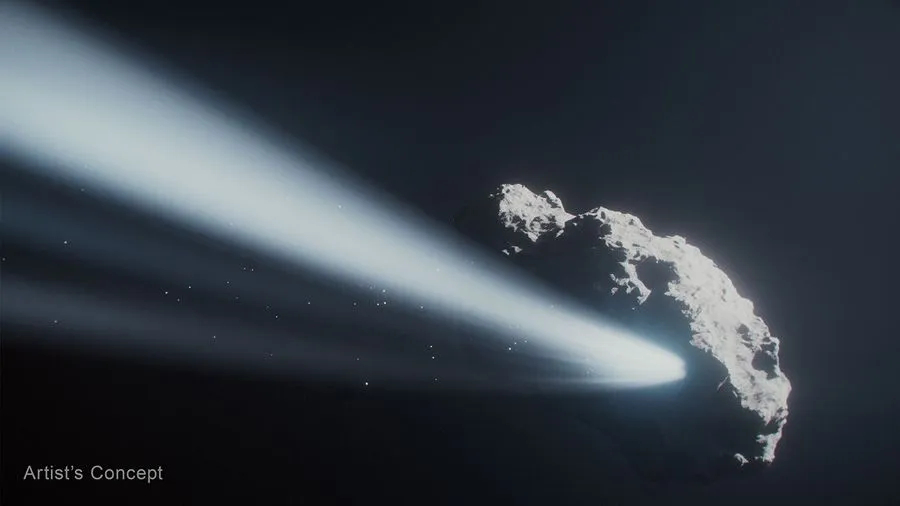
Today, 41P swings around the Sun once every 5.4 years. Its nucleus — the hard, icy core — is tiny. We’re talking roughly 0.6 miles, or about 1 kilometer, across. That’s approximately three times the height of the Eiffel Tower. In cosmic terms, that’s microscopic. And as we’ll see, being small has enormous — and dangerous — consequences.
The comet carries three names because it was discovered three separate times. Astronomer Horace Parnell Tuttle first spotted it in 1858. Michel Giacobini rediscovered it in 1907, and Ľubor Kresák found it again in 1951. For most of its known history, 41P was just another entry in a long list of periodic comets. Then 2017 happened — and everything changed.
How Did Scientists Discover the Spin Reversal?
The story begins not with a grand, planned experiment — but with archival curiosity. David Jewitt, a professor of planetary science and astronomy at the University of California, Los Angeles (UCLA), was browsing the Mikulski Archive for Space Telescopes (MAST) — NASA’s public data library — when he stumbled across Hubble observations of 41P from December 2017 that no one had ever analyzed.
Jewitt compared those Hubble frames to earlier data from two other instruments: the Discovery Channel Telescope at Lowell Observatory in Arizona (March 2017) and NASA’s Neil Gehrels Swift Observatory (May 2017). When he lined up all three datasets, the picture that emerged was extraordinary. The rotation had shifted so dramatically that the simplest explanation was a complete reversal of spin direction.
His paper detailing this finding was published on March 25, 2026, in The Astronomical Journal. It made headlines around the world — and rightly so. No one had ever caught a comet doing this before.
The Timeline: What Happened Between March and December 2017?
📅 March 2017 — The Baseline
In March 2017, the Discovery Channel Telescope at Lowell Observatory in Arizona caught 41P spinning with a period of roughly 20 hours. One complete rotation every 20 hours. Nothing alarming. That’s the starting point.
📅 May 2017 — The Dramatic Slowdown
By May 2017, 41P had made its closest approach to the Sun — what astronomers call perihelion. NASA’s Swift Observatory tracked it and found something alarming: the rotation period had stretched to between 46 and 60 hours. The comet had slowed by a factor of roughly three. Imagine Earth’s day suddenly expanding from 24 hours to almost three full days. Astronomers took immediate notice.
📅 December 2017 — The Reversal
Then came Hubble. Images from December 2017 showed 41P spinning again — now at roughly 14 hours per revolution. Faster than ever. But the direction had flipped. The comet hadn’t just sped back up; it had slowed nearly to a complete halt, then started spinning the other way entirely. No comet in scientific history had ever been observed doing this. Not once. Until now.
| Date | Observatory / Instrument | Rotation Period | Key Finding |
|---|---|---|---|
| March 2017 | Discovery Channel Telescope, Lowell Observatory, Arizona | ~20 hours | Baseline spin — pre-perihelion |
| May 2017 | NASA Neil Gehrels Swift Observatory | 46 – 60 hours | Near-perihelion — comet slowed ~3× after Sun flyby |
| December 2017 | NASA Hubble Space Telescope | ~14 hours | First observed spin reversal — spinning faster, opposite direction |
The Physics Behind the Flip: Torque, Outgassing, and Angular Momentum
So what actually reversed the comet’s spin? The answer lies in two things working together: outgassing jets and rotational physics. When a comet swings close to the Sun, solar heat causes frozen ices — water, carbon dioxide, carbon monoxide — to sublimate. They skip the liquid phase entirely and jump from solid straight to gas. Those gases then erupt off the surface in powerful jets.
Think of it like a fire hose strapped to the comet’s body. If all those jets pointed symmetrically in every direction, the forces would cancel each other out. But they don’t. On 41P, the jets were distributed unevenly — and they happened to push against the direction of rotation, acting like tiny, relentless braking thrusters.
“Jets of gas streaming off the surface can act like small thrusters,” said Jewitt. “If those jets are unevenly distributed, they can dramatically change how a comet, especially a small one, rotates.”
His analogy is perfect: “It’s like pushing a merry-go-round. If it’s turning in one direction, and then you push against that, you can slow it and reverse it.” Those jets pushed and pushed until 41P nearly stopped — and then sent it spinning the other way.
⚛️ The Key Physics Equations
Rotational mechanics gives us three tools to understand what happened to 41P.
1. Angular Momentum
L = I × ω
L is angular momentum. I is the moment of inertia (how the comet’s mass is distributed). ω (omega) is angular velocity — how fast it spins. For a near-spherical nucleus of mass m and radius r, the moment of inertia is I = (2/5) × m × r². Because 41P’s radius r is tiny (~500 m), I is extremely small — meaning even a weak torque changes its spin rapidly.
2. Torque from Outgassing Jets
τ = dL / dt
Torque (τ) is the rate at which angular momentum changes over time. When jets push against the existing spin, they apply a negative torque — shrinking L toward zero. If the jets keep pushing after L reaches zero, the spin builds again in the opposite direction. That’s exactly the reversal we observed.
3. Rotation Period and Angular Velocity
T = 2π / ω
As ω approaches zero, T approaches infinity — the comet nearly stops. When ω then grows negative (reversed), T becomes finite again in the opposite sense. This is precisely what the three observatories measured across March–December 2017.
| Comet Property | 41P/TGK (Small) | Typical Larger Comet |
|---|---|---|
| Nucleus Diameter | ~1 km | 5 – 20+ km |
| Moment of Inertia (I) | Very low | Much higher |
| Spin Sensitivity to Jet Torque | High — spins change rapidly | Low — jets rarely alter spin |
| Risk of Spin-Driven Breakup | Very high | Low to moderate |
Is Comet 41P Heading for Self-Destruction?
Here’s where the story takes a darker — and more dramatic — turn. The spin reversal didn’t just reveal exotic physics. It exposed a comet that’s quietly falling apart.
The comet’s total gas production dropped by roughly a factor of ten between its 2001 perihelion passage and its 2017 return. A tenfold decline in activity is massive. It tells us that near-surface volatile ices are either burning away permanently or getting buried under layers of insulating dust — a process that steadily shuts down the jets while leaving the comet’s structural integrity weaker over time.
But wait. If the jets are weakening, why is the spin still changing so dramatically? The answer is that even weakened jets, acting persistently over months, are enough to torque a tiny nucleus like 41P’s. And if the spin keeps accelerating — as the post-reversal period of 14 hours suggests — centrifugal forces will eventually overcome the comet’s feeble gravity and structural strength.
When that happens, 41P could fragment — split into multiple pieces — or simply disintegrate into a diffuse cloud of dust and rubble. “I expect this nucleus will very quickly self-destruct,” Jewitt said. That’s a blunt assessment, but it’s grounded in the data. 41P has probably been in its current orbit for only around 1,500 years — a heartbeat in astronomical time. Its structural countdown may already be running.
How Old Data Led to a Brand-New Discovery
One of the most human parts of this whole story? The discovery didn’t require a new mission, a new telescope, or a billion-dollar investment. It required one curious scientist and a public database.
Hubble has been collecting light from across the cosmos for over 35 years. Every image, every spectrum, every photometric measurement flows into the Mikulski Archive for Space Telescopes (MAST) — a publicly accessible repository covering more than a dozen missions. David Jewitt was browsing MAST when he found those December 2017 Hubble observations of 41P, untouched and unanalyzed for nearly eight years.
Eight years. A world-changing discovery sat in a free, public archive — and nobody had looked. That’s both humbling and exciting. It tells us that the archives of today’s missions hold discoveries we haven’t even thought to look for yet. NASA put it well: “Observations made years, or even decades ago, can be revisited to answer new scientific questions.” We couldn’t agree more — and it’s exactly why open science matters.
The 2028 Return: Will Comet 41P Survive Its Next Sun Flyby?
Comet 41P is already on its way back. Its next perihelion — its closest approach to the Sun — is set for February 16, 2028, at a distance of 1.05 AU. That’s just slightly farther from the Sun than Earth. It will be faintly visible from the pre-dawn sky in the constellation Serpens Cauda.
For astronomers, that 2028 passage is a golden window. Will its rotation have accelerated to dangerous levels? Will it show early signs of fragmentation — pieces breaking off, brightness surges, asymmetric jets? Or will it surprise us with yet another unexpected behavior? We genuinely don’t know. And that uncertainty is exactly what makes cometary science so gripping right now.
What we do have, thanks to this study, is a clear observational framework. We know which instruments are most useful, which photometric signatures to track, and what spin-period measurements to watch for. The 2028 apparition of 41P could become one of the most closely monitored comet passages in years — and FreeAstroScience will be right here, reporting every development.
Our Final Thoughts: A Comet That Reminds Us to Keep Wondering
Comet 41P/Tuttle-Giacobini-Kresák crossed our night sky as a fuzzy smudge. What it hid behind that blur was a tiny, tormented world — spinning up, slowing down, reversing direction, and slowly losing its battle against the forces eating it from within. In nine months of 2017, it compressed a physics masterclass into an observable sequence of events. And we were lucky enough to catch it, thanks to three telescopes, one sharp scientist, and eight years of untouched data waiting patiently in a public archive.
We started with a 20-hour spin. We watched it bloat to 60 hours. We caught it at 14 hours — running the other way. From angular momentum to outgassing torque, from comet origins in the Kuiper Belt to the threat of disintegration, 41P gave us an extraordinary window into how small solar system bodies live and die. Most cometary evolution unfolds over centuries. This one let us watch it happen in months.
At FreeAstroScience.com, protecting you from misinformation is at the heart of everything we do. When a discovery this significant breaks, we go straight to the peer-reviewed source, read the actual data, check the institutional press releases, and cut away the noise. We don’t exaggerate, and we don’t simplify dishonestly. Science is beautiful enough without distortion. An informed mind is a protected mind — and as we always say, the sleep of reason breeds monsters. Keep yours wide awake.
Come back to FreeAstroScience.com for more discoveries like this one. We publish every week — and the universe always has something astonishing in store for the curious.
📚 Sources & References
- NASA Science — NASA’s Hubble Detects First-Ever Spin Reversal of Tiny Comet (March 25, 2026).
science.nasa.gov - Space Telescope Science Institute — Press Release 2026-012 (March 26, 2026).
stsci.edu - Jewitt, D. (2026) — Reversal of Spin: Comet 41P/Tuttle–Giacobini–Kresak. The Astronomical Journal.
arxiv.org/abs/2602.06403 - Space.com — Hitting the brakes: Hubble Space Telescope watches doomed comet reverse its spin (March 25, 2026).
space.com - Phys.org — Hubble detects first-ever spin reversal of tiny comet (March 25, 2026).
phys.org - In-The-Sky.org — Comet 41P/Tuttle-Giacobini-Kresák: 2028 Perihelion Data.
in-the-sky.org - Jewitt, D. — Cometary Rotation. UCLA Faculty Publication.
faculty.epss.ucla.edu