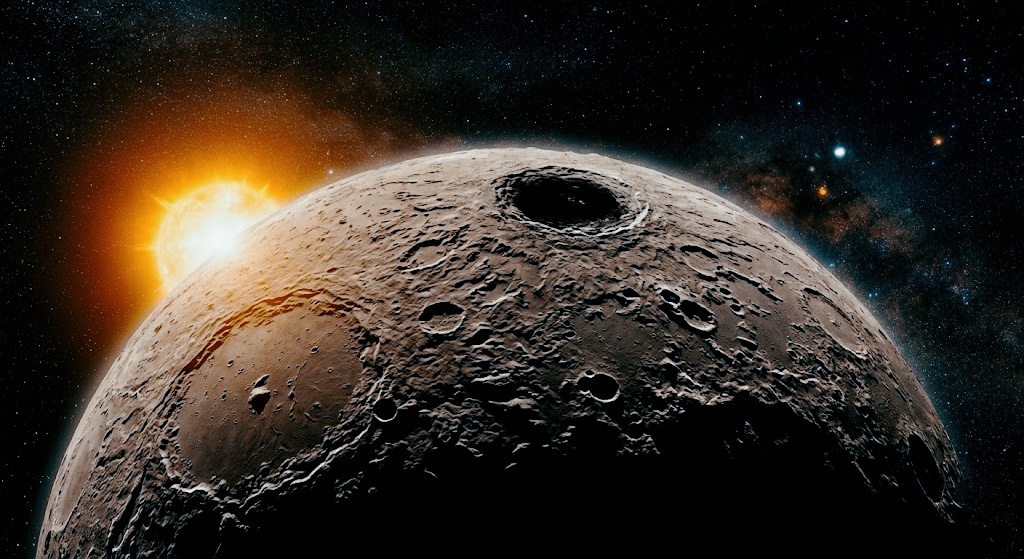
The analysis of lunar regolith samples collected by the Chang’e-5 mission has revealed crucial space weathering processes operating at the micro- and nanoscale. By examining impact glass particles, researchers demonstrated how solar wind irradiation and micrometeorite impacts continuously alter the structural and chemical properties of the lunar surface. These nanoscale discoveries provide vital benchmarks for interpreting remote-sensing data from the Moon and other airless celestial bodies.
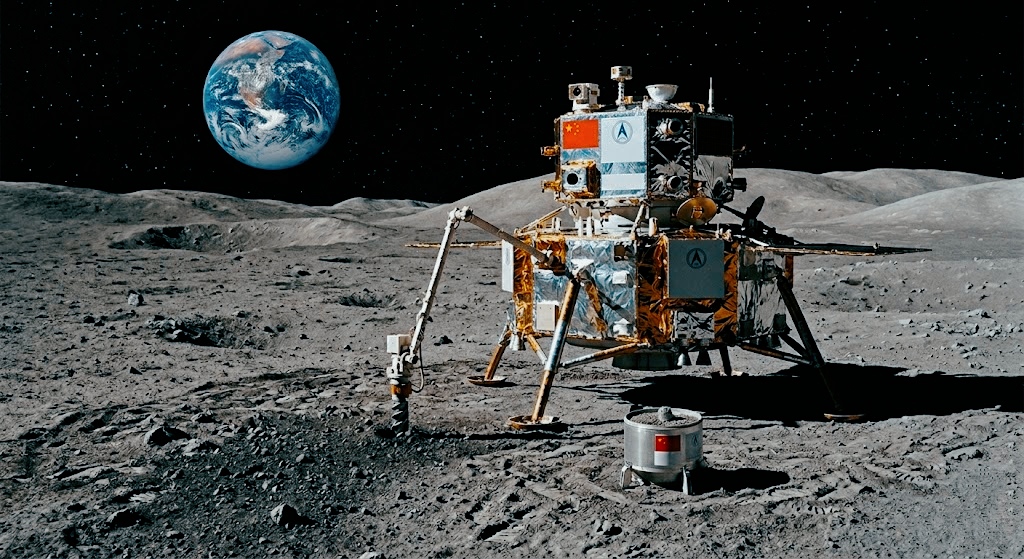
The absence of an atmosphere on the Moon eliminates biological activity, weather systems, and significant wind erosion, creating an environment where the lunar regolith serves as a pristine, long-term archive of surface processes. Atmospheric-free celestial bodies are constantly altered by space weathering, which shifts their composition, structure, and optical properties. Understanding these alterations at the micro- and nanoscale is essential for interpreting remote-sensing data and identifying potential surface resources.
To explore these mechanisms, a collaborative team led by Professor Yin Zongjun from the Nanjing Institute of Geology and Palaeontology, alongside Professors Shen Bing and Zhou Jihan from Peking University, conducted a systematic analysis of impact glass particles retrieved by the Chang’e-5 mission.
Deciphering lunar history: Nanoscale evolution in Chang’e-5 impact glass
The research team examined the Chang’e-5 impact glass using aberration-corrected transmission electron microscopy, scanning transmission electron microscopy, and advanced spectroscopic techniques. This investigation revealed iron-rich nanodroplets embedded within silicon-rich glass, alongside silicon-rich nanodroplets located within iron-rich glass domains. These nanodroplets displayed an amorphous, non-crystalline structure and were arranged in clusters that had undergone partial fusion and enlargement.
Such structural features suggest that micrometeorite impacts do more than simply induce localized melting within the lunar regolith. These high-energy events are capable of triggering silicate liquid immiscibility across extraordinarily brief timescales. The subsequent rapid cooling rate quenches the material, preserving the transient, phase-separated structures before the distinct chemical components can recombine or fully separate.
This dual-process evolution highlights how the Chang’e-5 samples record complex thermal and chemical transitions. The preservation of these amorphous nanodroplets offers direct evidence of the violent, high-temperature dynamics that shape the lunar surface during impact events. By capturing these fleeting states, the glass acts as a natural laboratory, documenting physical conditions that are difficult to replicate in terrestrial settings.
Nanophase iron distribution and three-dimensional quantification
Building upon the observation of phase separation, the study turned its focus to nanophase metallic iron, which represents a primary product of space weathering. Nanophase iron is highly significant because it alters the reflectance spectra of lunar soils, complicating remote-sensing interpretations. Using electron tomography combined with energy-dispersive X-ray spectroscopy and electron energy loss spectroscopy, the researchers successfully mapped the three-dimensional distribution, morphology, and valence states of this metallic iron.
Within a single reconstructed volume, the team identified 1,506 individual metallic iron particles, which exhibited a mean diameter of approximately 3.4 nanometers and a median diameter of 2.9 nanometers. Different structural layers within the glass contained distinct particle sizes, number densities, and volume fractions. Notably, the local volume fraction of metallic iron within a specific layer composed of larger particles reached as high as 30 percent.
To evaluate how these nanoparticles developed across different regions, the researchers combined structural reconstructions with elemental and iron valence analyses. They introduced a specific parameter, denoted as $\xi$, to quantify the contribution of external electrons during the reduction of iron. The results indicated that the metallic iron content in mature impact glass domains could reach up to 7.1 percent by weight, a value that significantly exceeds previous estimates for bulk Chang’e-5 soil samples and demonstrates profound nanoscale heterogeneity.
Chemical pathways and the reconstruction of space weathering
The integration of structural and chemical data allowed the researchers to isolate the specific mechanisms driving nanoparticle formation. They demonstrated that a sulfur-rich layer, characterized by large and irregularly shaped particles, originated primarily from the thermal decomposition of iron sulfide. Conversely, distinct layers containing high concentrations of smaller nanoparticles were produced through the disproportionation of divalent iron, a process in which the iron ions are simultaneously oxidized and reduced.
The region closest to the sample surface exhibited clear evidence of secondary modifications caused by solar wind irradiation. This continuous bombardment altered the underlying glass framework and promoted the structural maturation of the metallic iron particles. Consequently, the single sample of Chang’e-5 impact glass records a sequence of overprinting events, including impact melting, silicate liquid immiscibility, redox reactions, sulfide decomposition, and solar wind modification.
By utilizing high-resolution electron tomography and spectroscopy, the team bypassed the limitations inherent in conventional two-dimensional imaging. This approach enabled the quantitative reconstruction of three-dimensional nanostructures and the chronology of their formation. These sample-based insights advance the understanding of spectral evolution on airless bodies, clarify the origin of lunar impact glasses, and map the physical state of iron resources on the Moon.
The results of the study were published in the Journal of Geophysical Research: Planets and PNAS.