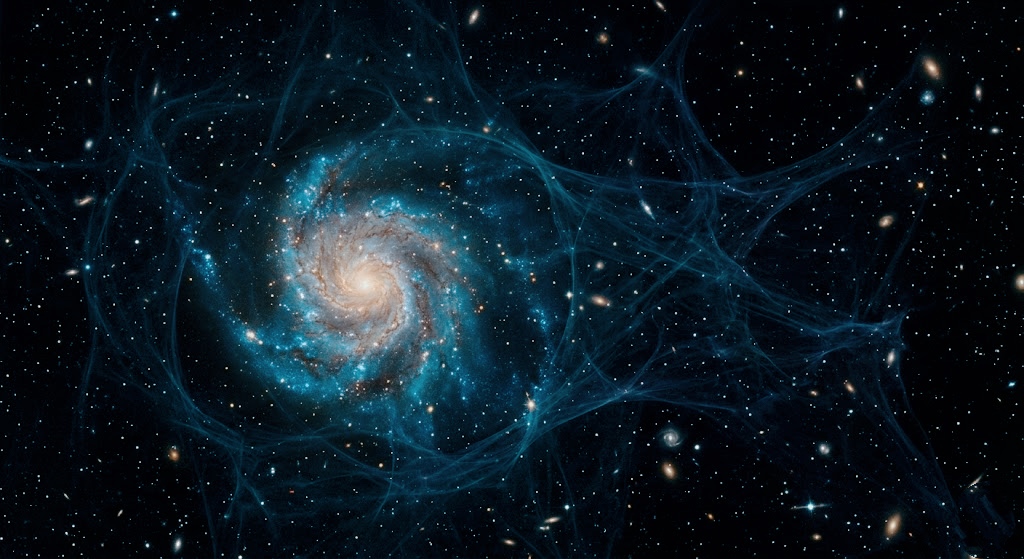
Dark matter represents an elusive form of matter that rarely emits, absorbs, or reflects light, interacting only weakly with ordinary matter. These unique properties make it exceptionally difficult to detect utilizing conventional experimental techniques and instruments, prompting innovative theoretical research to understand its fundamental nature.
Indirect deductions and the classical wave paradigm
Over the past few decades, physicists have indirectly deduced the existence of dark matter by studying its gravitational influence on stars, galaxies, and other cosmological objects. Because it has never been directly observed, the exact composition and precise nature of dark matter remain entirely unknown to modern science. One highly promising hypothetical dark matter particle is the axion, an ultralight particle that is predicted to be immensely abundant throughout the universe. The vast majority of existing scientific studies describe axions as a classical field, treating them as a wave-like entity that closely resembles a standard electromagnetic field.
Researchers from the University of Chicago, the Lawrence Berkeley National Laboratory, and UC Berkeley recently conducted a study to evaluate the validity of treating axionic dark matter as a classical field. Their research compared established classical axion detection theories with an advanced theoretical framework firmly rooted in quantum mechanics. The resulting paper suggests that while axionic dark matter may possess hidden quantum properties, distinguishing these features from classical effects is virtually impossible with the experimental instruments currently available.
Rapid progress has been recorded in utilizing cutting-edge quantum technologies to construct highly sensitive detectors for dark matter searches. However, as noted by co-author Lian-Tao Wang in an interview with Phys.org, quantum mechanics has not traditionally been used for the description of the dark matter itself. This lack of quantum modeling is particularly true for the axion, despite it being an extremely promising candidate for dark matter. Wang and his colleagues specifically sought to establish whether the classical treatment of axions was genuinely valid from a rigorous theoretical perspective.
Quantum detection models and experimental suppression
To answer this fundamental question, the research team directly compared models viewing axions as a classical field against a representation based entirely on quantum mechanics. Axionic dark matter interacts extremely weakly with experimental instruments, but it remains potentially detectable due to the incredibly high number of axions present. The physicists demonstrated that the inherently quantum effects of the axion are penalized by its weak interaction and are not amplified by its vast numerical abundance, manifesting only as tiny variations in the higher-order statistics of the detector.
As a core part of their study, the researchers successfully developed a novel model for dark matter detection via axions that is entirely based on the laws of quantum mechanics. They subsequently performed several complex calculations aimed at determining whether real-world experiments could successfully distinguish the quantum states of axions from classical states. Overall, their calculations suggest that even if axions exist in true quantum states, experimental detectors would almost always perceive them as behaving in a completely classical manner.
This observational limitation occurs because the quantum effects are heavily suppressed since the detector likely observes many similar axion waves that naturally average each other out. Furthermore, the exceptionally weak interaction of the axions with the detector tends to obscure these subtle quantum signatures. The recent work of Wang and his colleagues strongly suggests that models framing axions as a classical field function very well for current experimental purposes.
Dark matter: observability constraints and future research horizons
The study explicitly demonstrates that detecting the inherently quantum effects of axions is practically unrealizable with existing infrastructure. Even an optimally designed experiment would need to run significantly longer than the age of the universe to successfully detect such minuscule effects. There has been notable confusion within the scientific community regarding the precise meaning of intrinsic quantum effects and their actual observability in dark matter experiments, a point the team has now rigorously clarified.
The researchers were able to demonstrate mathematically that these intrinsic quantum effects will not be observable under realistic experimental conditions. Interestingly, a very similar reasoning applies to the detection of gravitational waves, highlighting a broader limitation in observing quantum states at cosmological scales. The fundamental ideas introduced by these researchers are also likely applicable to other ultralight dark matter candidates, broadening the impact of their theoretical framework.
In the future, the work completed by this team could contribute significantly to the introduction of novel techniques for detecting axions or other dark matter candidates. The authors are actively working to develop a comprehensive, end-to-end, and entirely quantum description of axion dark matter detection. Additionally, they would like to apply this new theoretical framework to the active search for novel quantum techniques within the broader field of dark matter research.
The study is published in Physical Review Letters.