The pursuit of human exploration on Mars represents one of the most ambitious endeavors in modern science, requiring radical shifts in how spacecraft generate and sustain velocity. While traditional chemical rockets have long served as the primary means of escaping Earth’s atmosphere, the transition to deep-space travel demands a more efficient and durable approach. NASA is currently spearheading the development of next-generation electric propulsion systems designed to bridge the gap between theoretical physics and the practical realities of a multi-year crewed mission.
Mars: the dawn of a new era in interplanetary travel
The experience of traveling aboard a vessel like the Odyssey involves a counterintuitive sensation of movement where the initial phase appears deceptively slow. Electric propulsion systems operate by accelerating ions to extreme speeds, creating a constant but gentle thrust that accumulates over time until the spacecraft reaches unprecedented velocities. Unlike the explosive burst of chemical engines, this method allows a ship to start at a walking pace and eventually surpass 400,000 kilometers per hour.
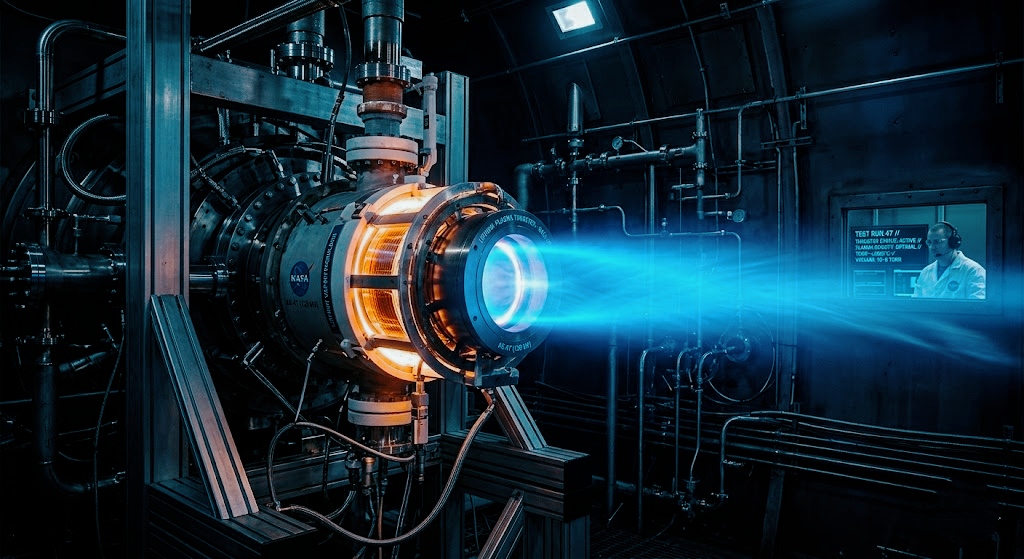
Recent milestones achieved by NASA engineers have demonstrated a propulsion system capable of reaching 120 kilowatts of power, utilizing lithium metal vapor as a revolutionary fuel source. This performance marks a significant leap forward in aerospace engineering, as the power output is estimated to be twenty-five times greater than that of the thrusters currently guiding the Psyche mission. This leap in power is essential for moving the massive amounts of hardware required for human survival.
James Polk, a senior researcher at the Jet Propulsion Laboratory, emphasizes that the successful testing of these thrusters is a pivotal moment for the agency. The demonstration proved that the design can not only function as intended but also hit the high-level power targets necessary for deep-space scaling. This success provides a reliable foundation for engineers to begin addressing the complexities of mass production for future interplanetary fleets.
Efficiency and thermal endurance in extreme environments
One of the primary advantages of this emerging technology is the extraordinary fuel economy it offers, potentially reducing propellant requirements by up to ninety percent compared to conventional chemical rockets. Such efficiency is vital for human missions, as it allows for a larger payload of life-support systems, food, and water without the prohibitive weight of traditional fuel. This mass reduction could be the deciding factor in making long-term exploration logistically feasible.
Furthermore, these new thrusters must exhibit immense physical resilience, as they are required to operate at temperatures exceeding 2800°C. Maintaining structural integrity under these extreme thermal conditions was a key focus of recent tests, where the hardware successfully withstood the heat. This durability ensures that the propulsion system can survive the harsh environment of space while maintaining consistent performance over thousands of hours.
To support a human crew, NASA estimates that a mission would require between two and four megawatts of power generated by a cluster of these thrusters. These units must be capable of running for over 23,000 hours of continuous operation to cover the vast distances involved. Achieving this level of longevity and heat resistance represents a monumental engineering feat that moves the Odyssey scenario closer to a reality.
Strategic timelines and the future of martian exploration
The logistical framework of a journey to the red planet is dictated by the orbital alignment of Earth and Mars, which creates a favorable launch window only once every two years. Because of these celestial mechanics, a standard human mission is projected to last approximately 2.6 years in total. This duration accounts for the time needed for the planets to realign properly to ensure a safe and fuel-efficient return journey to Earth.
A typical mission profile includes a transit phase of six to nine months to reach Mars, followed by a stay of roughly eighteen months on the surface. During this extended period, astronauts would conduct research and wait for the next planetary window to open. This timeline is currently the gold standard for mission planning, ensuring that the crew has the necessary astronomical positioning to navigate the void between worlds successfully.
While current robotic probes typically complete the one-way journey in seven months, the introduction of high-power electric propulsion could fundamentally alter these mission timelines. By achieving higher sustained speeds and requiring significantly less mass for fuel, these technological advancements provide more flexibility in mission architecture. Ultimately, the integration of such advanced propulsion systems brings the vision of a sustainable human presence on Mars into sharper focus.
The study is published in Universe Today.