What if a small robot, crawling across a dusty Martian crater, just handed us a chemistry lesson billions of years in the making? Welcome, dear reader. We’re thrilled you’ve stopped by FreeAstroScience.com today, where we break down hard science into clear, human language. In the next few minutes, we’ll walk you through what Curiosity has uncovered inside Gale Crater, why scientists can barely contain their excitement, and what it might mean for the oldest question we keep asking the stars: were we ever alone? Stay with us until the end. The payoff is worth it.
Curiosity’s 2026 Breakthrough Inside Gale Crater: The Chemistry That Made Us Stop Breathing
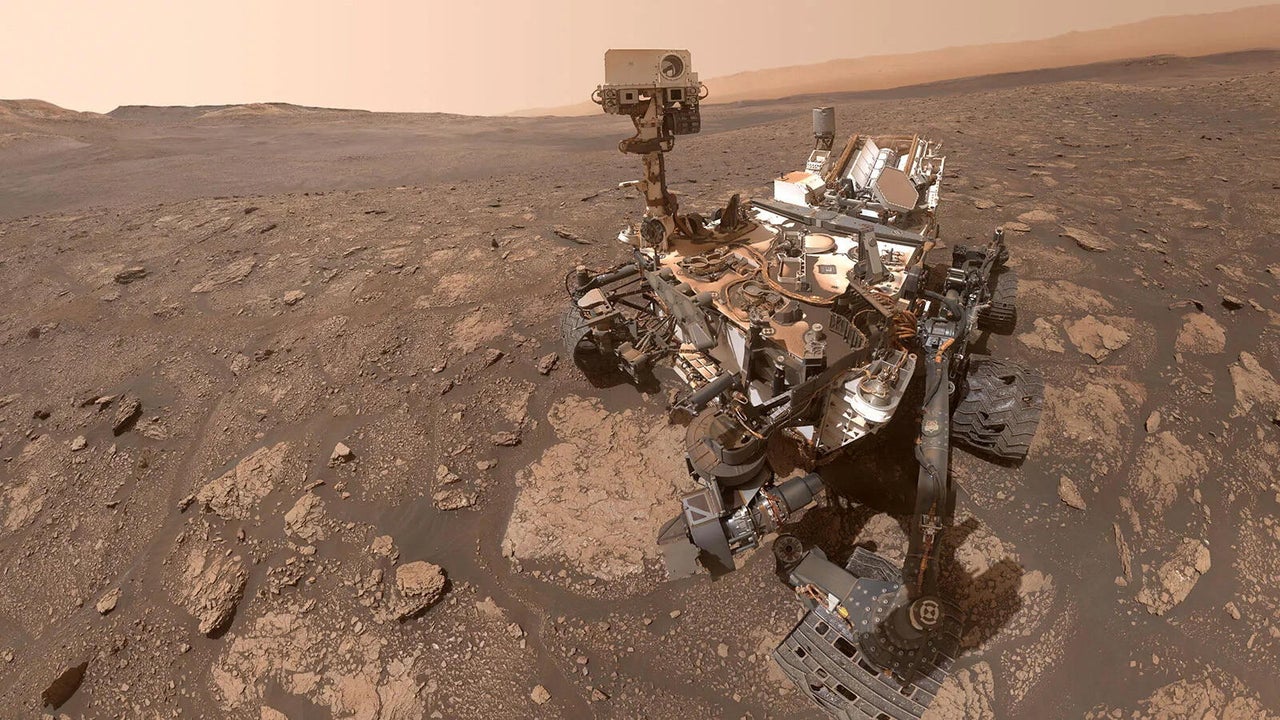
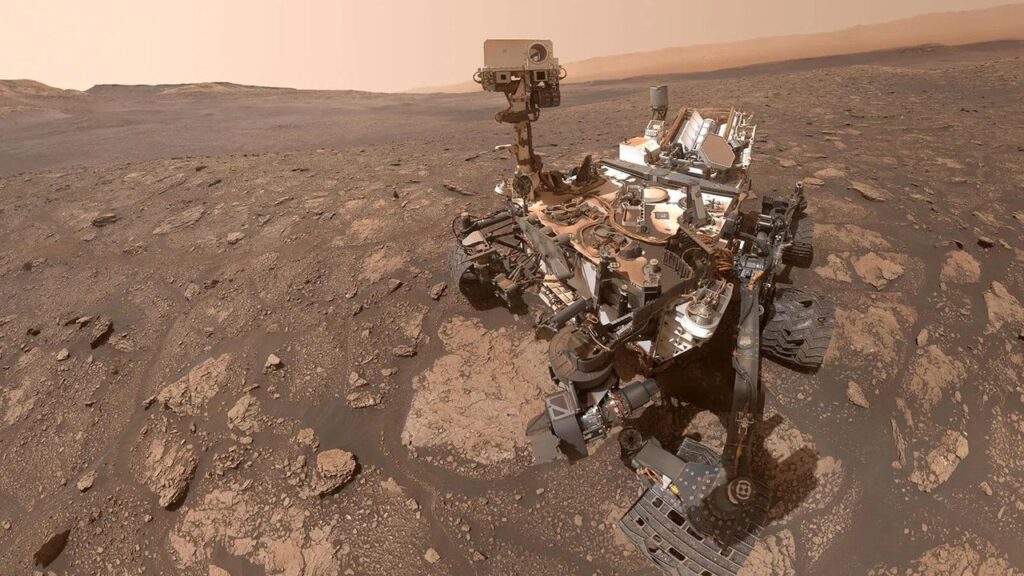
We’ll be honest. When we first read the Nature Communications paper published on April 21, 2026, our coffee went cold. The Curiosity rover, NASA’s nuclear-powered geologist on wheels, pulled off something nobody had done before on another planet. It ran a wet-chemistry experiment, and it worked. Twenty-plus organic molecules came tumbling out of a 3.5-billion-year-old rock.
We’re still catching our breath.
Why is Gale Crater such a special address on Mars?
Picture a bowl 154 kilometers wide, carved out by a meteorite about 3.7 billion years ago . That’s Gale Crater. In the middle sits Mount Sharp, a layered mountain that reads like a geology textbook stacked page by page.
Back when Mars was young, Gale wasn’t a dusty pit. Rivers fed a long-lasting lake inside it . Water seeped through the rocks for millions of years. Sand, silt, and clay piled up on the lakebed, trapping whatever floated by, including organic molecules.
Curiosity touched down here on August 6, 2012 . Ever since, the rover has climbed Mount Sharp one sedimentary layer at a time, reading Mars like an open diary.
What makes Glen Torridon the perfect hunting ground?
The 2020 drill target sat in a zone called Glen Torridon, rich in smectite clay . Clay matters. Its tiny mineral sheets act like a vault, shielding fragile organic molecules from radiation and chemical destruction. If Mars kept any chemical memories from its wet youth, clay is where they’d hide.
The specific rock Curiosity drilled is named Mary Anning, after the 19th-century English fossil hunter . A fitting tribute, we’d say.
What did the TMAH experiment actually do?
Here’s where things get juicy. Curiosity carries an onboard chemistry lab called SAM, short for Sample Analysis at Mars. Think of it as a miniature CSI kit .
SAM holds 74 single-use sample cups. Nine of those are reserved for “wet chemistry.” Two of those nine contain a reagent called tetramethylammonium hydroxide, or TMAH . Curiosity had never used one. Until now.
TMAH is a strong alkaline chemical. When heated with a rock sample, it does two things at once:
- It chops up big, stubborn organic macromolecules into smaller, readable fragments.
- It tags those fragments so they turn into gases the rover can actually detect .
Before this run, no one had ever performed wet chemistry on another world . The team had exactly two chances. They spent one on Mary Anning.
Which molecules did Curiosity sniff out?
The list reads like a chemistry exam from another planet. Benzothiophene, methyl benzoate, naphthalene, trimethylbenzene, tetramethylbenzene, methylnaphthalene, and dihydronaphthalene . Five of the seven confirmed molecules had never been spotted on Mars before .
Two finds stand out for us.
Benzothiophene — the sulfur survivor
This double-ringed aromatic molecule contains sulfur. It’s the largest confirmed aromatic organic molecule ever identified as native to Mars . Why does sulfur matter? Because sulfur acts like a chemical umbrella, shielding fragile organic structures from the radiation that bombards the Martian surface . The same molecule turns up in meteorites like Murchison and Tissint, which suggests shared cosmic plumbing between Earth and Mars .
The nitrogen heterocycle — a whisper of DNA
Here’s the line that made our jaw drop. The SAM instrument also detected a nitrogen-bearing molecule shaped like a methylated double-ring aromatic, consistent with a nitrogen heterocycle . These ring structures? They’re the same family of compounds that build the nucleobases inside DNA and RNA .
“That detection is pretty profound because these structures can be chemical precursors to more complex nitrogen-bearing molecules. Nitrogen heterocycles have never been found before on the Martian surface or confirmed in Martian meteorites.” — Amy Williams, University of Florida, lead author
Read that again. A precursor to the building blocks of genetic material, preserved in a Martian rock since the time Earth’s own earliest microbes were figuring out how to exist.
Does this mean life existed on Mars?
No. And we have to be honest with you here.
Williams and her team are careful, and rightly so. These organic molecules could have arrived on Mars in three ways :
- Meteorite delivery. Early Mars got pelted by carbon-rich space rocks, just like Earth did. Sixteen of the 28 species detected match molecules found in the Murchison meteorite .
- Abiotic geochemistry. Processes like serpentinization, where water reacts with certain minerals, can cook up organic molecules without any biology involved .
- Biology. Ancient microbes could have left these chemical signatures behind.
We can’t tell which story is true from this dataset alone.
“We cannot yet say that Mars ever harbored life, but our findings further support the evidence that Mars was a habitable world around the time that life on Earth originated.” — Amy Williams
What this discovery does prove is something quieter but still remarkable: Mars can preserve complex organic chemistry for 3.5 billion years . If biology ever existed there, its molecular fingerprints might still be readable today. That changes the math for every future mission.
What comes next for the hunt?
Curiosity has one TMAH cup left . The team is saving it for a target worth the gamble.
Meanwhile, the TMAH technique is graduating to the next class of explorers. Two missions will carry it forward:
- Rosalind Franklin rover (European Space Agency). Launch is now slated for 2028 . Its drill will reach roughly two meters underground, far deeper than Curiosity can go, where radiation damage is weaker and preservation is better.
- Dragonfly mission (NASA). A rotorcraft heading to Titan, Saturn’s hazy orange moon, where prebiotic chemistry may be running in real time .
The final verdict on Martian life, though, probably won’t come from a rover. It’ll come from rock samples returned to Earth, where our most sensitive instruments can examine them atom by atom . The Perseverance rover is caching those samples right now inside Jezero Crater, waiting for a ride home.
Why this story matters for the rest of us
We live on a warm, wet planet packed with life. Mars is a cold, dry museum of what could have been. Every molecule Curiosity finds adds a line to a story that started 4.5 billion years ago, when the Sun was younger and the inner solar system was wet, chaotic, and chemically alive.
If the same meteorites that seeded Earth’s chemistry also seeded Mars , then our origin story isn’t just an Earth story. It’s a solar system story. And we’re the ones lucky enough to finally read it.
—
## A Final Thought From Us
This article was written specifically for you by FreeAstroScience.com, where we break down complex scientific principles into plain, friendly language. We believe the best gift we can give you isn’t an answer. It’s the habit of asking better questions.
Curiosity’s Mary Anning experiment didn’t hand us proof of alien life. It handed us something more valuable: proof that the chemical memory of another world is still intact, waiting to be read. The rock kept its secrets for 3.5 billion years. We cracked the first pages open in a single experiment. That’s worth a pause.
At FreeAstroScience, we keep reminding you: never switch off your mind. Keep it awake, keep it curious, keep it questioning. As Goya warned us, the sleep of reason breeds monsters. A thinking reader is a free reader.
Come back soon. There’s more sky to read, and we’d love to read it with you.
— Gerd Dani, for FreeAstroScience.com
—
📚 Sources & Further Reading
- Williams, A. J. et al. Diverse organic molecules on Mars revealed by the first SAM TMAH experiment. Nature Communications 17, 2748 (2026). https://doi.org/10.1038/s41467-026-70656-0
- Deutsche Welle — NASA’s Mars rover finds new organic matter in crater (Apr 21, 2026)
- Universe Today — MSL Curiosity Found New Organic Chemicals On Mars (Apr 22, 2026)
- Scientific Inquirer — Curiosity Rover and a Chemical Treasure Chest on Mars
- Brightcast News — Curiosity Rover Just Found the Building Blocks
- NASA Science — A Guide to Gale Crater
- Mid-Day — Curiosity finds diverse organics in Gale Crater