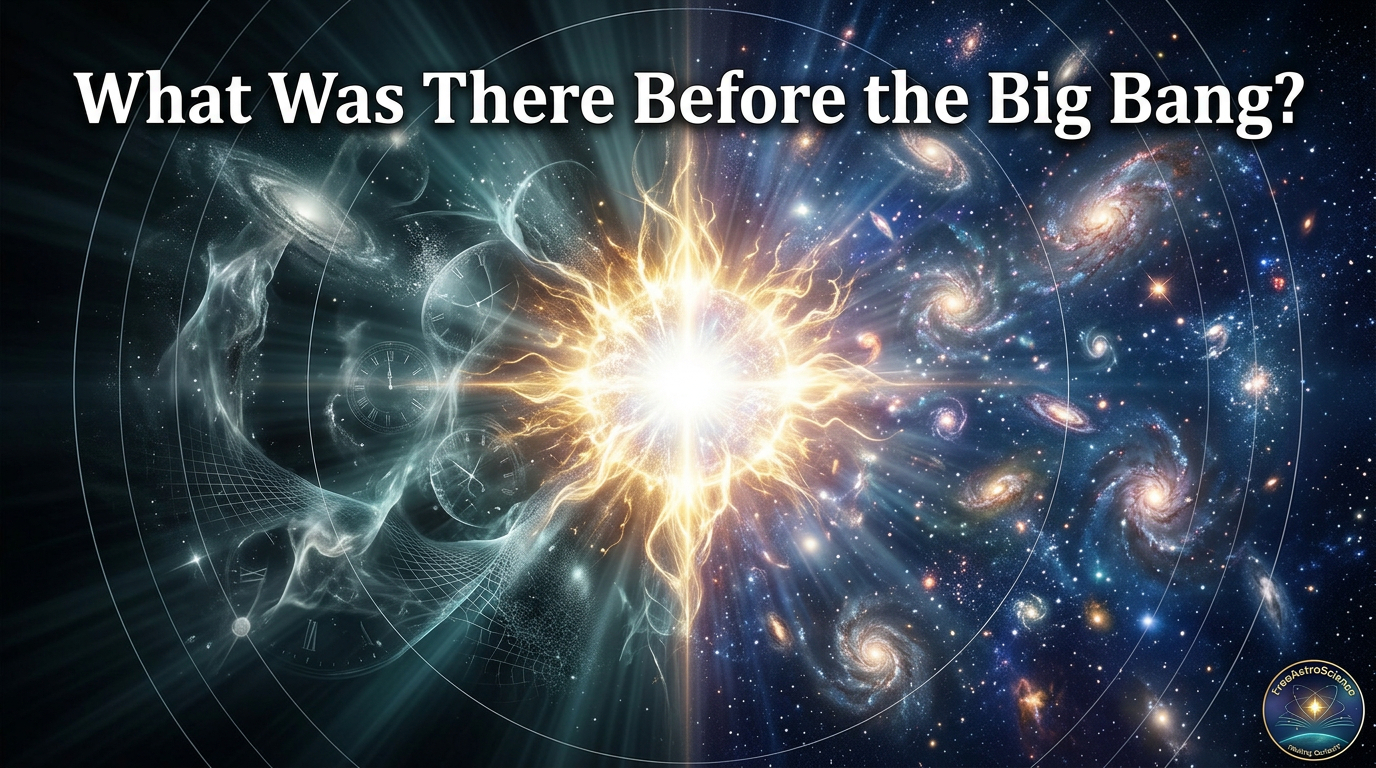
Have you ever looked up at the stars and asked yourself — not just what’s out there, but what came before all of it? Before the galaxies, before the atoms, before time itself began ticking?
Welcome to FreeAstroScience, where we take the biggest questions in the cosmos and break them down into language anyone can enjoy. Today, we’re going after one of the most staggering puzzles ever posed by science: what was there before the Big Bang? It’s a question that haunts physicists, keeps philosophers up at night, and frankly, should spark curiosity in every single one of us.
We’ve gathered the latest thinking from some of the sharpest minds in cosmology — Sean Carroll, Stephen Hawking, Roger Penrose, Paul Steinhardt, and others — so you can see where the science actually stands in 2026. Stay with us to the very end. We promise you won’t look at the night sky the same way again.
📖 Table of Contents
- What Exactly Was the Big Bang?
- How Did the First Matter Appear from Nothing?
- Cosmic Inflation: The Prologue to the Big Bang?
- What Are the Leading Theories About “Before”?
- Hawking’s No-Boundary Proposal — There Is No “Before”
- The Big Bounce — A Cyclical Universe That Keeps Restarting
- The Mirror Universe — Time Running Backward
- Two-Headed Time — The Arrow Points Both Ways
- Penrose’s Conformal Cyclic Cosmology — Cold Death to Hot Rebirth
- Baby Universes — Could We Be a Cosmic Offspring?
- Can We Ever Test These Ideas?
- Why This Question Still Matters
Before Space, Time, and Everything: What Science Actually Tells Us
The short answer? We don’t know. The longer answer? There are several brilliant, sometimes mind-bending theories that push our understanding of physics to its absolute edge. Let’s walk through them together — one step at a time.
What Exactly Was the Big Bang?
Let’s clear up a popular misconception right away. The Big Bang wasn’t an explosion like a firecracker going off in empty space. There was no empty space for it to explode into.
“The Big Bang is a moment in time, not a point in space,” explains Sean Carroll, a theoretical physicist at the California Institute of Technology . About 13.82 billion years ago, matter, energy, space — and time itself — erupted into being . Everything we observe today — a sphere roughly 93 billion light-years across, holding at least 2 trillion galaxies — was once compressed into a region smaller than a centimeter .
But here’s what most people miss. The universe didn’t expand into something. Space is the universe, and it stretched along with everything else . There was no “outside.” No empty void watching from the sidelines. Astronomy books sometimes compare the cosmos to a rising cake with raisins (galaxies) drifting apart. But unlike a cake, the universe may have no edge at all .
“No matter where you are in the universe, if you go back 14 billion years, you arrive at a point where everything was extremely hot, dense, and rapidly expanding,” Carroll has said .
So when we ask “what came before the Big Bang?” — we’re really asking: what came before time itself?
How Did the First Matter Appear from Nothing?
If we’re talking about stable atoms and molecules — the stuff you and we are made of — none of that existed at the Big Bang. Not for hundreds of thousands of years afterward .
The first long-lived matter particles, protons and neutrons, showed up about one ten-thousandth of a second after the Big Bang . Before that? A chaotic soup of short-lived elementary particles, including quarks (the building blocks of protons and neutrons), alongside their antimatter counterparts. Matter and antimatter were created and destroyed in roughly equal amounts, annihilating each other in bursts of energy .
The Quantum Vacuum — Something from Almost Nothing?
So where did even those fleeting particles come from?
Quantum field theory offers a surprising answer. Even what we call a vacuum — supposedly empty space — is alive with activity . Energy fluctuations constantly produce particles that pop into existence and vanish almost instantly. These aren’t just theoretical curiosities; scientists have confirmed them in countless experiments .
This might sound like getting something from nothing. But philosopher David Albert has pointed out that a quantum vacuum isn’t really “nothing” — it’s a something with very specific physical properties . The question stays open: where did spacetime itself originate?
The Planck Epoch — Where All Known Physics Fails
Wind the clock back far enough, and we reach the Planck epoch. This was the first sliver of time after the Big Bang — so brief it’s almost beyond description. We’re talking one ten-millionth of a trillionth of a trillionth of a trillionth of a second .
The boundary of this era is defined by the Planck time, a fundamental constant of nature:
Planck Time
tP = √( ℏ G ⁄ c5 ) ≈ 5.39 × 10−44 s
Where ℏ is the reduced Planck constant, G is Newton’s gravitational constant, and c is the speed of light. This is the smallest meaningful unit of time in physics — roughly 10−44 seconds.
At this point, space and time themselves become subject to quantum fluctuations. Our two greatest physics frameworks — quantum mechanics (for the very small) and general relativity (for the very large) — both apply, but they refuse to cooperate . We need a complete theory of quantum gravity to understand what was happening. We don’t have one yet .
The best candidates — string theory and loop quantum gravity — suggest that ordinary space and time are emergent. Think of waves on the surface of a deep ocean . What we experience as spacetime might be the product of quantum processes operating at a level we can barely wrap our heads around.
“We don’t know what we’re looking for,” Carroll has admitted, “and we won’t until we have a theory” .
Cosmic Inflation: The Prologue to the Big Bang?
One of the leading ideas about the moments just before the Big Bang is cosmic inflation — a theory developed around 1980 by physicists Alan Guth, Alexei Starobinsky, Andrei Linde, and Katsuhiko Sato .
The idea? Before the hot, dense conditions of the Big Bang appeared, the universe went through a breathtaking expansion. It doubled in size at least 80 times in less than a trillionth of a second .
University at Buffalo physicist Will Kinney puts it this way in his book An Infinity of Worlds: imagine a chessboard. Place one penny on the first square, two on the next, four on the next. By the 28th square, you’re a millionaire. By the 38th, a billionaire. Fill all 64 squares, and you’re a trillionaire thousands of times over. Inflation involved at least 80 such doublings .
This rapid inflation was fueled by a mysterious form of energy that filled empty space. When the doubling stopped, that energy transformed into particles of matter and radiation — flooding space with the superhot plasma we call the Big Bang .
Physicists sometimes call inflation the “ultimate free lunch” . When the inflationary vacuum doubled its volume, it doubled its energy too. Like banknotes that multiply when you pull a stack apart. To kick-start the whole process, all you needed was a chunk of inflationary vacuum weighing about one kilogram. And quantum theory says that can pop into existence from nothing .
But here’s the catch. Inflation is also a great eraser. “Any trace of the initial conditions of how it got started get diluted because of this exponentially large expansion,” Kinney says . Whatever came before inflation may be forever hidden from us.
That’s both humbling and frustrating. The very mechanism that explains our universe’s smoothness and structure may also be the reason we can’t peek behind the curtain.
What Are the Leading Theories About “Before”?
Scientists don’t agree on a single answer. But several bold theories have earned serious attention. Let’s walk through each one.
Hawking’s No-Boundary Proposal — There Is No “Before”
Stephen Hawking and James Hartle tackled this question in the 1980s and arrived at a radical answer: there was no “before.”
Their no-boundary proposal suggests that time and space form a closed, rounded surface — a four-dimensional hemisphere of spacetime . Picture Earth’s globe. The Big Bang is the North Pole. There’s no point north of the North Pole. “Before” simply loses all meaning.
“It’s almost like a Zen idea,” says Jean-Luc Lehners, former head of the Theoretical Cosmology group at the Max Planck Institute .
Carroll has noted that the proposal “has a decent amount of support, or at least interest, within the physics community” and considers it “a natural starting point” given what we know about quantum gravity .
Hawking himself once put it with characteristic bluntness: “Since events before the Big Bang have no observational consequences, one may as well cut them out of the theory and say that time began at the Big Bang” .
Not everyone is satisfied with that answer, of course. Many physicists believe there’s something worth investigating beyond that boundary — even if Hawking thought looking was pointless.
The Big Bounce — A Cyclical Universe That Keeps Restarting
What if the Big Bang wasn’t a beginning at all, but a transition?
Paul Steinhardt, a physicist at Princeton University, proposes a cyclic universe: one that expands significantly, then contracts a little, then starts expanding all over again . The fast transition between contraction and expansion isn’t really a “bang” — it’s a “big bounce.”
“When people think about contracting universes, they’re usually thinking about things coming to a crunch,” Steinhardt says. But that’s not what he’s describing. The universe perhaps shrinks to a smaller fraction of its size — not to nothing. That slow shrinking smooths things out in ways inflation theory struggles to explain .
Here’s the really exciting part. “Nothing bad happens to space” during the contraction and bounce . Information — even objects like black holes — might survive from one cycle to the next. “There might be things in our observable universe which are from before,” Steinhardt says .
Professor Henry Tye from Cornell University has taken this even further. Using results from the Dark Energy Survey (DES) and the Dark Energy Spectroscopic Instrument (DESI), his team suggests dark energy might not be constant after all . If their model is correct — with a negative cosmological constant and axion-driven expansion — the universe’s growth could eventually reverse.
“The Universe’s expansion is still accelerating now in our theory,” says Dr. Hoang Nhan from Donostia International Physics Centre. “The expansion only slows down when the ‘crunching’ phase starts, which may happen in the next 11 billion years, followed by a Big Crunch around eight billion years afterwards” .
A universe that breathes — expanding and contracting over cosmic cycles. It’s an ancient idea dressed in 21st-century mathematics.
The Mirror Universe — Time Running Backward on the Other Side
This one sounds like science fiction. It isn’t.
Latham Boyle, a researcher at the Higgs Center for Theoretical Physics at the University of Edinburgh, proposes a CPT-symmetric universe (charge-parity-time-symmetric) . The concept is simple to picture.
Imagine two ice cream cones touching at their tips. The contact point is the Big Bang. On our side, time flows forward. On the mirror side, it flows backward .
“There’s the universe after the Big Bang and the universe before the Big Bang,” Boyle says, “and they’re kind of mirror copies of one another” .
And it’s not just time that’s flipped. On the other side, there’s antimatter where we have matter. Left becomes right. The asymmetries in molecules and particles — called chirality — would have opposite orientations .
What makes this theory special? It makes testable predictions. A CPT-symmetric universe wouldn’t produce the primordial gravitational waves that classical cosmology predicts . If astronomers detect those waves, Boyle’s idea is ruled out. The theory also predicts that dark matter could be explained by a specific type of neutrino .
“What I like here is the economy,” cosmologist Brian Keating has said about the idea .
Two-Headed Time — The Arrow Points Both Ways
Sean Carroll and Alan Guth, the pioneering cosmologist at MIT, developed a model called Two-Headed Time .
In their picture, time has existed forever. The evolution of the cosmos is symmetric around the Big Bang. Before it, the universe was contracting. It reached a minimum size at t = 0 and has been expanding since . Think of a Slinky falling to the floor — maximum compression on impact, then a bounce back upward.
The key insight ties into entropy, the measure of disorder. Smaller spaces tend to have more order. So the order of the universe peaked at the Big Bang. Disorder increased in both directions — before and after .
Since the arrow of time points from order toward disorder, the future points away from the Big Bang in two directions. If you picture time as a long road and the Big Bang as a pothole, a sign at that pothole would show two arrows pointing opposite ways .
“When I came to understand that the reason I can remember the past but not the future is ultimately related to conditions at the Big Bang, that was a startling epiphany,” Carroll has said .
A person living in the contracting phase would also see the Big Bang in their past. Time, for them, would run in the opposite direction from ours . Near the Big Bang itself, time would have no clear direction at all — shards of glass would assemble into goblets as often as goblets would shatter.
Penrose’s Conformal Cyclic Cosmology — From Cold Death to Hot Rebirth
Nobel Prize-winning physicist Roger Penrose (2020 Nobel in Physics) offered one of the most stunning proposals in modern cosmology .
His theory — conformal cyclic cosmology (CCC) — starts with a striking observation. The extremely cold, empty, expanded state of the universe in the far future turns out to be mathematically related to the extremely hot, dense, small state at the Big Bang .
How? Through a mathematical technique called conformal rescaling — a geometric transformation that changes the size of an object but preserves its shape . In the extreme environments at the death and birth of a universe, Penrose argues, size as a concept ceases to make sense. Time does too .
So the death of one universe gives rise to the next. A total absence of matter — a void after every last black hole has evaporated into faint glimmers of light — somehow produces all the matter we see around us .
The Big Bang arises from almost nothing. That cold, empty cosmos, viewed from a different physical perspective, is as close to nothing as physics allows. But that nothing is still a kind of something — a physical universe, even if an empty one .
It’s a beautiful and deeply counterintuitive idea. The end is the beginning. The beginning is the end.
Baby Universes — Could We Be a Cosmic Offspring?
In 2004, Sean Carroll and physicist Jennifer Chen proposed yet another possibility: our universe might be the offspring of a parent universe .
The analogy? Radioactive decay. When a nucleus decays, it emits a particle. A parent universe could do the same thing — except instead of emitting particles, it emits entirely new baby universes, perhaps infinitely .
“A quantum fluctuation would allow this to happen,” Carroll explained . These universes would be parallel and would never interact with or influence each other .
If cosmic inflation is correct, our universe may be just one bubble among a possibly infinite number of bubble universes in an ever-expanding inflationary vacuum . Physicist Will Kinney borrowed the title of his book — An Infinity of Worlds — from the 16th-century visionary Giordano Bruno, who wrote: “God is infinite, so His universe must be too… not in a single earth, a single world, but in a thousand thousand, I say in an infinity of worlds” .
We might be one world among countless others. That’s a thought big enough to keep you awake tonight.
Comparing the Leading “Before the Big Bang” Theories
| Theory | Key Idea | Proposed By | Testable? |
|---|---|---|---|
| No-Boundary Proposal | There is no “before.” Time and space form a closed surface with no starting point — like there’s no north of the North Pole. | Stephen Hawking & James Hartle (1983) | Indirectly |
| Big Bounce / Cyclic Universe | The universe contracts and expands in repeated cycles. The Big Bang is a “bounce,” not a beginning. | Paul Steinhardt & Neil Turok; Henry Tye | Yes — dark energy evolution |
| Mirror (CPT-Symmetric) Universe | A mirror copy of our universe exists on the other side of the Big Bang, with time, matter, and chirality all reversed. | Latham Boyle, Kieran Finn & Neil Turok | Yes — gravitational waves, neutrinos |
| Two-Headed Time | Time extends forever in both directions from the Big Bang. The arrow of time points away from t = 0 on each side. | Sean Carroll & Alan Guth | Indirectly |
| Conformal Cyclic Cosmology | A cold, empty, dying universe is mathematically identical to the hot, dense state of a new Big Bang. | Roger Penrose (2020 Nobel Laureate) | Under investigation — CMB anomalies |
| Baby Universes / Multiverse | Our universe “budded off” from a parent universe through quantum fluctuations, like radioactive decay emitting particles. | Sean Carroll & Jennifer Chen (2004) | Extremely difficult |
Table: FreeAstroScience.com — Data compiled from leading cosmological sources, April 2026.
Can We Ever Test These Ideas?
This is the question that separates physics from philosophy.
“I’m happy to listen to any framework,” says cosmologist Brian Keating at the University of California, San Diego, “but I only start taking it seriously when it produces a clean observational target that a real instrument can go after. If there isn’t a discriminant you can measure, you’re doing metaphysics with equations” .
Fair point. So where do we actually stand?
Cosmic microwave background (CMB): Precision measurements of this ancient afterglow — the cooled remnant of the Big Bang’s heat, first discovered by radio astronomers in 1965 — have built strong support for cosmic inflation and eliminated several rival theories .
Gravitational waves: Since the first detection of gravitational waves from colliding black holes, a new window into the early universe has opened. If primordial gravitational waves are found, they’d rule out the CPT-symmetric mirror universe model — while confirming key predictions of standard cosmology .
Dark energy surveys: Projects like DESI and DES are mapping millions of galaxies, hunting for signs that dark energy has been changing over time . If dark energy is evolving, it supports the Big Bounce scenario and Tye’s axion-based model.
Neutrino observations: Boyle’s mirror universe predicts a specific type of neutrino that could explain dark matter. Future instruments may confirm or deny this .
Not all theories are equally testable. Steinhardt’s cyclic model predicts that the current cosmic acceleration “must end” — and it might already be ending . If detected, that would be a paradigm shift. On the other hand, if cosmic inflation is correct, it may have erased every trace of what came before . Some answers might simply lie beyond our reach.
And that’s an honest admission. As Will Kinney writes: “It’s just basic honesty. You’re telling the truth. I think that hyping speculative things undermines people’s faith in science as a rigorous undertaking” .
Why This Question Still Matters
We may never get a definitive answer. And that’s okay.
The search itself is what pushes science forward. Each theory on this list — whether it involves bouncing universes, mirror worlds, or time with two heads — sharpens our understanding of the cosmos and pushes us toward the theory of quantum gravity that physics so desperately needs.
As physicist Sean Carroll has told Alan Lightman: “I strongly believe that the low entropy of the early universe is a puzzle that the wider cosmology community doesn’t take nearly as seriously as they should. Misunderstandings like that offer opportunities for making new breakthroughs” .
The question of “before” isn’t academic trivia. It connects to the deepest problems in physics: the nature of time, the origin of matter, the fate of everything. It connects to us — creatures made of stardust, asking where the stars themselves came from.
Our Final Thoughts
So what was there before the Big Bang? Honest answer: we don’t know yet. But we have ideas — bold, beautiful, sometimes strange ideas backed by mathematics and, increasingly, by real-world observations.
Maybe the universe bounced from a prior contraction. Maybe it mirrors itself across time, with an antimatter twin running backward on the other side. Maybe the Big Bang is the North Pole of a closed spacetime sphere, and “before” is a word that simply doesn’t apply. Maybe a dying cosmos gave birth to ours through a trick of geometry that Penrose calls conformal rescaling. Or maybe — just maybe — we’re one baby universe among an infinity of others, budded off from a parent cosmos we’ll never see.
Each of these possibilities stretches our understanding of reality to its breaking point. That’s exactly where discovery happens.
This article was written for you by FreeAstroScience.com, where we explain complex scientific principles in simple terms — because we believe knowledge should never be locked behind jargon or paywalls. At FreeAstroScience, we seek to educate you to never turn off your mind, to keep it active and questioning at all times. Because, as Francisco Goya reminded us centuries ago, el sueño de la razón produce monstruos — the sleep of reason breeds monsters.
The universe is vast, and every answered question reveals ten new ones. Come back to FreeAstroScience.com soon. There’s always more to learn — and your curiosity is the most powerful telescope ever built.