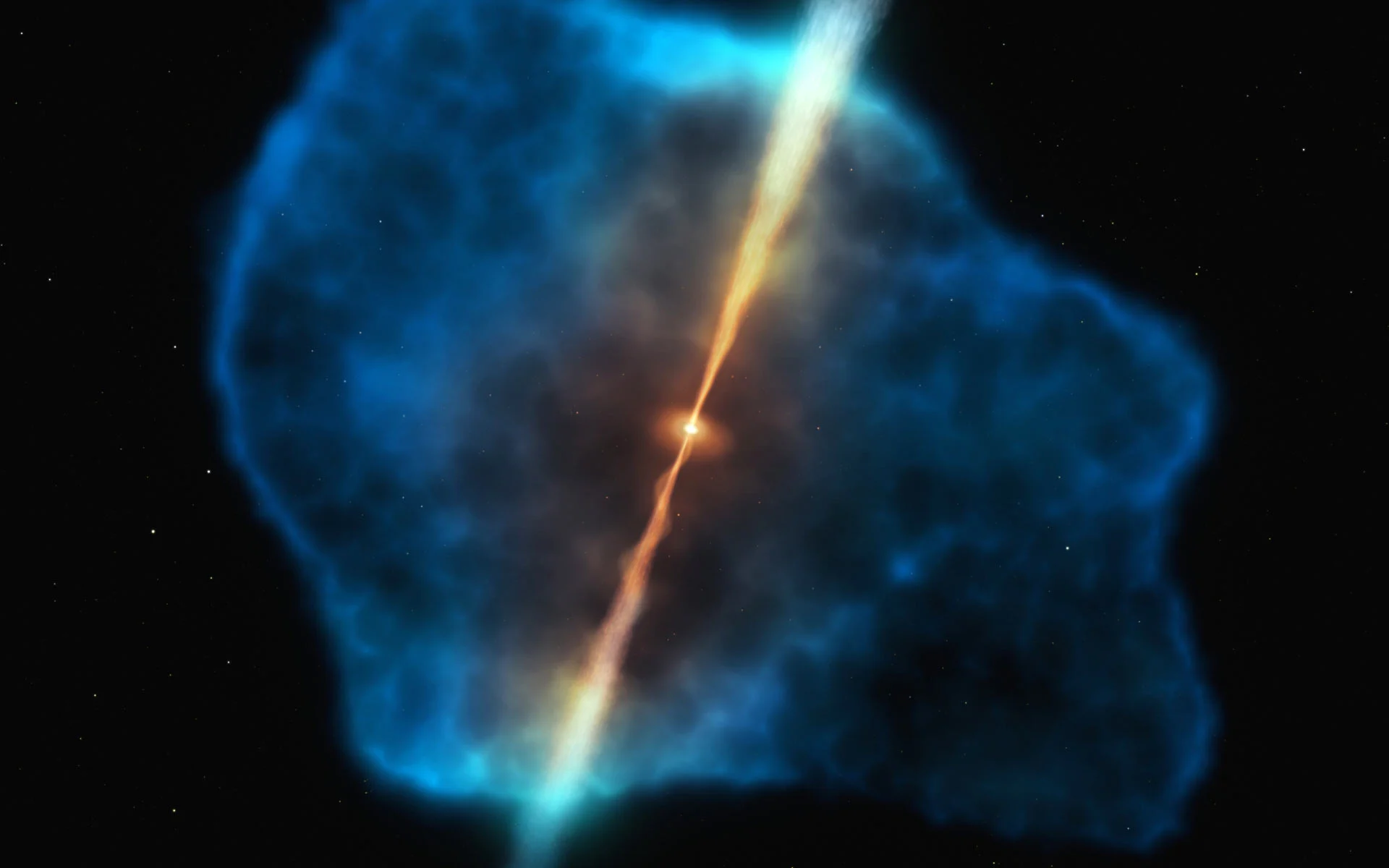
What if every newborn galaxy in the young universe wore a glowing hydrogen coat larger than a thousand Milky Ways stitched together?
Welcome, dear reader. You’ve landed on FreeAstroScience, the corner of the internet where we take the biggest ideas in science and speak them plainly. We’re thrilled you’re here, because today’s story is a genuine leap forward. A single survey in Texas has cranked our map of the young cosmos up by a factor of ten. Stay with us to the final line. You’ll leave with a fresh picture of how galaxies grew up, and why this discovery matters for every one of us who has ever looked up at night and wondered.
How Did Baby Galaxies Hide Inside Giant Hydrogen Clouds?
📖 Table of Contents
- What on Earth Is a Hydrogen Halo?
- Why Had We Only Found 3,000 Before?
- How Did HETDEX Change the Game?
- What Do These Numbers Actually Mean?
- What Comes Next for Cosmic Dawn Research?
What on Earth Is a Hydrogen Halo?
Picture a firefly wrapped in fog. The fog gives off no light on its own. When the firefly flashes, though, the droplets catch the glow and shine back at us.
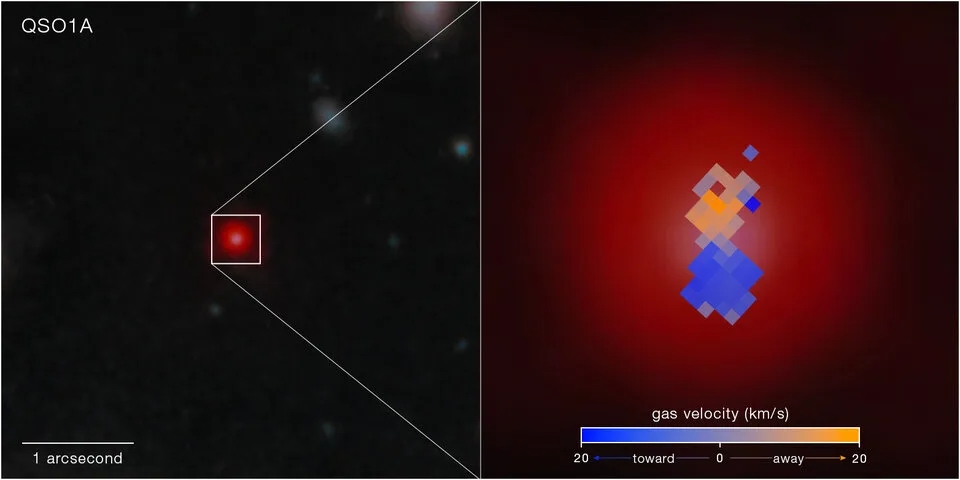
That’s roughly what a hydrogen halo does around an ancient galaxy. Neutral hydrogen drifts quietly through space, emitting nothing we can easily spot. Blast it with ultraviolet light from a galaxy full of hot young stars, and the gas lights up. Astronomers call these lit-up clouds Lyman-alpha nebulae.
Here’s why they matter. Big Bang cosmology and the LCDM model both predict that massive clouds of neutral hydrogen permeated the young universe. From this raw material, the first stars and galaxies assembled rapidly over several hundred eons—a period astronomers call Cosmic Dawn. If the theory holds, every young galaxy should sit inside a reservoir of hydrogen. The pantry that fed its formation.
Until this new study, we had caught only a few thousand of these halos. Nowhere near enough to say the model was right.
A Quick Word on the Light We’re Chasing
When a hydrogen electron drops from its second energy level to its first, it releases a photon at one very specific wavelength. That signal is the fingerprint astronomers chase across cosmic distances.
Lyman-alpha rest wavelength:
λrest = 121.6 nm (ultraviolet)
Observed wavelength after cosmic expansion:
λobserved = λrest × (1 + z)
where z is the redshift. For galaxies 10–12 billion years old, z ≈ 2 to 3, shifting the signal from UV into visible light our telescopes can grab.
Why Had We Only Found 3,000 Before?
Imagine hunting candle flames in a stadium at night, from a mile away. You’d spot the brightest ones. The rest? Lost in the dark.
Earlier surveys ran into that exact problem. Their instruments picked up only the loudest, most extreme halos. The medium and small ones slipped through. To make things worse, observations of early galaxies were so magnified to cut through foreground interference that only the tiniest halos stayed visible. So anything between “small and hard to see” and “huge and rare” stayed hidden from us.
For twenty years we stared at the same handful of examples. Three thousand halos total. A drop in the cosmic ocean.
“We’ve been analyzing the same handful of objects for the past 20 or so years.” — Erin Mentuch Cooper, HETDEX Data Manager
How Did HETDEX Change the Game?
Meet the hero of this story: the Hobby–Eberly Telescope Dark Energy Experiment, HETDEX for short. It sits at The University of Texas at Austin McDonald Observatory.
HETDEX started with a different mission. Its builders wanted to map over one million galaxies during a three-year run to measure the influence of dark energy. Along the way, it picked up signals its designers never chased directly: the faint glow of hydrogen halos, far dimmer than anything earlier surveys could detect.
Three things make HETDEX special:
- The Hobby-Eberly Telescope is one of the largest on Earth.
- Each observation produces 100,000 spectra at once.
- Researchers combine those spectra using a trick called stacking.
Stacking works a bit like photo averaging. Layer a thousand fuzzy images of the same subject and random noise cancels out, while the real signal builds up. Apply that to galaxy spectra and you can pull out features no single observation would ever reveal.
Of the 1.6 million early galaxies HETDEX has catalogued so far, Cooper’s team grabbed the 70,000 brightest. Then they handed the data to supercomputers at the Texas Advanced Computing Center (TACC) and told the machines to hunt for halos.
What the Numbers Actually Look Like
| Measurement | Previous Surveys | HETDEX Result |
|---|---|---|
| Hydrogen halos detected | ~3,000 | ~33,000 (10× jump) |
| Galaxies surveyed | Handful of bright cases | 70,000 analysed |
| Halo diameters | Only the extremes | Tens of thousands to hundreds of thousands of light-years |
| Sky area covered | Narrow fields | Over 2,000 full Moons |
| Data volume | Gigabytes | ~0.5 petabyte |
| Cosmic epoch probed | Scattered snapshots | 10–12 billion years ago |
What Do These Numbers Actually Mean?
Nearly half the 70,000 galaxies showed a hydrogen halo wrapped around them. Roughly 33,000 confirmed halos—ten times what we had before.
And these halos are anything but small. They stretch tens of thousands to hundreds of thousands of light-years across. For scale, our own Milky Way disk spans about 100,000 light-years. Some of these ancient halos could swallow an entire galaxy cluster without blinking.
“We’ve captured nearly half a petabyte of data on not only these galaxies but the regions in between. Our observations cover a region of the sky measuring over 2,000 full Moons. The scope is enormous and unprecedented.” — Karl Gebhardt, HETDEX Principal Investigator, chair of UT Austin’s astronomy department
Three takeaways land hard here:
- Hydrogen halos were not rare. They were standard equipment for early galaxies.
- Our Big Bang and LCDM models predicted exactly this kind of gas reservoir, and the data now backs them up with real statistics rather than guesswork.
- We finally have a representative sample. Not just the loudest few, but a genuine catalog of the ordinary young universe.
Cooper’s team offers one honest caveat. The faintest halos may be even bigger than they look, because the outer edges are too dim for current instruments to trace. So the real sizes could climb higher still. Science, as ever, leaves room for surprise.
What Comes Next for Cosmic Dawn Research?
The paper was published in The Astrophysical Journal, with Cooper and Gebhardt joined by researchers from the Institute for Gravitation and the Cosmos, the Kavli Institute for the Physics and Mathematics of the Universe, the National Astronomical Observatory of Japan, the Leibniz-Institute for Astrophysics Potsdam, and a string of universities.
What excites us most? This catalog is a starting point, not a finish line. Scientists can now study how the young universe actually evolved with real statistics in hand. They can test the physics of how gas collapses into stars. They can pair HETDEX data with deep images from JWST to see both the galaxy and its gas shroud at the same time.
As Dustin Davis, a co-author on the study, put it: “We have huge amounts of data, and there are all kinds of neat, fun, weird things waiting for us to find.”
We agree. And we suspect the weirdest discoveries haven’t even surfaced yet.
Where This Leaves Us
Here’s where we land. Twelve billion years ago, baby galaxies floated inside vast shrouds of hydrogen gas that glowed whenever their stars flared up. We suspected it. Theory predicted it. Thanks to HETDEX, we’ve now seen it tens of thousands of times over.
That’s a gentle reminder, we think, that the universe rewards patience. Twenty years of staring at three thousand objects. Then one clever instrument, one sharp technique, one supercomputer run—and suddenly the count jumps tenfold. Every giant leap in astronomy starts with someone refusing to accept the last headline as the final word.
This piece was written for you by FreeAstroScience.com, where we turn complicated scientific principles into plain words you can actually use. We exist to help you keep your mind awake at all hours, because the sleep of reason breeds monsters. Keep asking questions. Keep challenging what you read. And please, come back soon—the cosmos has more secrets waiting, and we’d love to walk through them with you.
📚 References & Further Reading
- Williams, M. (2026, April 16). Early Galaxies Were Surrounded by Huge Clouds of Hydrogen, and Astronomers Found a Whole Bunch! Universe Today. universetoday.com
- Mentuch Cooper, E., Gebhardt, K., Davis, D., et al. HETDEX Collaboration paper in The Astrophysical Journal.
- Hobby–Eberly Telescope Dark Energy Experiment (HETDEX) — The University of Texas at Austin McDonald Observatory. hetdex.org
- Texas Advanced Computing Center (TACC). tacc.utexas.edu
- NASA / ESA / CSA / STScI — JWST deep imaging used in halo visualizations.
- Image credit: M. Kornmesser / ESO (gas halo illustration); HETDEX / UT Austin (telescope photograph); Erin Mentuch Cooper / HETDEX + JWST (hydrogen halo composite).