The 1937 Idea That Could Flip Particle Physics on Its Head
What if a particle could be its own shadow, its own opposite, its own evil twin?
Welcome back, dear reader. We’re thrilled you’ve joined us once again at FreeAstroScience.com, the quiet corner of the internet where we take the hardest physics and translate it into words that feel like conversation. This piece is Part 4 of our neutrino saga, and if you haven’t read the last chapter yet, please do yourself a kindness. Go check out What If Invisible Neutrinos Surround Us Right Now? first. We’ll wait right here for you.
Stay with us until the final word. We’re going to tell you about a vanished Italian genius, a 1937 idea that still keeps physicists awake, and experiments running at this very moment in deep underground labs, chasing a signal that might rewrite everything we thought we knew about matter.
📖 What You’ll Find in This Article
- Who Was Ettore Majorana, and Why Won’t He Leave Physics Alone?
- What Separates a Dirac Particle from a Majorana Particle?
- How Does a Simple Photon Hint at the Answer?
- Dirac’s Four Particles vs Majorana’s Two
- How Do Scientists Hunt a Ghost?
- What Is Neutrinoless Double Beta Decay?
- Why Haven’t We Caught the Signal Yet?
- What Really Happened to Majorana?
Who Was Ettore Majorana, and Why Won’t He Leave Physics Alone? {#majorana-man}
Picture the year 1937. Europe teeters on the edge of catastrophe. In Rome, a young physicist named Ettore Majorana sits at his desk, staring at equations most of his colleagues can barely follow.
He’s looking at Dirac’s framework — the picture-perfect mathematical vision of quantum mechanics that describes electrons, positrons, and the whole zoo of charged particles. And he’s doing something almost nobody in history has the nerve to do.
He’s pushing back.
Majorana asks a question so simple it feels childish: Does everything really have to work this way? Does every particle truly need a distinct antiparticle sitting across from it like a mirror image?
His answer shook the foundations. No. It’s not mandatory. It’s a choice the universe made, not a law it was forced to obey. For electrons, quarks, and every charged particle we’ve ever detected, the universe picked the Dirac option. But neutrinos? Neutrinos carry no electric charge at all. So maybe, just maybe, the rules are different for them.
One year later, in March 1938, Majorana boarded a ferry from Palermo to Naples and was never seen again.
He left behind a letter. A bank account emptied. And an idea so strange that ninety years later, physicists are still digging tunnels kilometers underground trying to prove or disprove it.
What Separates a Dirac Particle from a Majorana Particle? {#dirac-vs-majorana}
Let’s slow down and get clear on this. Every charged particle we know — electrons, protons, quarks — follows Dirac’s rules. That means two things:
- It has a distinct antiparticle with opposite charge.
- It flips between “left-handed” and “right-handed” states, and the universe shrugs about which one it is at any moment.
A Majorana particle would play by different rules entirely. Its “opposite partner” wouldn’t have opposite charge (there’s no charge to flip). Instead, the opposite would be about handedness — left versus right. And that little twist would mean something wild:
The neutrino could be its own antiparticle.
Read that again. Slowly. Because it’s the kind of sentence that sounds like science fiction but might be the literal truth of how our universe is built.
How Does a Simple Photon Hint at the Answer? {#photon-hint}
Remember when 3D movies were suddenly everywhere around 2010? Those glasses work because of something beautiful.
Light comes in two “handednesses” — left-circularly polarized and right-circularly polarized. Each lens in the 3D glasses filters one out and lets the other pass. Your left eye sees one image, your right eye sees another, and your brain stitches them into depth.
Here’s the twist most people never hear: the photon is its own antiparticle. A left-handed photon and a right-handed photon aren’t matter and antimatter. They’re just the same particle wearing different hats.
Why does the photon get away with this? Because it carries no electric charge. Nothing in the rulebook forces a particle/antiparticle split when there’s no charge to flip.
The Majorana idea is simple, almost embarrassingly so: maybe the neutrino does the exact same thing, for the exact same reason. No charge, no forced split, no evil twin hiding in the mathematics.
Dirac’s Four Particles vs Majorana’s Two {#four-vs-two}
Here’s where the two pictures really start to diverge. In the Dirac view of neutrinos, we’re asked to believe in four separate particles. In the Majorana view, there are only two. Take a look:
| State | Dirac Picture | Majorana Picture |
|---|---|---|
| Left-handed neutrino | ✅ Observed | ✅ Same as left-handed antineutrino |
| Right-handed antineutrino | ✅ Observed | ✅ Same as right-handed neutrino |
| Right-handed neutrino | ❓ Predicted but invisible | — doesn’t exist separately |
| Left-handed antineutrino | ❓ Predicted but never seen | — doesn’t exist separately |
| Total distinct particles | 4 (two invisible) | 2 (both visible) |
You see the problem. The Dirac picture asks us to accept four kinds of particles when we only ever detect two. It excuses the missing pair with a shrug: they exist, but they interact with essentially nothing, so stop asking.
Majorana’s picture says something cleaner. Maybe there are only two particles. Maybe the universe isn’t secretly hiding half the story. Maybe we were overcomplicating things all along.
But nature doesn’t owe us elegance. A theory can be beautiful, simple, symmetrical — and completely wrong. So how do we actually check?
How Do Scientists Hunt a Ghost? {#ghost-hunt}
You can’t exactly walk up to a neutrino, tap it on the shoulder, and ask, “Hey buddy, are you your own antiparticle?”
So physicists came up with something cleverer. They watch atoms die.
There’s a rare nuclear process called double beta decay. Sometimes, inside certain unstable nuclei, two neutrons decay at the same time. The result? Two protons take their place, two electrons fly out, and two antineutrinos slip away into the void.
We’ve seen this happen. It’s real. It’s documented. It takes a staggeringly long time — some isotopes have half-lives of 10²¹ years, which is roughly 100 billion times longer than the age of the universe. But rare doesn’t mean impossible, and big detectors with tons of material do catch these events.
What Is Neutrinoless Double Beta Decay? {#neutrinoless}
Now here’s where Majorana’s ghost walks back into the room.
If neutrinos are Majorana particles — if they truly are their own antiparticles — then something spectacular could happen inside the nucleus. Instead of two antineutrinos flying out, one antineutrino from the first decaying neutron could fly straight into the second, canceling itself out as it goes.
The result? Two protons, two electrons, and nothing else. No neutrinos escape. No energy carried away by invisible ghosts.
We call this neutrinoless double beta decay. Look at the contrast:
⚛️ The Two Decay Equations
Standard double beta decay (confirmed, happens rarely but measurably):
2n → 2p + 2e− + 2νe
Neutrinoless double beta decay (only possible if neutrinos = antineutrinos):
2n → 2p + 2e−
The Majorana condition that makes this possible is written as: ψ = ψc — the particle equals its own charge conjugate.
If a detector ever catches this signal — just two electrons, no missing energy — it would be a Nobel-grade discovery. It would prove that neutrinos really are their own antiparticles. It would mean Majorana was right. And it would open the door to explaining one of the biggest mysteries in cosmology: why our universe is made of matter and not antimatter.
Right now, in deep underground laboratories that look suspiciously like the villain’s lair in a Bond film, massive experiments are hunting for exactly this signal. Detectors like GERDA, KamLAND-Zen, Majorana Demonstrator, and the next-generation LEGEND project sit under mountains of rock, shielded from cosmic rays, surrounded by tons of carefully chosen isotopes like germanium-76 and xenon-136.
They watch. They wait. They count.
Why Haven’t We Caught the Signal Yet? {#no-signal}
Here’s the honest truth: as of today, we’ve got nothing.
No neutrinoless double beta decay has ever been confirmed. Not one event. Not anywhere.
That’s not a “no.” It’s not a “yes” either. It’s a patient “not yet.”
The signal from neutrinoless double beta decay, if it exists at all, would be almost impossibly faint. Neutrino masses are so vanishingly small — less than about 0.8 electron-volts, or roughly a millionth the mass of an electron — that even if the process happens, it almost never happens. The non-observation tells us the half-life must be longer than roughly 10²⁶ years. It sets limits. It closes down some theoretical possibilities. But it doesn’t settle the question.
Think of it like listening for one specific whisper in a city of eight million people. Silence tells you the whisper is quiet. It doesn’t tell you whether it’s there at all.
And that’s exactly where physics sits today. We’re listening. Hard.
What Really Happened to Majorana? {#vanished}
Nobody knows.
Some said it was suicide. The letter he sent his family before boarding that ferry in 1938 wasn’t exactly the writing of a man at peace. Some said he faked his own death and fled to a monastery in southern Italy. There were unverified reports of sightings in Argentina and Venezuela, years and even decades later. A few witnesses claimed to have met him working as a mathematician under a new name.
No conclusive proof ever surfaced.
A lot like the particle that bears his name. A case that hasn’t been closed. A possibility that won’t quite let itself be pinned down. A ghost we keep chasing because we can feel it there, just beyond our instruments, just past the edge of what we can measure.
Our Closing Thought
We’ve taken you on quite a walk today, friend. We started in 1937 with a young physicist questioning the foundations of reality. We traveled through Dirac’s mathematics, photons and 3D glasses, four particles versus two, underground detectors, and a decay process so rare it might not even exist.
What we want you to carry away is this: the universe is stranger than our neat textbooks suggest. An idea can sit on the edge of proof for nine decades, and brilliant people can spend their entire careers chasing it, and we still might not have an answer for another generation. That’s not failure. That’s science breathing.
Neutrinos could be Dirac particles, just like electrons. Or they could be something entirely their own kind — Majorana particles, self-twinned, identical to their own opposites. The experiments running right now, as you read this, might tell us within the next ten to twenty years.
This article was written for you by FreeAstroScience.com, where we take the hardest ideas in physics and translate them into plain language you can actually hold onto. Our mission is simple but serious: we want you to never turn off your mind. Keep it sharp, keep it curious, keep it questioning — because the sleep of reason breeds monsters, and an awake mind is the best defense against nonsense we have.
Come back and see us soon at FreeAstroScience.com. We’ve got more chapters coming in this neutrino saga, and we promise the story only gets stranger from here.
Stay curious, friend. The universe is listening.
— Gerd Dani
📚 Sources & Further Reading
- Sutter, P. (2026, April 15). Are Neutrinos Their Own Evil Twins? Part 4: Majorana’s Mystery. Universe Today. universetoday.com
- FreeAstroScience. What If Invisible Neutrinos Surround Us Right Now? (Part 3). Read Part 3 →
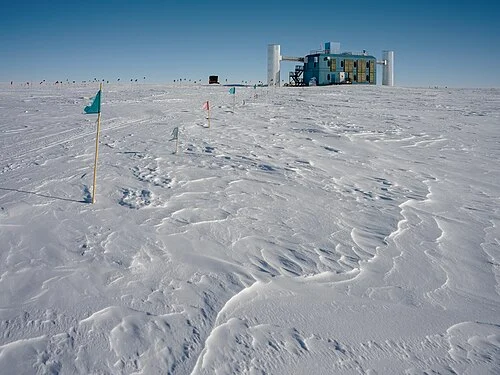
- IceCube Collaboration / NSF. IceCube Neutrino Observatory imagery, South Pole, 2023. Licensed under CC BY-SA 4.0.
- Majorana, E. (1937). Teoria simmetrica dell’elettrone e del positrone. Il Nuovo Cimento, 14, 171–184.
This article was produced by FreeAstroScience.com. Crafted with care for curious minds.