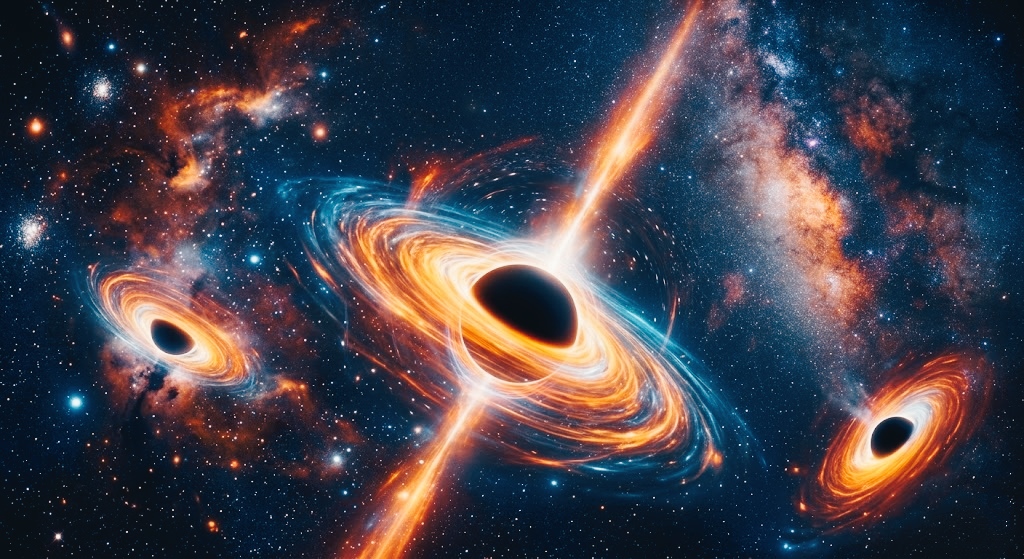
The Universe’s First Stars Are No Longer a Theory — Meet Hebe, the Proof
What if the very first stars that ever shone — born from nothing but hydrogen and helium in the pitch-dark aftermath of the Big Bang — were still visible to us, 13.4 billion years later?
Welcome to FreeAstroScience.com, where we break down the most exciting scientific discoveries into language everyone can enjoy. We’re glad you’re here. Whether you’re a student, a curious parent, a lifelong stargazer, or someone who just stumbled onto this page — this story is for you.
In April 2026, a team of over 60 astrophysicists led by Roberto Maiolino at the University of Cambridge announced something extraordinary. Using the James Webb Space Telescope, they confirmed the detection of a tiny, ancient object called Hebe — a helium emitter sitting just 3 kiloparsecs from the galaxy GN-z11, at a redshift of z = 10.6. That’s roughly 400 million years after the Big Bang. And the light coming from Hebe matches exactly what we’d expect from Population III stars — the first generation of stars the universe ever made.
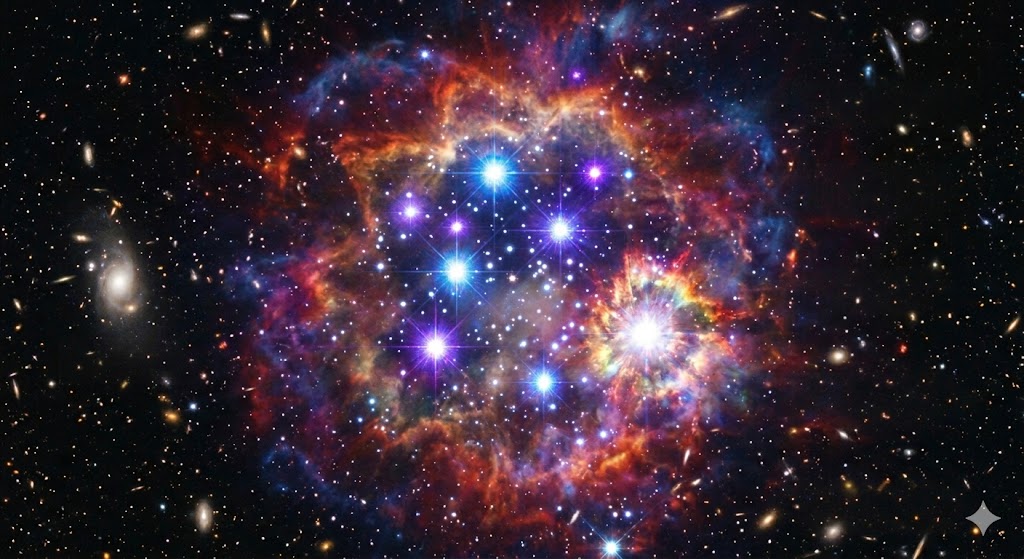
This isn’t a tentative hint. It isn’t a maybe. The team calls Hebe “one of the most convincing pieces of evidence for Population III stars in the early Universe.” And we think you deserve to understand why that sentence matters so much.
Grab a coffee. Settle in. Let’s walk through this discovery together — from the physics to the poetry of it. We promise it’s worth reading to the end.
📚 Table of Contents
- 01What Are Population III Stars — and Why Should We Care?
- 02GN-z11: The Brightest Galaxy at the Edge of Time
- 03Who Is Hebe — and How Did JWST Find Her?
- 04What Does Doubly Ionized Helium Tell Us?
- 05Where Are the Metals? The Silence That Speaks Volumes
- 06Could Something Else Explain Hebe’s Light?
- 07How Massive Were These First Stars?
- 08Why Does Finding Population III Stars Change Everything?
- 09Key Observational Data at a Glance
- 10The First Light Has Been Found
What Are Population III Stars — and Why Should We Care?
Think of the universe as a story. Every atom of iron in your blood, every grain of calcium in your bones, every breath of oxygen you’ll ever take — all of it was cooked inside a star. But the very first stars? They had nothing to work with. No carbon. No oxygen. No iron. Just hydrogen and helium, the two simplest elements, left over from the Big Bang.
We call these pioneer stars Population III (or Pop III). They formed inside tiny gas clouds — galactic embryos, really — within the first few hundred million years after the universe began. Theoretical models suggest they were monstrously hot and unbelievably massive, perhaps 10 to 500 times the mass of our Sun. Their surface temperatures would have been scorching. Their lifetimes? Brutally short — just a few million years.
And then they exploded.
Those colossal supernova explosions scattered the first heavy elements into the surrounding gas. Carbon, oxygen, nitrogen, iron — all the building blocks we depend on — were born in those violent deaths. Without Population III, there would be no rocky planets. No water. No DNA. No us.
For decades, astrophysicists predicted their existence but couldn’t spot them directly. They lived too fast, too far away, and too long ago. Identifying them below a critical metallicity of about 10⁻⁴ to 10⁻⁶ times the Sun’s metal content has been the challenge. Finding their trace across 13.4 billion years of cosmic distance felt like trying to hear a whisper in a thunderstorm.
Until now.
GN-z11: The Brightest Galaxy at the Edge of Time
Before we meet Hebe, we need to talk about her neighbour.
GN-z11 holds a special title: it’s the most ultraviolet-luminous galaxy known at a redshift greater than 10. In plain terms, it’s one of the oldest and brightest galaxies we’ve ever photographed. Located at coordinates RA 12:36:25.44, DEC +62:14:31.3, this galaxy sits at a redshift of z = 10.6 — we’re seeing it as it was only about 400 million years after the Big Bang.
GN-z11 isn’t small, either. Its stellar mass is estimated at roughly 8 × 10⁸ solar masses (about 800 million times the mass of our Sun). It lives in an overdense region of space — a cosmic neighbourhood packed with matter — and likely hosts an active galactic nucleus (AGN), meaning a supermassive black hole is feeding at its core.
Why does GN-z11 matter for our story? Because theoretical models predicted that Population III stars wouldn’t just form in tiny, isolated pockets. They could also form in the haloes — the outer gas envelopes — around massive galaxies like GN-z11. Fresh, pristine gas falling toward a big galaxy can be compressed and heated by ultraviolet radiation from the central source, triggering the birth of metal-free stars right at the galaxy’s doorstep.
That prediction turned out to be exactly right.
Who Is Hebe — and How Did JWST Find Her?
In 2024, Roberto Maiolino and his team used the NIRSpec Integral Field Unit (IFU) on the James Webb Space Telescope to explore the immediate environment around GN-z11. At medium spectral resolution (R ∼ 1000), they spotted something unusual: a faint emission line in a small region just 3 kiloparsecs (about 9,800 light-years) northeast of GN-z11. The line matched the wavelength expected for HeII λ1640 — ionized helium — at a redshift very close to the host galaxy.
The team named this tiny source Hebe, after the ancient Greek goddess of youth (Ἥβη) — fitting, since we’re looking at a celestial object born in the youth of the cosmos. The name also stands as an acronym: HElium Balmer Emitter.
But a single detection at medium resolution isn’t enough to rewrite textbooks. So the team went back. Between May 15 and 17, 2025, they pointed JWST at the same patch of sky with the high-resolution grating G235H (R ∼ 2700), accumulating a staggering 38.8 hours of total exposure time across 38 dithered pointings.
The result? The HeII emission line reappeared — now detected at 6σ significance. That’s a powerful statistical confirmation. In a companion observation, a second team led by Hannah Übler independently detected a hydrogen-gamma (Hγ) emission line at the exact same location and the same redshift. Two different teams. Two different spectral lines. Same tiny spot of sky.
This isn’t coincidence. This is confirmation.
What Does Doubly Ionized Helium Tell Us?
Here’s where the physics gets beautiful.
Helium is the second simplest element. To strip both of its electrons away — to doubly ionize it — you need photons with enormous energy. We’re talking about photons with energies above 54.4 electron volts (eV). For comparison, ionizing hydrogen requires only 13.6 eV. That’s a fourfold difference.
Ionization Energy Comparison
Hydrogen (H → H⁺): 13.6 eV
Helium single ionization (He → He⁺): 24.6 eV
Helium double ionization (He⁺ → He²⁺): 54.4 eV
Only the hottest, most massive stars can produce enough of those high-energy photons. Population III stars — with no metals to cool them down and cap their temperatures — are prime candidates. When their ferocious ultraviolet radiation slams into surrounding helium gas, the gas becomes doubly ionized. As electrons recombine with the helium ions, they release a telltale glow: the HeII λ1640 recombination line.
That’s the line JWST caught in Hebe.
Here’s the kicker: the high-resolution data revealed that the HeII emission isn’t one single line. It splits into two components, separated by about 120–126 km/s. Each component is narrow — consistent with being spectrally unresolved individually (velocity dispersion below 35 km/s). This double structure suggests two nearby star clusters within 400 parsecs of each other, possibly at slightly different evolutionary stages.
The equivalent width of the HeII emission — a measure of how strong the line is compared to the background light — exceeds 47 Ångströms for the total signal, with lower limits of 28 Å and 22 Å for the individual components. These values are far higher than anything expected from metal-enriched stellar populations.
Where Are the Metals? The Silence That Speaks Volumes
Sometimes, what you don’t see is more important than what you do.
The G235H spectral setup covers a wavelength range where several strong metal emission lines should appear in any ordinary high-redshift galaxy. If Hebe contained even modest amounts of metals, we’d expect to see lines from nitrogen (NIV), carbon (CIV, CIII]), oxygen (OIII]), or nitrogen (NIII]). In normal galaxies at these redshifts, at least some of these lines are as strong as — or stronger than — HeII.
None of them showed up.
| Emission Line | Wavelength | Ratio to HeII (upper limit) | Detected? |
|---|---|---|---|
| NIV] doublet | 1483, 1486 Å | < 0.60 | ❌ No |
| CIV doublet | 1548, 1551 Å | < 0.56 | ❌ No |
| OIII] doublet | 1661, 1666 Å | < 0.63 | ❌ No |
| NIII] multiplet | 1749 Å | < 0.46 | ❌ No |
| CIII] doublet | 1906, 1908 Å | < 0.36 | ❌ No |
Source: Maiolino et al. (2026), Table 1. Each upper limit refers to an individual component of the doublet.
The companion analysis by Übler et al. (2026) tells the same story at longer wavelengths: no [NeIII] λ3869 emission, no other metal signatures — just Hγ standing alone. And the theoretical modelling by Rusta et al. (2026) shows that these non-detections are extremely constraining. You can’t hide metals if they’re there. The spectral coverage is too broad, the sensitivity too deep.
What we’re left with is an environment of extraordinary chemical purity — a pocket of gas that still looks almost exactly like the primordial material the Big Bang produced. Hebe is, in a sense, a natural laboratory frozen in time, preserving the conditions of the cosmos at its youngest.
Could Something Else Explain Hebe’s Light?
Good science means considering every possible explanation before declaring victory. The Maiolino team took this seriously. They tested four alternative scenarios, and each one fell short.
Could Wolf-Rayet Stars Be Responsible?
Wolf-Rayet (WR) stars are massive, evolved stars with powerful stellar winds that can produce HeII emission. At first glance, it’s a reasonable idea. But the team found several problems. The HeII line in Hebe is only about 110 km/s wide — far narrower than WR emission lines, even in the most metal-poor WR stars observed. WR stars at very low metallicities still show prominent nitrogen or carbon emission lines — which Hebe doesn’t have. And the fraction of WR stars drops steeply as metallicity decreases. The double-peaked line profile doesn’t match the typical smooth, Gaussian shape of WR features, either.
Verdict: very unlikely.
What About a Direct Collapse Black Hole?
Hebe sits near GN-z11, which bathes the surrounding space in strong Lyman-Werner radiation — an environment theoretically suited for forming a Direct Collapse Black Hole (DCBH). But there’s no sign of a broad-line region in the Hγ emission, and the upper limit on a possible black hole mass is only a few × 10⁴ solar masses. More telling, the extreme equivalent widths of both HeII and Hγ far exceed what black hole accretion models can produce.
Verdict: possible but significantly disfavoured.
Could the AGN in GN-z11 Be Lighting Up a Pristine Gas Cloud?
GN-z11 hosts an AGN with an estimated luminosity of around 10⁴⁵ erg/s. Could its radiation be photoionizing a nearby pristine gas clump? The team modelled this scenario carefully. The result: at a distance of 3 kpc, the AGN’s radiation falls more than two orders of magnitude short of producing the observed HeII luminosity. Even in extreme scenarios — where GN-z11 was once a hundred times more luminous, or where super-Eddington accretion beams radiation anisotropically — the numbers still don’t add up.
Verdict: safely ruled out.
Primordial Black Holes?
A primordial black hole (PBH) — formed in the very early universe from density fluctuations — is another creative hypothesis. Recent constraints from the cosmic microwave background place an upper mass limit of about 10⁴ solar masses for PBHs, which fits the observational upper limit. But PBH accretion models still struggle with the exceptionally high equivalent widths and the distinctive emission line profiles.
Verdict: interesting but unconvincing.
After ruling out every competitor, the team’s conclusion is clear: Population III stars remain the only model that consistently reproduces all the observed properties of Hebe.
How Massive Were These First Stars?
One of the most exciting outcomes of this discovery is a real estimate of how massive Pop III star clusters can be. The companion theoretical paper by Rusta et al. (2026) constrains the total stellar mass of Hebe’s Pop III clusters to between 10⁴ and a few × 10⁵ solar masses — that’s somewhere between 10,000 and a few hundred thousand times the mass of our Sun.
That range fits well with theoretical predictions for Pop III systems, though it sits towards the higher end — which makes sense given the special environment near a massive galaxy like GN-z11.
Several uncertainties could push the actual mass downward. The gravitational lensing factor from a foreground galaxy at z = 2.028 is estimated at 1.42 for Hebe, but it could be higher, which would mean lower intrinsic luminosity and therefore lower mass. Rotating or binary Pop III star models also predict higher luminosity per unit mass. And since we’ve resolved Hebe into two spectral components, each one probably consists of even smaller sub-clusters blended within our spectral resolution.
Pop III Critical Metallicity Threshold
Population III stars form only when gas metallicity falls below a critical threshold, typically defined as:
Zcr ≈ 10−4 – 10−6 Z☉
Below this level, metals can’t cool the gas efficiently enough to fragment it into smaller clumps — so only very massive stars are born. Above it, the universe starts making stars like the ones we see today.
The distribution of masses in a Pop III cluster — what astronomers call the Initial Mass Function (IMF) — is still one of the biggest open questions in astrophysics. Different IMFs were tested in the diagnostic models: stars ranging from 1–100 M☉, 1–500 M☉, and 50–500 M☉, all with a Salpeter slope. Hebe’s data, especially the EW(HeII) versus HeII/Hγ diagnostic plot, aligns best with models featuring very massive stars — the 50–500 M☉ range — though less extreme mass ranges aren’t fully excluded.
Why Does Finding Population III Stars Change Everything?
Let’s step back from the technical details for a moment.
You and we are made of star-stuff. That’s not poetry — it’s chemistry. The oxygen we breathe was forged inside a star. The iron carrying oxygen through our veins was born in a supernova explosion. The calcium holding our skeletons together was scattered into space billions of years ago.
But which star? Where did the chain begin?
Population III stars are the answer. They are the original factories. They took the two simplest ingredients the Big Bang provided — hydrogen and helium — and turned them into everything else. When they died, they seeded the cosmos with the first heavy elements, making it possible for new generations of stars to form with richer chemistries. Those second-generation stars (Population II) made more elements still. Eventually, after billions of years and countless stellar life cycles, you get Population I stars like our Sun — orbited by rocky planets, drenched in water, humming with life.
Finding Hebe means we’ve traced that chain all the way back to its first link. We’re not just looking at ancient light. We’re looking at the origin of origin.
And there may be more. The HeII maps hint at a second, marginally detected emitter about 0.8 arcseconds north of GN-z11, and possibly a third to the northwest. If those are confirmed, it would suggest that pristine gas was recently accreting onto GN-z11’s halo from the north-northeast, triggering Pop III star formation at multiple locations as the gas was compressed. That’s the theory coming alive before our eyes.
Key Observational Data at a Glance
| Parameter | Value |
|---|---|
| Redshift (HeII centroid) | z = 10.583 |
| Distance from GN-z11 | ~3 kpc (≈ 9,800 light-years) |
| Total HeII flux (aperture-corrected) | (1.11 ± 0.17) × 10⁻¹⁹ erg s⁻¹ cm⁻² |
| Rest-frame EW(HeII) total | > 47 Å |
| HeII spectral components | 2 (separated by 126 ± 17 km/s) |
| De-lensed HeII luminosity (total) | (8.54 ± 1.29) × 10⁴⁰ erg s⁻¹ |
| Detection significance | 6σ |
| Continuum detection (F200W) | Not detected (< 3.1 nJy at 5σ) |
| Estimated Pop III stellar mass | 10⁴ – few × 10⁵ M☉ |
| Lensing magnification (Hebe) | μ ≈ 1.42 |
| Instrument & mode | JWST NIRSpec-IFU, G235H (R ∼ 2700) |
Data compiled from Maiolino et al. (2026), Übler et al. (2026), and Rusta et al. (2026).
The First Light Has Been Found
Let’s take a breath and look at what just happened.
For the first time, we have confirmed spectroscopic evidence — backed by independent detections of two different emission lines, by two separate research teams, with no satisfactory alternative explanation — that Population III stars existed in the halo of a real galaxy at redshift 10.6. Hebe is small. She’s faint. She has no detectable continuum emission and no metals. But her helium glow tells a story 13.4 billion years in the making.
These aren’t just the oldest stars. They’re the first stars. The ones that lit up a dark universe and set off the chain of chemical reactions that would eventually give rise to planets, oceans, and — eventually — people capable of wondering where they came from.
The search isn’t over. Future observations will tell us more about Hebe’s sub-components, the possible second and third HeII emitters nearby, and the still-unknown mass distribution of Pop III stars. But the threshold has been crossed. As the reccom.org coverage of this study put it well, the hunt for the first stars has officially moved from theory to practice.
We wrote this article at FreeAstroScience.com because we believe in explaining the most complex ideas in science with clarity and honesty. We exist to remind you: never turn off your mind. Keep it active. Keep it curious. Because the sleep of reason breeds monsters — but the wakefulness of reason reveals wonders like Hebe.
If this story moved you, if it made you feel a little less alone in this vast universe, come back and visit us. There’s always more to explore, and we’ll be here to walk through it with you.
📖 References & Sources
- Maiolino, R. et al. (2026). “The search for Population III: Confirmation of a HeII emitter with no metal lines at z=10.6.” MNRAS, preprint. arXiv:2603.20362v4
- Übler, H. et al. (2026). Companion paper on Hγ detection in Hebe. arXiv:2603.20360
- Rusta, E. et al. (2026). Theoretical interpretation of Hebe in the Pop III scenario. arXiv:2603.20363
- Maiolino, R. et al. (2024b). Initial HeII detection at medium resolution. A&A, 687, A67.
- Bunker, A. J. et al. (2023). GN-z11 spectroscopic confirmation. A&A, 677, A88.
- Nakajima, K. & Maiolino, R. (2022). Pop III diagnostic models. MNRAS, 513, 5134.
- Meloni, D. (2026). “Popolazione III: le stelle primordiali che hanno dato inizio alla vita.” Reccom Magazine, 15 April 2026.
- STScI MAST Archive — JWST Programme PID 5086. mast.stsci.edu
Written by Gerd Dani for FreeAstroScience.com — where complex science becomes clear thinking. Published April 2026.