The Sombrero Galaxy: A Cosmic Hat 31 Million Light-Years Away
Have you ever looked up at the night sky and wondered what’s hiding just beyond the reach of your naked eye? What if one of the most breathtaking objects in the cosmos — a galaxy shaped like a wide-brimmed Mexican hat — has been floating silently in the constellation Virgo this whole time, waiting for you to notice it?
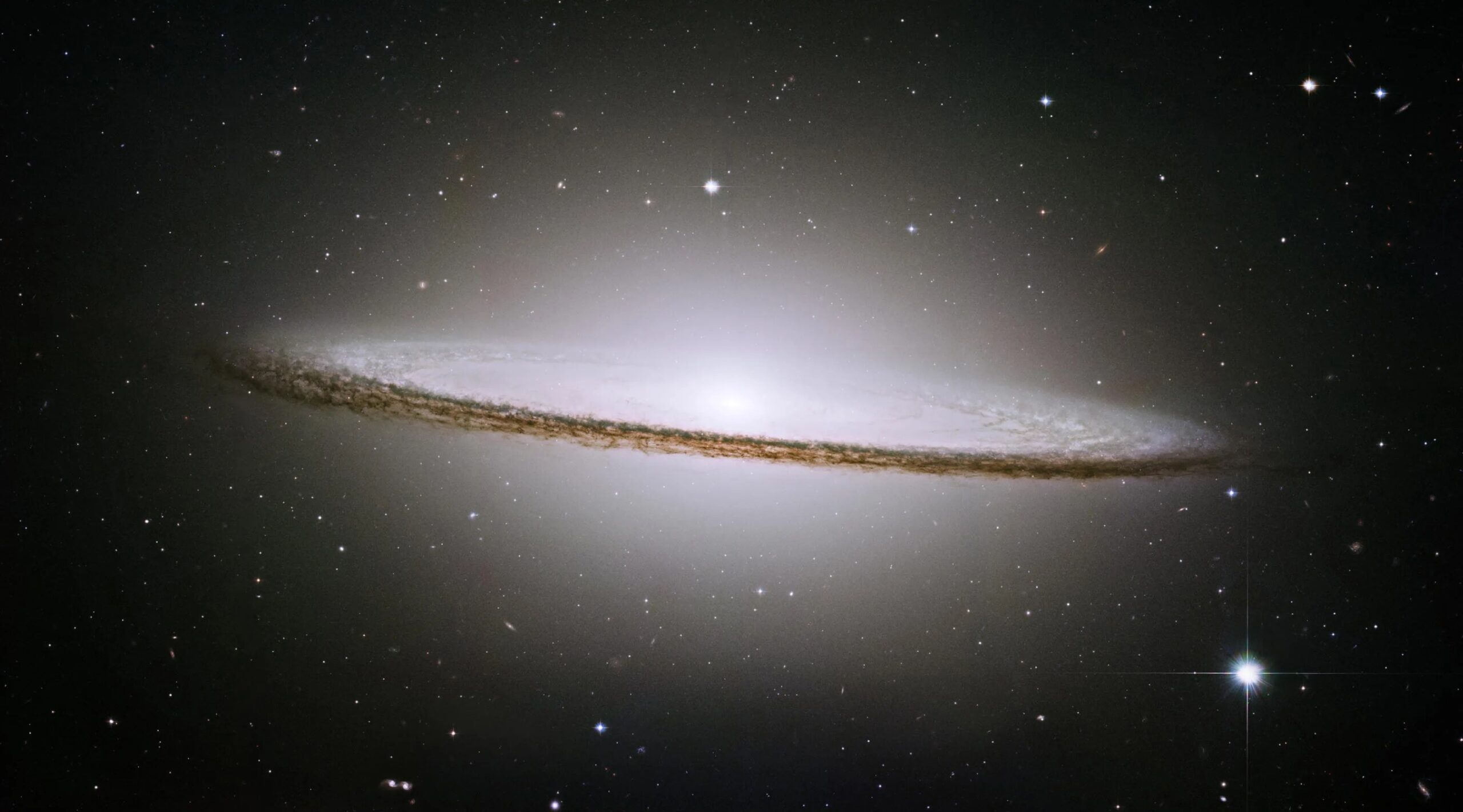
Welcome to FreeAstroScience.com, where we break down complex scientific ideas into language that actually makes sense. We’re glad you’re here. Today, we’re taking a close look at Messier 104, better known as the Sombrero Galaxy — one of the most photographed, most studied, and honestly most beautiful galaxies astronomers have ever pointed a telescope at. A brilliant white core wrapped in a dark ribbon of dust, sitting roughly 31 million light-years from Earth . It looks like the universe put on a hat.
Whether you’re a seasoned stargazer or someone who just stumbled upon this page out of curiosity, stick around. By the time you finish reading, you’ll understand why this galaxy has captivated scientists for over two centuries — and why it still surprises us today.
At FreeAstroScience, we believe in one simple idea: never turn off your mind. Keep it active at all times. Because the sleep of reason breeds monsters. So let’s keep our minds wide awake and explore M104 together.
📖 Table of Contents
- 1. What Exactly Is the Sombrero Galaxy?
- 2. Who Discovered M104 — And Why Did It Take 140 Years to Get Catalogued?
- 3. How Massive Is the Black Hole at Its Core?
- 4. Spiral or Elliptical — Why Can’t Astronomers Agree?
- 5. Key Physical Data at a Glance
- 6. Why Does It Have So Many Globular Clusters?
- 7. What Has the James Webb Space Telescope Revealed?
- 8. How Can You Spot the Sombrero Galaxy Yourself?
- 9. How Did M104 Help Prove the Universe Is Expanding?
- 10. Final Thoughts
What Exactly Is the Sombrero Galaxy?
Picture a glowing, brilliant-white core — like a cosmic lightbulb — wrapped in a thick, dark band of dust. Now tilt it almost edge-on, about 6 degrees from your line of sight . That’s the Sombrero Galaxy. Its shape has reminded people of a broad-brimmed Mexican hat for over a century, and the name stuck for good reason.
Officially catalogued as Messier 104 (or NGC 4594), this galaxy sits in the constellation Virgo, right near the border with Corvus — the Crow . It’s one of the brightest galaxies visible from Earth, with an apparent magnitude of about 8.0 , making it a realistic target even for amateur telescopes and binoculars.
But don’t let the pretty picture fool you. The Sombrero is a scientific puzzle. Astronomers have spent decades arguing about what kind of galaxy it actually is. We’ll get to that debate shortly — it’s one of the best plot twists in modern astronomy.
A Quick Sense of Scale
The Sombrero Galaxy contains an estimated 100 billion stars . Its diameter? Depending on the measurement method, it spans somewhere between 50,000 and 105,000 light-years . That makes it either a third the size of our Milky Way or slightly larger than it, depending on which estimate you trust. The galaxy’s mass clocks in at about 800 billion solar masses .
Think about that. Eight hundred billion suns’ worth of matter, all held together by gravity, spinning in the dark. And we can see it from our little planet, 31 million light-years away, as a faint smudge of light.
Who Discovered M104 — And Why Did It Take 140 Years to Get Catalogued?
Here’s where the story gets quirky. French astronomer Pierre Méchain first spotted the Sombrero Galaxy on May 11, 1781 . He described it in a letter to J. Bernoulli on May 6, 1783:
“On May 11, 1781, I have discovered a nebula above Corvus; it did not appear to me to contain stars; it is faint and very difficult to see when the wires of the micrometer are illuminated.”
His colleague Charles Messier — the man behind the famous catalogue — jotted down Méchain’s finding in his personal copy of the Connoissance des Temps in 1784. But here’s the thing: Messier never officially added it to his catalogue .
The galaxy sat in limbo for 140 years.
It wasn’t until 1921 that French astronomer Camille Flammarion found Messier’s handwritten notes, identified the object as NGC 4594, and formally added it to the Messier catalogue as M104 . Meanwhile, the German-British astronomer William Herschel had independently discovered the same galaxy on May 9, 1784, noting a mysterious “dark stratum” — what we now call the dust lane . His son John Herschel observed it again on March 9, 1828, and was nearly certain he saw a dark band separating the core from the surrounding glow .
Because the Herschels didn’t know about Méchain’s earlier observation, Méchain’s name doesn’t appear in the New General Catalogue compiled by Danish astronomer John Louis Emil Dreyer in 1888 . A small historical injustice, perhaps — but at least we know the truth now.
How Massive Is the Black Hole at Its Core?
At the center of the Sombrero Galaxy lurks one of the most massive black holes ever found in a nearby galaxy. And “massive” is an understatement.
A team led by astronomer John Kormendy first detected it in the 1990s using data from the Hubble Space Telescope and the Canada–France–Hawaii Telescope (CFHT) on Mauna Kea in Hawaii . They found that stars orbiting near the galaxy’s core were moving so fast that the only explanation was a central object with a mass equal to roughly 1 billion suns .
More recent estimates push that number even higher — to approximately 8.83 billion solar masses . To put that in perspective, Sagittarius A*, the supermassive black hole at the center of our own Milky Way, has a mass of about 4.1 million solar masses . The Sombrero’s black hole is more than 2,000 times heavier .
A Quiet Giant
Despite its staggering mass, this black hole is surprisingly quiet. It doesn’t produce the spectacular jets or blinding radiation we see in some active galaxies. The nucleus of M104 is classified as a LINER — a low-ionization nuclear emission-line region . That means the gas around it is only weakly ionized, and there’s no significant star-forming activity in the core .
Think of it as a sleeping giant. It has the power to reshape its surroundings, but right now, it’s just… sitting there. Calm. Enormous. Waiting.
⚫ Black Hole Mass Comparison
Sombrero Galaxy vs. Milky Way
| Property | Sombrero Galaxy (M104) | Milky Way |
|---|---|---|
| Central Black Hole | ~8.83 billion M☉ | ~4.1 million M☉ |
| Black Hole Name | — | Sagittarius A* |
| Mass Ratio | M104’s black hole is ~2,000× more massive | |
| Activity Level | Low (LINER) | Very Low |
M☉ = solar masses. Data from Hubble/CFHT observations.
Spiral or Elliptical — Why Can’t Astronomers Agree?
This is one of the most fascinating debates surrounding M104. For decades, everyone assumed the Sombrero was a spiral galaxy — it has a disk, a dust lane, even faint spiral structure. Its morphological classification reads SA(s)a, meaning an unbarred spiral .
But then came the Spitzer Space Telescope.
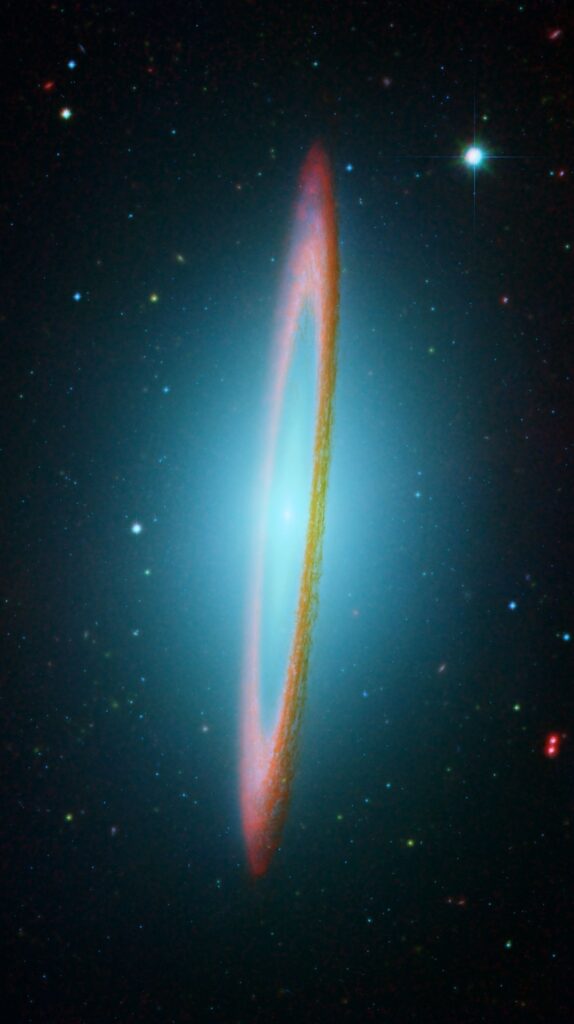
In 2012, NASA’s Spitzer observed the Sombrero in infrared light and found something startling: the galaxy’s halo was far larger and more massive than anyone had thought . A halo that large is a hallmark of giant elliptical galaxies, not spirals.
So what is it? The current best answer: both.
Two Galaxies in One
Astronomers now think of M104 as essentially two galaxies nested inside each other — a disk galaxy living within a giant elliptical galaxy . It’s a bit like finding a sports car parked inside a warehouse. Both structures are real; they just happen to share the same address.
One theory suggests that a massive elliptical galaxy may have captured a gas cloud over 9 billion years ago. That gas cloud fell into orbit around the elliptical’s core, eventually forming the rotating disk and dust ring we see today . If a smaller spiral galaxy had been absorbed instead, its disk would likely have been ripped apart — so the gas-cloud scenario fits better.
Scientists compare M104 to Centaurus A, another elliptical galaxy that contains a disk. But Centaurus A may be younger, and it could one day evolve to look like the Sombrero . That’s a remarkable thought: we might be looking at two different stages of the same cosmic process.
Key Physical Data at a Glance
Let’s pause the storytelling for a moment and get into the hard numbers. Here’s a comprehensive summary of what we know about M104.
🌌 Messier 104 — Physical Properties
| Parameter | Value |
|---|---|
| Common Name | Sombrero Galaxy |
| Catalogue Designations | M104 / NGC 4594 |
| Constellation | Virgo (near Corvus border) |
| Galaxy Type | SA(s)a — Spiral / Elliptical hybrid |
| Distance from Earth | 31.1 ± 1.0 million light-years (9.55 Mpc) |
| Diameter | 94,900 – 105,000 light-years |
| Mass | ~800 billion solar masses |
| Estimated Stars | ~100 billion |
| Apparent Magnitude | +8.0 |
| Absolute Magnitude | −21.8 |
| Apparent Size | ~9′ × 4′ arcminutes |
| Inclination Angle | ~84°.3 (nearly edge-on) |
| Supermassive Black Hole Mass | ~8.83 billion M☉ |
| Globular Clusters | ~1,200 – 2,000 |
| Recession Velocity | ~1,024 km/s |
| Redshift (z) | 0.003416 |
| Nucleus Type | LINER (Active Galactic Nucleus) |
| Galaxy Group | Virgo II Groups (not Virgo Cluster) |
| Discoverer / Date | Pierre Méchain / May 11, 1781 |
Sources: NASA/Hubble, Spitzer, CFHT, and ground-based observations. Image credits: NASA/JPL-Caltech, Hubble.
Why Does It Have So Many Globular Clusters?
Globular clusters are dense, spherical collections of ancient stars — some of the oldest objects in any galaxy. The Milky Way has about 150 of them . That sounds like a lot, until you hear that the Sombrero Galaxy has an estimated 1,200 to 2,000 .
That’s roughly 10 times more than what we find in our own galaxy .
Why so many? Astronomers think the answer lies in the Sombrero’s unusually large central bulge. The bigger the bulge, the more globular clusters a galaxy tends to host . These clusters are old — their estimated ages range from 10 to 13 billion years , which means many of them formed when the universe itself was still young.
This abundance of globular clusters is another clue that the Sombrero Galaxy may have a more complex history than a simple spiral galaxy. Huge populations of globulars are more typical of giant elliptical galaxies , which ties back to the spiral-vs-elliptical debate we discussed earlier.
What Has the James Webb Space Telescope Revealed?
The Sombrero Galaxy isn’t just a relic of past discoveries. It’s very much a current research target, and the James Webb Space Telescope (JWST) has given us fresh eyes on this old favorite.
In November 2024, the JWST’s Mid-Infrared Instrument (MIRI) imaged M104 and showed something remarkable: the clumpy nature of the galaxy’s dusty disk . In visible light — the kind captured by Hubble — the Sombrero’s core blazes brilliantly. But in mid-infrared wavelengths, that same core appears as a smooth inner disk, while the dust ring reveals its true texture .
MIRI also detected polycyclic aromatic hydrocarbons (PAHs) in the Sombrero’s dust ring . These carbon-containing molecules are often linked to very young star-forming regions — a hint that new stars may still be emerging in the galaxy’s outer ring, even though the core itself shows almost no star formation.
For the first time, Webb captured the dust clumps at high resolution at infrared wavelengths, showing how dust distributes itself throughout the outer ring . The telescope also picked up distant background galaxies in the same field of view, their colors revealing information about their properties and distances .
Every new instrument we point at M104 peels back another layer. And that’s exactly what makes science exciting — we’re never truly done asking questions.
How Can You Spot the Sombrero Galaxy Yourself?
You don’t need a multimillion-dollar space telescope to see M104. Believe it or not, a decent pair of binoculars can pick it up on a clear night .
Finding M104 in the Night Sky
The Sombrero Galaxy sits 11.5 degrees west of Spica, the brightest star in Virgo, and about 5.5 degrees east of Eta Corvi in the constellation Corvus . Here’s a simple way to find Spica first: follow the arc of the Big Dipper’s handle outward. It leads you to Arcturus in Boötes, and then continuing that arc takes you straight to Spica .
From Spica, look toward Corvus. M104 sits roughly halfway between Spica and Epsilon Corvi .
What You’ll See
- Binoculars: A faint, elongated smudge of light .
- 4-inch telescope: Under excellent conditions, you might catch a hint of the dark dust lane .
- 8-inch telescope or larger: The bulge and disk become visible. The dark dust lane stands out clearly .
- 10-inch to 12-inch telescope: The dust lane is unmistakable. Some observers even spot globular clusters in the halo .
The best time to observe M104 is during late spring in the Northern Hemisphere . In the Southern Hemisphere, it’s visible from late autumn to early winter .
Its coordinates for your star-tracking app:
- Right Ascension: 12h 39m 59.4s
- Declination: −11° 37′ 23″
How Did M104 Help Prove the Universe Is Expanding?
Here’s a piece of history that doesn’t get enough attention. In 1912, American astronomer Vesto Slipher measured the recession velocity of the Sombrero Galaxy at the Lowell Observatory . He found it was speeding away from us at about 1,024 km/s .
At the time, that was the largest redshift ever measured .
Slipher’s measurement — along with similar observations of other galaxies — became one of the first concrete clues that the universe itself was expanding. These early redshift calculations laid the groundwork for what would become the Big Bang theory .
Think about it: a galaxy shaped like a hat helped us realize the entire cosmos is growing. There’s something poetic about that.
A Note on Distance Measurements
Pinning down M104’s exact distance hasn’t been simple. Different methods have produced different numbers over the years:
📏 Distance Estimates for M104
| Year | Method | Distance (Mly) |
|---|---|---|
| 1996 | Planetary nebulae luminosity | 29 ± 2 |
| 1997 | Surface brightness fluctuations | 30.6 ± 1.3 |
| 2001 | Surface brightness fluctuations (refined) | 32 ± 3 |
| 2003 | Surface brightness fluctuations (refined) | 29.6 ± 2.5 |
| 2016 | Tip of the red-giant branch (Hubble) | 31.1 ± 1.0 |
Mly = million light-years. The 2016 Hubble measurement is currently the most widely accepted value.
The most widely accepted current distance — 31.1 ± 1.0 million light-years — was measured in 2016 using the tip of the red-giant branch method with Hubble data . But as you can see, the figures have bounced between about 29 and 32 million light-years across different studies and techniques .
That’s science for you: always refining, always getting a little closer to the truth.
The Sombrero’s Cosmic Neighborhood
Here’s a fun fact that often gets overlooked: despite sitting in the constellation Virgo, M104 is not a member of the Virgo Cluster . It’s the only Messier galaxy in Virgo that stands apart from that famous galactic neighborhood.
Instead, it belongs to the Virgo II Groups (also called the Virgo S Cloud or the Virgo Southern Extension) — a filament-like cloud of over a hundred galaxies and galaxy clusters stretching about 30 megalight-years in diameter, off the southern edge of the Virgo Supercluster .
In 2009, astronomers also discovered an ultracompact dwarf galaxy in M104’s vicinity — a tiny, dense companion with a half-light radius of only 47.9 light-years . These ultracompact dwarfs are thought to be the stripped cores of dwarf elliptical galaxies that lost their outer stars through gravitational tidal interactions.
Even galaxies have neighbors. And sometimes, those neighbors get a little too close.
The Dust Ring: A Star Factory (Sort Of)
The thick dust lane isn’t just for show. It’s a symmetrical ring that contains most of M104’s cold hydrogen gas and dust . Spectroscopic observations in the infrared confirm that this ring is the galaxy’s primary site for star formation .
But don’t expect fireworks. The Sombrero’s dust ring forms less than one solar mass of new stars per year . For comparison, the Milky Way produces about two solar masses per year . So while stars are being born in M104, the pace is gentle — almost leisurely.
The JWST’s detection of polycyclic aromatic hydrocarbons in that ring, though, hints that pockets of very young star formation may be hiding within the dust . There could be more going on than we realize. The Sombrero hasn’t finished telling us its secrets.
Final Thoughts: Why the Sombrero Galaxy Still Matters
We’ve covered a lot of ground — from Pierre Méchain’s first glimpse in 1781 to the James Webb Space Telescope’s infrared portraits in 2024. Through it all, one thing stands out: the Sombrero Galaxy refuses to be fully understood.
It looks like a spiral but hides an elliptical skeleton. It hosts a monstrous black hole that barely makes a sound. It holds ten times more globular clusters than our own galaxy. It helped prove the universe is expanding — and it still has new stories to tell under infrared light.
M104 reminds us that the cosmos rewards patience and curiosity. Every generation of astronomers has found something new in this galaxy, and there’s no reason to think that process will stop anytime soon.
So next spring, if you get a clear night and a halfway decent telescope, point it toward Virgo. Look between Spica and Corvus. You’ll see a faint glow — a bright core wrapped in shadow, like a hat left out under the stars. You’ll be looking at 100 billion stars, a black hole weighing nearly 9 billion suns, and 2,000 ancient star clusters, all sitting 31 million light-years away.
And you’ll understand why we keep looking up.
This article was written specifically for you by FreeAstroScience.com, where we explain complex scientific ideas in plain language — because knowledge belongs to everyone. We believe that learning should never stop, that curiosity is the most human trait we have, and that keeping your mind active is the best defense against ignorance.
Come back to FreeAstroScience whenever you need a dose of wonder. We’ll be here, scanning the skies.
Image credits: NASA/JPL-Caltech, Hubble Space Telescope.
📚 References & Further Reading
- Constellation Guide — Sombrero Galaxy (Messier 104): Virgo’s Iconic Hat
- Go-Astronomy — M104 (NGC 4594) Sombrero Galaxy
- Deep Sky Corner — Sombrero Galaxy (Messier 104)
- Messier Objects — Messier 104: Sombrero Galaxy
- Dwarf Vision — Sombrero M104
- NASA Science — Messier 104 (The Sombrero Galaxy)
- Wikipedia — Sombrero Galaxy
- AstroBackyard — The Sombrero Galaxy (M104)
- The Virtual Telescope Project — Messier 104, the Sombrero in the Sky