Have you ever wondered if everything we know about the building blocks of the universe could fit inside a single equation? It sounds almost absurd — the entire zoo of subatomic particles, three of the four fundamental forces, and the mechanism that gives matter its mass, all compressed into one mathematical expression. And yet, that equation exists. It’s called the Standard Model Lagrangian, and it’s simultaneously the most successful and most humbling achievement in the history of physics.
Welcome to FreeAstroScience, where we explain complex scientific principles in simple terms. We’re Gerd Dani and the FreeAstroScience team, and we believe the sleep of reason breeds monsters — so we never stop asking questions. Today, we’re going to walk you through this legendary equation, piece by piece, symbol by symbol. No advanced physics degree required. Just curiosity. So grab your coffee, settle in, and read to the very end. By the time you’re done, you’ll see the universe a little differently.
📑 Table of Contents
- 1. What Is the Standard Model, and Why Should You Care?
- 2. What Does the Lagrangian Density Actually Contain?
- 3. What Particles Live Inside This Equation?
- 4. How Do the Three Fundamental Forces Compare?
- 5. Why Does the Gauge Group SU(3) × SU(2) × U(1) Matter?
- 6. A Brief History: Who Built This Equation?
- 7. What’s Missing from the Standard Model?
- 8. Final Thoughts: One Equation, a Universe of Meaning
The Standard Model Equation: Everything We Know About Matter Written in One Formula
1. What Is the Standard Model, and Why Should You Care?
Picture a recipe book. Not for cakes or pasta — for reality itself. A single book that tells you every ingredient the universe uses to build atoms, stars, your morning coffee, and the phone in your hand. That book exists, and physicists call it the Standard Model of particle physics.
The Standard Model is a quantum field theory that describes three of the four known fundamental forces — the electromagnetic force, the weak nuclear force, and the strong nuclear force — while classifying all known elementary particles . It was developed in stages throughout the second half of the 20th century, with the current formulation finalized in the mid-1970s .
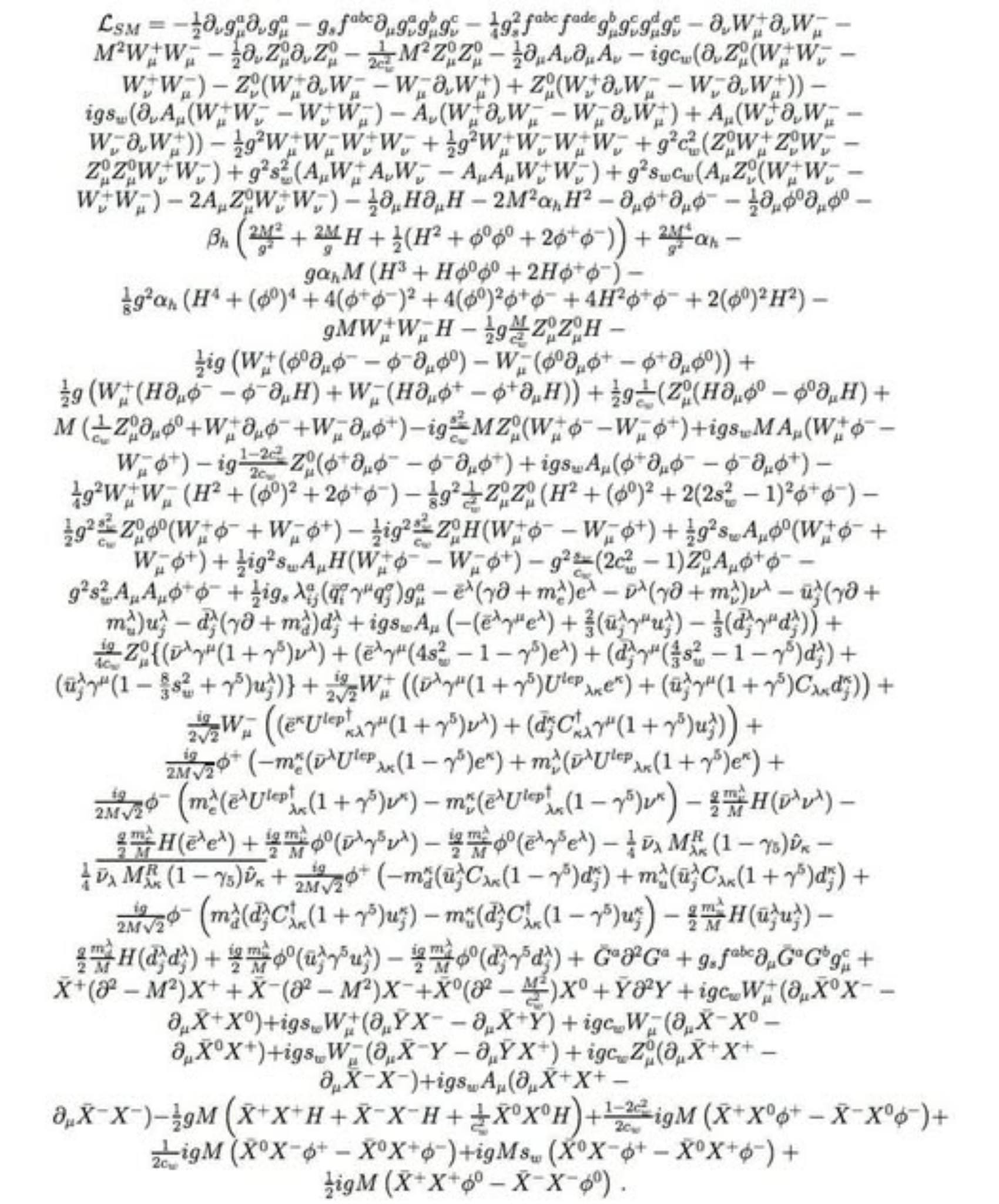
And here’s the thing that blows our minds: all of it, every particle, every interaction, can be encoded in a single mathematical expression called the Lagrangian density, written as ℒ_SM.
Think of the Lagrangian like a compact DNA strand. It looks dense and intimidating at first glance. But once you learn how to read it, every term tells a story — about how particles move, how they interact, how they get mass, and how forces emerge from symmetry.
The Standard Model is renormalizable and mathematically self-consistent . That means it doesn’t produce nonsensical infinities when you calculate things properly, and its internal logic holds together. It’s predicted the existence of particles before we found them — the top quark in 1995, the tau neutrino in 2000, and the Higgs boson in 2012 .
Not bad for one equation.
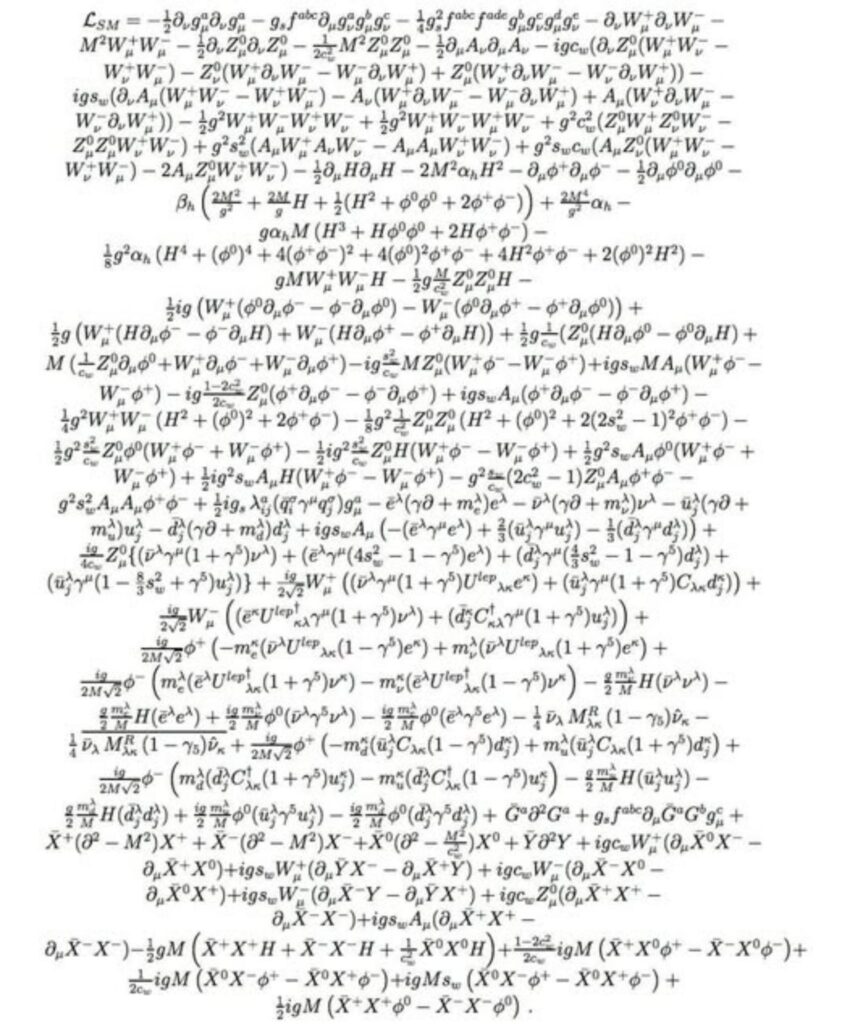
2. What Does the Lagrangian Density Actually Contain?
The full Standard Model Lagrangian — the one shown in the image that often circulates online — looks like a wall of symbols. Let’s not pretend otherwise. It’s big. It’s complex. It fills an entire page.
But here’s our promise: it breaks down into just five logical sections. Each section handles a different job. Once you understand what each section does, the whole thing starts to make sense. We don’t need to understand every Greek letter to grasp the architecture.
Let’s walk through them one at a time.
2.1 Gauge Kinetic Terms — How Force Fields Move on Their Own
The first chunk of the Lagrangian describes how the gauge boson fields — the carriers of forces — behave when they’re just moving through empty space, not yet interacting with any matter.
There are three types of force-carrying bosons in the Standard Model. Photons carry electromagnetism, gluons carry the strong force, and W and Z bosons carry the weak force . Each one has its own field, and the gauge kinetic terms describe the energy stored in those fields.
In mathematical shorthand, you’ll often see terms like:
−¼ Gaμν Gaμν (gluon field strength — strong force)
−¼ Wiμν Wiμν (weak boson field strength — weak force)
−¼ Bμν Bμν (hypercharge field strength — electromagnetic sector)
Each of these terms is built from something called a field strength tensor. Think of it like this: if the field is a river, the field strength tensor measures how fast the water is swirling and flowing. The “−¼” factor comes from convention and ensures the equations of motion come out right.
For the gluon field, the Yang-Mills equations are non-linear — the gluon fields interact with themselves. That self-interaction is exactly why the strong force behaves so differently from electromagnetism. Photons don’t carry electric charge, so they fly right past each other. Gluons do carry color charge, so they tug on each other. It’s like the difference between messengers who ignore each other and messengers who stop to argue along the way.
2.2 Fermion Kinetic Terms — How Matter Particles Move and Feel Forces
The second section of the Lagrangian deals with fermions — the matter particles. These are the quarks and leptons that make up everything you can touch, see, or bump into.
The Standard Model includes 12 elementary particles of spin ½, known as fermions . They respect the Pauli exclusion principle, meaning no two identical fermions can occupy the same quantum state at the same time .
The fermion kinetic terms typically look like:
ψ̄ i γμ Dμ ψ
where ψ is the fermion field, γμ are the Dirac gamma matrices, and Dμ is the covariant derivative.
The covariant derivative is where the magic happens. It’s not just a regular derivative — it contains within it the gauge fields (the force carriers). So when we write Dμ, we’re secretly encoding all the interactions between the fermion and the photon, the W/Z bosons, and the gluons.
Different fermions carry different charges, so the covariant derivative acts differently on each one. Left-handed particles and right-handed particles are treated differently too — under weak isospin SU(2) transformations, left-handed particles form doublets, while right-handed particles are singlets . That’s a fancy way of saying the weak force only talks to left-handed matter. It’s one of the strangest facts in all of physics: nature is not ambidextrous.
There are six quarks (up, down, charm, strange, top, bottom) and six leptons (electron, muon, tau, plus their three corresponding neutrinos) . Each quark comes in three color charges, and when you count all the chirality components, you end up with 96 complex-valued components for the full fermion field .
2.3 The Higgs Sector — Where Mass Is Born
The third section is about the Higgs field, and it’s where one of the most dramatic events in physics takes place: spontaneous electroweak symmetry breaking.
The Higgs field is a scalar field, often written as ϕ (phi), and it forms a doublet under the SU(2) weak symmetry. The Higgs sector contains two parts:
A kinetic term:
(Dμϕ)†(Dμϕ)
This tells us how the Higgs field moves and how it couples to the gauge bosons.
A potential term:
V(ϕ) = μ² ϕ†ϕ + λ (ϕ†ϕ)²
The famous “Mexican hat” potential, where μ²<0 triggers symmetry breaking.
Here’s the beautiful part. When μ² is negative, the lowest energy state of the field isn’t at zero — it’s at some nonzero value. The Higgs field “chooses” a direction in this potential, and that choice breaks the electroweak symmetry. The W and Z bosons gobble up parts of the Higgs field and become massive. The photon remains massless. And one physical Higgs particle survives — the one discovered at CERN’s Large Hadron Collider on July 4, 2012.
The Higgs mechanism is believed to give rise to the masses of all the elementary particles in the Standard Model, including the W and Z bosons and the fermions .
2.4 Yukawa Coupling Terms — Giving Fermions Their Mass
The Higgs field doesn’t just give mass to the W and Z bosons. Through Yukawa coupling terms, it also gives mass to every quark and every charged lepton.
These terms look schematically like:
−yf ψ̄L ϕ ψR + h.c.
where yf is the Yukawa coupling constant for fermion f, and “h.c.” means Hermitian conjugate.
Before the Higgs field picks its vacuum state, fermions are massless. They zip around at the speed of light. But once the Higgs field settles into its nonzero value, these Yukawa terms turn into mass terms. The mass of each fermion is proportional to its Yukawa coupling constant multiplied by the Higgs vacuum expectation value (about 246 GeV).
Here’s the catch: the Standard Model doesn’t predict what those coupling constants are. The electron’s Yukawa coupling is tiny (giving it a mass of about 0.511 MeV), while the top quark’s coupling is close to 1 (giving it a mass of roughly 173 GeV). Nobody knows why these values are what they are. They’re measured, plugged in, and the equation works. But the “why” remains an open question — one of the deepest mysteries in particle physics.
2.5 Gauge-Fixing and Ghost Terms — The Technical Housekeeping
The fifth and final section isn’t glamorous, but it’s necessary. When physicists try to quantize gauge field theories — turn them from classical equations into proper quantum descriptions — they run into a technical problem: the gauge fields have too many degrees of freedom.
Imagine you’re trying to describe the position of a photon’s oscillation. A photon traveling through space has two physical polarization states (left-handed and right-handed circular polarization, for example). But the mathematical description of the electromagnetic field, Aμ, has four components. The extra components are non-physical. You need to fix the gauge — make a choice — to get rid of them.
This is where gauge-fixing terms and Faddeev-Popov ghost fields enter the equation. Ghost fields are fictional particles (they don’t show up in experiments) that appear in intermediate calculations — especially in Feynman diagrams — to cancel out the contributions from non-physical polarization states.
In the full Lagrangian image, you can see terms involving fields often written as X̄ and X or c̄ and c — those are the ghosts. They’re mathematical bookkeeping, but without them, the theory produces wrong answers.
3. What Particles Live Inside This Equation?
Every term in the Lagrangian corresponds to a real (or auxiliary) particle. Let’s organize them.
| Category | Particles | Spin | Role | Count |
|---|---|---|---|---|
| Quarks | up, down, charm, strange, top, bottom | ½ | Build protons, neutrons, and hadrons | 6 (× 3 colors = 18) |
| Leptons | electron, muon, tau + 3 neutrinos | ½ | Charged leptons and neutral neutrinos | 6 |
| Gauge Bosons | Photon (γ) | 1 | Carries the electromagnetic force | 1 |
| Gauge Bosons | Gluons (g) | 1 | Carry the strong force | 8 |
| Gauge Bosons | W+, W−, Z0 | 1 | Carry the weak force | 3 |
| Scalar Boson | Higgs boson (H) | 0 | Gives particles their mass | 1 |
All fermions — quarks and leptons — obey Fermi–Dirac statistics. All bosons follow Bose–Einstein statistics . Quarks carry color charge and participate in both strong and electroweak interactions. Leptons have integer electric charge (or zero, for neutrinos), carry no color charge, and interact only through the electroweak force .
Each fermion also has an antiparticle. The electron has the positron. Every quark has its antiquark. That gives nature a deep symmetry between matter and antimatter — a symmetry that, as we’ll see, isn’t quite perfect.
4. How Do the Three Fundamental Forces Compare?
One of the cleanest ways to see the Standard Model at a glance is to compare its three forces. Here’s the comparison, adapted from standard physics references :
| Force | Relative Strength | Carrier Boson(s) | Acts On | Range |
|---|---|---|---|---|
| Strong | 1 | 8 Gluons | Quarks (color charge) | ~10−15 m |
| Electromagnetic | 1/137 | Photon (γ) | Charged particles | Infinite (∞) |
| Weak | ~10−10 | W+, W−, Z0 | All fermions | ~10−18 m |
Notice the wild range of strengths. The strong force is about 10 billion times more powerful than the weak force. But the weak force has a trick: it can change one type of quark into another, which is why it’s responsible for radioactive beta decay. The electromagnetic force stretches to infinity because its carrier — the photon — is massless. The weak force barely reaches across an atomic nucleus because the W and Z bosons are extremely heavy (about 80 and 91 GeV respectively) .
Gravity is not part of this table in the Standard Model. We added a note about it to be complete. Its hypothetical carrier, the graviton, has never been detected, and General Relativity (which handles gravity beautifully on large scales) has not yet been reconciled with quantum field theory .
5. Why Does the Gauge Group SU(3) × SU(2) × U(1) Matter?
The entire Standard Model is invariant under the gauge symmetry group SU(3) × SU(2) × U(1) . Let’s break that down into plain language.
A gauge symmetry is a rule that says: “You can transform the fields in a certain way, and the physics stays the same.” It’s like rotating a perfect sphere — no matter which angle you pick, the sphere looks identical.
Each factor in the product corresponds to a force:
- SU(3) — This is the symmetry group of the strong force (quantum chromodynamics, or QCD). It acts on the three color charges of quarks: red, green, blue. The “3” means there are three color states, and SU(3) has 8 generators — corresponding to the 8 gluons.
- SU(2) — This is the symmetry group of the weak isospin. It acts on left-handed fermion doublets. It has 3 generators, which correspond to the three weak bosons before symmetry breaking (W1, W2, W3).
- U(1) — This is the symmetry group of weak hypercharge. It has 1 generator, corresponding to the B boson field.
After the Higgs field breaks the electroweak symmetry (SU(2) × U(1) → U(1)em), the W3 and B fields mix to produce the physical Z boson and the photon. The Weinberg angle (θW) controls how much mixing occurs .
The studies confirm the Standard Model is a gauge theory of SU(3) × SU(2) × U(1) that describes fundamental particles and interactions and incorporates spontaneous symmetry breaking .
6. A Brief History: Who Built This Equation?
No single person wrote the Standard Model. It was assembled over decades by dozens of brilliant minds.
The story starts in 1928, when Paul Dirac introduced the Dirac equation, which predicted the existence of antimatter . In 1954, Yang Chen-Ning and Robert Mills extended gauge theory to non-abelian groups to explain the strong interaction .
In 1961, Sheldon Glashow combined the electromagnetic and weak interactions into a single theoretical framework . Three years later, in 1964, Murray Gell-Mann and George Zweig independently proposed quarks as the building blocks of protons and neutrons .
The real breakthrough came in 1967, when Steven Weinberg and Abdus Salam independently incorporated the Higgs mechanism into Glashow’s electroweak theory, producing the modern electroweak theory . In 1973, the neutral weak currents predicted by this theory were discovered at CERN .
That same year — 1973 — David Gross, Frank Wilczek, and David Politzer discovered asymptotic freedom in non-Abelian gauge theories, which explained why quarks behave as if they’re free at short distances but are confined inside protons and neutrons .
The term “Standard Model” was coined by Abraham Pais and Sam Treiman in 1975 , though Weinberg later claimed he’d used it as early as 1973, choosing the name “out of a sense of modesty” .
The experimental confirmations kept coming: the bottom quark in 1977, the W and Z bosons in 1983, the top quark in 1995, the tau neutrino in 2000, and finally the Higgs boson in 2012 .
Each discovery added another brick to the wall. Each one confirmed that the equation worked.
7. What’s Missing from the Standard Model?
Despite its extraordinary success, the Standard Model is not the final word. It’s an effective field theory — a theory that works spectacularly well within its domain but admits its own limitations .
Here’s what the Lagrangian ℒ_SM does not include:
Gravity. The Standard Model incorporates special relativity but not general relativity. At energies or distances where quantum gravitational effects become significant — near black hole singularities or at the Planck scale (~10−35 m) — the Standard Model breaks down .
Dark matter. Roughly 27% of the universe’s energy content appears to be dark matter. The Standard Model does not contain any viable dark matter particle that possesses all the required properties deduced from observational cosmology .
Dark energy. About 68% of the universe’s energy content is attributed to dark energy, driving the accelerating expansion of the cosmos. The Standard Model has nothing to say about this .
Neutrino masses. The original Standard Model assumed neutrinos were massless. The discovery of neutrino oscillations proved they have mass, and right-handed neutrinos must exist in nature . Extensions have been proposed, but this remains an open area of research.
Matter-antimatter asymmetry. The Standard Model doesn’t fully explain why we live in a universe dominated by matter rather than antimatter . CP violation exists within the theory (through complex phases in the CKM and PMNS matrices ), but it’s not enough to account for the observed imbalance.
The Standard Model is the best map of particle physics we’ve ever drawn. But like any map, it admits blank regions where the words might as well read: “Here be dragons.”
🧩 The Five Pillars of ℒSM — A Quick Reference
1. Gauge Kinetic Terms
Energy of force fields (gluons, W/Z bosons, photon) without interactions.
2. Fermion Kinetic Terms
Energy of quarks and leptons + their interaction with gauge fields via the covariant derivative.
3. Higgs Sector
Kinetic term of the scalar Higgs doublet ϕ + the potential that triggers spontaneous electroweak symmetry breaking.
4. Yukawa Terms
Couple the Higgs field to fermions, generating quark and lepton masses after symmetry breaking.
5. Gauge-Fixing & Ghost Terms
Necessary for proper quantization. Remove non-physical degrees of freedom in gauge fields (appear in Feynman diagrams).
8. Final Thoughts: One Equation, a Universe of Meaning
Let’s step back and appreciate what we’ve just walked through together.
The Standard Model Lagrangian — that imposing wall of symbols — summarizes everything we currently know about the fundamental building blocks of nature and the forces that bind them. All known particles, from the humble electron to the elusive Higgs boson. All three quantum forces: electromagnetic, weak, and strong. All encoded in a single mathematical density, ℒ_SM, governed by the gauge symmetry SU(3) × SU(2) × U(1).
And yet, it’s incomplete. Gravity sits outside. Dark matter and dark energy remain unaccounted for. The masses of neutrinos demand extensions. The universe’s preference for matter over antimatter isn’t fully explained.
That incompleteness isn’t a failure — it’s an invitation. Every blank space in this equation is a question waiting for the next generation of physicists (maybe one of you?) to answer.
At FreeAstroScience, we don’t just share science — we share the conviction that understanding the universe is a right, not a privilege. We explain complex ideas in simple terms because we believe knowledge should be open, accessible, and alive. The sleep of reason breeds monsters, as Goya once said. So we keep our minds active. Always questioning. Always learning.
If this article made you see a string of Greek letters and think, “I actually understand what that means now” — then we did our job.
Come back to FreeAstroScience.com anytime you want to sharpen your understanding of the cosmos. We’ll be here, breaking down the equations that describe reality — one symbol at a time.
📚 References & Sources
- Mathematical Formulation of the Standard Model — Wikipedia
- Standard Model — Wikipedia
- The Standard Model — OpenStax University Physics III (LibreTexts)
- The Standard Model of Particle Physics — Springer (2024)
- The Deconstructed Standard Model Equation — Symmetry Magazine
- The Standard Model Equation — Consensus Academic Search Engine
- The Standard Model — University of Cambridge, Part III Mathematical Tripos (David Tong)
- The Standard Model of Particle Physics — Bobby Samir Acharya (CERN Indico)
- The Standard Model: A Primer — McMaster Physics