Have you ever wondered why the Taj Mahal seems to play
tricks on our eyes?
Welcome, dear readers, to another journey with
FreeAstroScience, where we explore not just the stars but also the marvels
humanity has built on Earth. Today, we’ll walk together through the white
marble gardens of Agra, a place where history, love, and science meet. Stay
with us until the end, and you’ll see the Taj Mahal not just as a monument, but
as a living lesson in optics, art, and timeless beauty.
About me
How can fields as distant as auditing, philosophy, and sustainability find common ground in one journey?For me, the answer has always been writing. It’s where complex ideas transform into stories that invite us to think, to feel, and to act with more awareness. I’m Flávia Ceccato, a Brazilian auditor, writer, and lifelong learner. Over the years, my journey has taken me through many different worlds: public auditing, energy regulation, education, and even philosophy. What ties it all together is my passion for asking “why” and “what if,” and turning those questions into stories, insights, and practical tools. Writing, for me, isn’t just about sharing knowledge. It’s about opening conversations that matter about responsibility, sustainability, and our shared search for purpose.
What’s the Story Behind the Taj Mahal?
In the 17th century, the Mughal emperor Shah Jahan
built the Taj Mahal in memory of his beloved wife, Mumtaz Mahal, who
died in 1631.
- Construction
began in 1632 and took about 22 years. - More
than 20,000 artisans and workers participated. - White
marble was brought from Makrana, Rajasthan, and precious stones
from as far as Tibet, China, and Sri Lanka.
It isn’t just a mausoleum. It’s a message carved
in stone: love, grief, and the human desire to create something eternal.

Why Does the Taj Mahal Look Closer Than It Is?
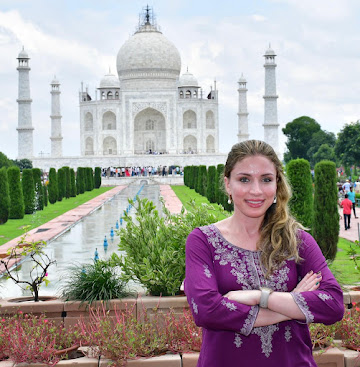
Visitors often notice something curious. When approaching
the Taj Mahal from the main gateway, the building looks much larger and closer
than its actual distance.
This is no coincidence. It’s a brilliant optical illusion
engineered by Mughal architects.
- The
long central water channel and the carefully aligned trees create a forced
perspective. - As
you move forward, the monument doesn’t just appear nearer — it almost
seems to float. - The white
marble surface reflects sunlight differently at dawn, noon, and dusk,
adding another layer of illusion.
Even Shah Jahan himself, confined later in the Agra Fort,
could gaze across the Yamuna River and feel that the Taj Mahal was somehow
closer, as if love itself bent space.

What About the Colors That Change Through the Day?
Stand before the Taj Mahal at sunrise, and you’ll see a soft
pink glow. Wait until midday, and it shines brilliant white. At
sunset, it radiates golden-orange tones. On full moon nights, it seems
almost blue and translucent.
Science explains this wonder:
- Marble
crystals scatter light, making the monument respond to changing
sunlight. - The clean
atmosphere over the river Yamuna amplifies these shifts. - Our
eyes, sensitive to different wavelengths at different times of day,
complete the illusion.
What looks like a divine transformation is, in
fact, physics meeting poetry.
 |
| Source: https://www.pexels.com/photo/photo-of-the-taj-mahal-in-india-15832951/ |
Are the Taj Mahal’s Decorations Painted?
Many believe the floral motifs and intricate patterns on the
façade are painted. But here’s the truth:
- The
technique is called pietra dura (stone inlay). - Craftsmen
carved fine grooves into marble and filled them with semi-precious
stones like lapis lazuli, jade, carnelian, turquoise, and malachite. - No
paint was ever used. What you see are natural stones, still shining
after centuries.
Imagine thousands of tiny fragments, cut with precision, fit
together like a cosmic puzzle. Each flower on the Taj Mahal is eternal, not
painted but born of geology itself.

Why Does This Matter Today?
The Taj Mahal is more than a tourist destination. It’s a
reminder that art and science are inseparable. Architects of the past
used geometry, optics, and materials science without calling it that.
They built illusions to awaken emotions, to make us see with both eyes and
heart.
At FreeAstroScience, we believe in keeping curiosity alive.
The Taj Mahal whispers the same message: don’t stop looking, don’t stop
wondering. Because the sleep of reason, as Francisco Goya warned, breeds
monsters.
Conclusion: A Palace That Teaches Us to See
The Taj Mahal is not only a monument to love. It’s a palace
that teaches us how perception, light, and matter dance together.
- Its
size shifts with perspective. - Its
colors change with the sun. - Its
decorations endure thanks to stones, not paint.
Next time you look at a photo of the Taj Mahal, pause. Ask
yourself: what am I truly seeing — stone, light, or the illusion of eternity?
And come back to FreeAstroScience.com, where we keep asking
questions and finding answers together. Because knowledge, like the Taj Mahal,
is built to last.
Written for you by Flávia Ceccato of FreeAstroScience—where big ideas are made simple, and respect rules.