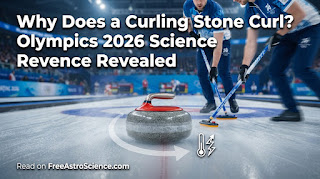

Have you ever wondered why a 20-kilogram granite stone glides across ice and mysteriously curves to the side? As the Milano-Cortina 2026 Winter Olympics unfold, curling isn’t just captivating millions with its strategic gameplay—it’s challenging our understanding of friction, thermodynamics, and material science.
You’re about to discover why this “roaring game” represents one of sport’s most fascinating physics laboratories. From 60-million-year-old volcanic rock to split-second energy bursts that rival Olympic sprinters, we’ll reveal the secrets that separate champions from contenders. Whether you’re a physics enthusiast or simply curious about what’s happening on that ice sheet in Cortina d’Ampezzo, this journey will change how you watch every stone release, every sweep, and every strategic curl toward the house.
This article is crafted especially for you by FreeAstroScience.com—where we make science simple and keep minds alert. Because, as Francisco Goya reminded us, “the sleep of reason breeds monsters.”
Table of Contents
What Makes Ailsa Craig Granite So Special for Olympic Curling?
Every curling stone you’ll see sliding across the ice at the Cortina Olympic Stadium shares a legendary birthplace: Ailsa Craig, a tiny uninhabited island rising from the Firth of Clyde off Scotland’s west coast. But this isn’t about tradition for tradition’s sake—it’s pure material science.
About 60 million years ago, as the supercontinent connecting North America, Greenland, and Europe tore apart, magma cooled deep underground to form what geologists call microgranite. What emerged wasn’t just any rock. Ailsa Craig granite developed an interlocking crystal structure so dense that Phil Stone, an honorary research associate with the British Geological Survey, describes it as “a bit of a devil to break”.
Here’s where it gets really interesting. The stones used in Olympic competition typically feature Blue Hone granite for the running band—the narrow ring that actually contacts the ice. Why? Two critical properties make it irreplaceable:
Extreme hardness: The quartz and feldspar crystals interlock like a three-dimensional puzzle, creating what Godfrey Fitton, professor of igneous petrology at the University of Edinburgh, calls a “mesh” structure. You can hammer it and it barely chips.
Nearly zero water absorption: This might be the most critical factor. Water that penetrates stone expands by 9% when it freezes. In a sport played on ice, where freeze-thaw cycles are constant, that expansion would create microfractures that destroy a stone’s integrity within seasons. Blue Hone granite simply doesn’t let water in.
Think about that for a second. These stones must maintain precise flatness and balance through thousands of impacts, sliding up to 1.7 kilometers per game at speeds generating enough friction to melt ice. One microscopic crack changes everything. That’s why nearly every Olympic stone traces its DNA to this single Scottish island—it’s not nostalgia, it’s engineering necessity.
Why Does a Curling Stone Actually Curl?
Here’s the million-dollar question that’s puzzled physicists for over a century: Why does a rotating curling stone curve sideways? If you release a stone with clockwise rotation, it curves right. Counterclockwise? It sweeps left. Simple observation—but the explanation? That’s where things get wild. phys
The Three-Phase Friction Journey
Recent research from the University of Saskatchewan reveals something remarkable: a curling stone experiences three distinct friction regimes during its 25-second journey down the ice:
1. Wet friction phase (high speed): When you first release the stone, it’s moving fast—hydroplaning on a thin water film created by frictional heating. The pressure and speed actually warm the pebbled ice surface, even though the ambient temperature sits at -4°C.
2. Mixed friction phase (moderate speed): As the stone slows past what curlers call the “break point,” the running band starts creating tiny scratches in the ice pebbles. Think of it as the stone beginning to “bite” into the surface.
3. Dry friction phase (low speed): In the final meters, there’s no lubricating water layer. The stone’s rough protrusions cross the scratches it created moments earlier, and here’s the key—they tend to follow those scratches.
Asymmetric Friction: The Real Culprit
The stone only rotates 2-3 times during its entire path—far too slow for aerodynamic effects like a curveball in baseball. Instead, we’re dealing with what scientists call “asymmetric friction”.
Picture this: The forward-rotating side of the stone (in the direction of travel) moves faster relative to the ice than the backward-rotating side. That faster motion generates more frictional heat, creating a microscopically thicker water layer, which reduces friction on that side. The stone effectively pivots around the slower, higher-friction side—causing the curl.
But wait—there’s more. Research published in Nature Scientific Reports in 2022 confirmed that stones also experience “point-like friction” from discrete pebbles, creating pivot points that amplify the curling effect. Swedish researchers from Uppsala University demonstrated this by pre-scratching ice in various patterns and watching stones follow the grooves—even non-rotating stones could be guided by the scratches.
It’s a dance between thermodynamics and mechanical steering, and scientists are still refining the mathematical models to predict trajectories perfectly. That’s why you’ll see Olympic curlers discussing ice conditions so intensely—tiny changes in pebble size or ice temperature dramatically alter the physics.
How Does Sweeping Change a Stone’s Path?
If you think those athletes frantically scrubbing the ice are just “cleaning” the surface, you’re missing one of sport’s most elegant applications of thermodynamics.
The Heat Generation Strategy
Sweeping generates heat—plain and simple. When curlers apply constant pressure and high-frequency brush strokes just ahead of the moving stone, they’re creating enough friction to momentarily melt the microscopic tops of ice pebbles. This creates a molecular-thin water layer that acts as a lubricant.
The effects are dramatic and twofold:
Increased distance: The reduced friction allows the stone to travel farther—sometimes the difference between scoring and missing entirely.
Straighter trajectory: Here’s the subtle part. By reducing overall friction, sweeping decreases the asymmetric drag between the stone’s left and right sides. Less asymmetric friction means less curl. So sweepers can actually “straighten out” a stone’s path when needed.
The Physical Toll Is Real
Don’t let the smooth ice and strategic atmosphere fool you—sweeping is brutal. Research shows that 20 seconds of aggressive sweeping generates 600-1,600 kilojoules of work. That’s like running an all-out sprint while crouched over, applying massive downward pressure.
Heart rates during intense sweeping average 170 beats per minute, with some athletes hitting nearly 200 bpm—approaching maximum exertion. Over a single game, a player might sweep up to 1.7 kilometers. Think about that the next time you see someone casually chatting between ends—they just completed the equivalent of multiple sprint intervals.
The precision required is even more remarkable. Variables like brush pressure, stroke frequency, environmental conditions, and the specific ice preparation all factor into the outcome. Elite sweepers must calibrate their effort in real-time based on the stone’s speed and the skip’s strategy—all while maintaining that punishing 170+ bpm heart rate.
What Does Curling Demand from an Athlete’s Body?
Curling might look leisurely compared to downhill skiing or speed skating, but the physiological demands tell a different story. These athletes operate two distinct energy systems in rapid succession—and it’s this unique combination that separates recreational players from Olympians.
The Dual-Engine System
Anaerobic power (the sprint engine): When sweeping begins, athletes need immediate explosive power. The anaerobic system delivers energy without requiring oxygen, perfect for those intense 10-20 second bursts of maximum effort. This is the same system sprinters use off the starting blocks.
Aerobic endurance (the recovery engine): But here’s the catch—after that all-out sweeping effort, the athlete must recover quickly while maintaining readiness for the next shot. The aerobic system kicks in, processing oxygen to clear metabolic byproducts and prepare muscles for the next burst.
This alternation creates a fascinating challenge. Research on heart rate recovery in curlers shows that the body must shift from near-maximum exertion (90-94% of heart rate reserve) back to a state of fine motor control in under two minutes. You can’t throw a precise curling stone with a 190 bpm heart rate and shaking arms.
From Power to Precision in Seconds
Think about the complete skill set required: You sweep with maximum intensity, generating massive downward force while sliding in a crouched position. Your heart is hammering, your forearms are burning, and you’ve got maybe 60-90 seconds before you need to execute a shot requiring the touch of a surgeon.
That’s why you’ll see Olympic curlers practicing specific recovery protocols and interval training. They’re not just building cardiovascular fitness—they’re training their bodies to toggle between explosive power and steady-handed precision on demand. It’s a unique physiological profile that doesn’t quite fit any other winter sport.
Why Is Curling Called the Most Honorable Sport?
Beyond the granite and the physics, curling maintains something increasingly rare in modern competitive sports: a self-enforced code of honor that puts integrity above victory.
The Spirit of Curling
The World Curling Federation codifies this ethos as the “Spirit of Curling”. It’s not just a suggestion—it’s the foundational philosophy of the sport. Here’s what makes it remarkable:
Players call their own violations: If you accidentally commit a rule infraction, you’re expected to report it yourself—even if it costs you the game. There’s no waiting for a referee to catch you. Your responsibility is to uphold the integrity of the match.
Winning unfairly is worse than losing: The code explicitly states that “a true curler would prefer to lose rather than win unfairly”. Read that again. It’s written into the sport’s constitution that your reputation and honor matter more than the scoreboard.
No intimidation or distraction: You don’t trash-talk opponents. You don’t try to break their concentration. You don’t celebrate in ways that demean the other team. The emphasis is on “kindly feeling and honorable conduct”.
Why This Matters at Milano-Cortina 2026
In an era where we’re accustomed to seeing professional athletes argue calls, bend rules, and prioritize competitive advantage above all else, curling stands apart. It’s a sport where the athletes themselves are the primary enforcers of fair play.
This isn’t naïve idealism—it’s a practical recognition that curling’s complexity makes referee oversight nearly impossible for every nuance. The sport evolved in small Scottish communities where your word was your bond, and that culture persists at the highest Olympic level.
When you watch the Milano-Cortina 2026 competitions, you’re seeing a sport where scientific precision meets ethical responsibility. The athletes are as committed to the Spirit of Curling as they are to the physics of the perfect draw. That’s not just refreshing—it’s fundamental to what makes curling unique.
The Verdict: Where Science Meets Sportsmanship
So why does a curling stone curl? The answer weaves together 60-million-year-old volcanic geology, asymmetric friction dynamics, thermodynamic manipulation of ice surfaces, and athletes who can shift from maximum cardiac output to surgical precision in under a minute.
Every stone released at the Cortina Olympic Stadium during Milano-Cortina 2026 represents a convergence of material science, physics mysteries still being decoded, and a code of honor that puts fairness above podiums. The granite from that solitary Scottish island travels a path determined by interlocking crystals, rotating friction points, and the heat generated by athletes pushing their cardiovascular systems to the limit.
But perhaps most remarkable is that in a world increasingly dominated by technology, instant replays, and contentious officiating, curling remains a sport where players call their own penalties and would rather lose honestly than win through deception. The science is complex, the physics continue to puzzle researchers, and the integrity remains absolute.
The next time you watch a stone glide down the ice, remember: You’re witnessing one of nature’s rarest materials, behaving according to principles scientists are still unraveling, delivered by athletes balancing explosive power with pinpoint control, all governed by a code of honor that’s centuries old.
That’s not just a sport. That’s physics, physiology, and philosophy colliding on ice.
Want to explore more fascinating intersections of science and sport? Visit FreeAstroScience.com, where we break down the universe’s mysteries—one curious question at a time. Because staying curious keeps our minds sharp and our understanding deep.
Sources
-
Focus.it – “Milano-Cortina 2026: la scienza segreta dietro al fascino del curling alle Olimpiadi invernali” (February 5, 2026) [Provided PDF document]
-
Olympics.com – “How does the combination of pebbled ice and stone shape curling?” (February 3, 2026) – https://www.olympics.com/en/milano-cortina-2026/news/combination-pebbled-ice-stones-shape-curling/
-
Glenn Paulley – “We are getting closer to understanding the physics of curling” (March 26, 2025) – https://glennpaulley.ca/curling/2025/03/27/we-are-getting-closer-to-understanding-the-physics-of-curling/
-
Nature Scientific Reports – “Study of curling mechanism by precision kinematic measurements” (September 2, 2022) – https://www.nature.com/articles/s41598-022-19303-4
-
The Curling Club – “Why Do They Sweep? The Physics of Curling Explained” (December 2, 2025) – https://thecurlingclub.com/blog/why-do-they-sweep-the-physics-of-curling-explained
-
CurlTech – “Ice and Rocks” (January 25, 2026) – https://www.curltech.com/curling-training/ice-and-rocks
-
Science Friday – “Why Olympic Curling Stones Come From This Scottish Island” – https://www.sciencefriday.com/articles/getting-to-the-core-of-olympic-curling-stones/
-
National Museums Scotland – “The Roaring Game: Scotland’s curling stone island” (February 4, 2026) – https://www.nms.ac.uk/discover-catalogue/the-roaring-game-scotlands-curling-stone-island
-
World Curling Federation – “Spirit of Curling” – https://www.capitalcurlingclub.org/spirit-of-curling.html
-
Journal of Sports Science & Medicine – “The Sports Science of Curling: A Practical Review” (November 30, 2009) – https://www.jssm.org/jssm-08-495.xml%3EFulltext
-
Phys.org – “The mechanism that puts the curl in the curling stone revealed” (May 12, 2013) – https://phys.org/news/2013-05-mechanism-stone-revealed.html
-
Rikkyo University – “Solving the century-old mystery of why curling stones curl” (September 4, 2022) – https://english.rikkyo.ac.jp/news/2022/dn4ddm0000005cta.html