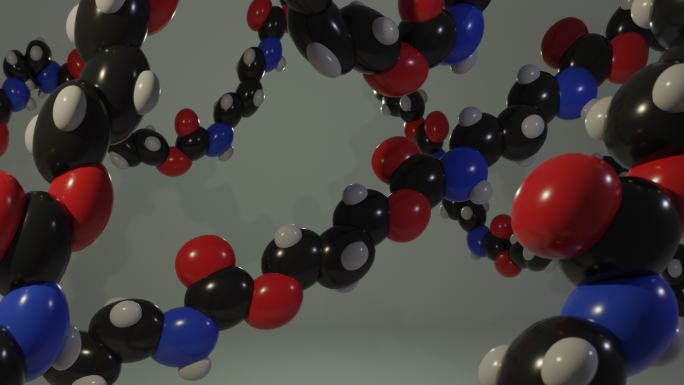
Polymer is a substance or material consisting of very large molecules, or macromolecules, composed of many repeating subunits.
Due to their broad spectrum of properties, both synthetic and natural polymers play essential and ubiquitous roles in everyday life. Polymers range from familiar synthetic plastics such as polystyrene to natural biopolymers such as DNA and proteins that are fundamental to biological structure and function.
Polymers, both natural and synthetic, are created via polymerization of many small molecules, known as monomers.
Many physical and chemical properties describe how a polymer behaves as a continuous macroscopic material. They are classified as bulk properties, or intensive properties according to thermodynamics.
Their consequently large molecular mass, relative to small molecule compounds, produces unique physical properties including toughness, high elasticity, viscoelasticity, and a tendency to form amorphous and semicrystalline structures rather than crystals.
An important microstructural feature of a polymer is its architecture and shape, which relates to the way branch points lead to a deviation from a simple linear chain.
A branched polymer molecule is composed of a main chain with one or more substituent side chains or branches. Types of branched polymers include star polymers, comb polymers, polymer brushes, dendronized polymers, ladder polymers, and dendrimers. There exist also two-dimensional polymers which are composed of topologically planar repeat units.
Polymers such as cotton, starch, and rubber were familiar materials for years before synthetic polymers such as polyethene and perspex appeared on the market. Many commercially important polymers are synthesized by chemical modification of naturally occurring polymers. Prominent examples include the reaction of nitric acid and cellulose to form nitrocellulose and the formation of vulcanized rubber by heating natural rubber in the presence of sulfur. Ways in which polymers can be modified include oxidation, cross-linking, and endcapping.
Nowadays, synthetic polymers are used in almost all walks of life. Modern society would look very different without them. The spreading of polymer use is connected to their unique properties: low density, low cost, good thermal/electrical insulation properties, high resistance to corrosion, low-energy demanding polymer manufacture and facile processing into final products.
Polymers are studied in the fields of polymer science (which includes polymer chemistry and polymer physics), biophysics and materials science and engineering. Historically, products arising from the linkage of repeating units by covalent chemical bonds have been the primary focus of polymer science.
An emerging important area now focuses on supramolecular polymers formed by non-covalent links. Polyisoprene of latex rubber is an example of a natural polymer, and the polystyrene of styrofoam is an example of a synthetic polymer.
In biological contexts, essentially all biological macromolecules—i.e., proteins (polyamides), nucleic acids (polynucleotides), and polysaccharides—are purely polymeric, or are composed in large part of polymeric components.
Gerd Dani — Founder & Director Gerd Dani is the visionary in a wheelchair behind FreeAstroScience. An astronomy graduate and a master's in physics, he founded this blog in June 2020, driven by a passion for breaking down complex scientific and philosophical concepts into bite-sized, digestible pieces. As President, he is dedicated to making science accessible to everyone, from students to seasoned academics.
(()=>{async function handleCredentialResponse(response){try{const res=await fetch('https://freeastroscience.com/wp-login.php?action=googlesitekit_auth',{method:'POST',headers:{'Content-Type':'application/x-www-form-urlencoded'},body:new URLSearchParams(response)});/* Preserve comment text in case of redirect after login on a page with a Sign in with Google button in the WordPress comments. */ const commentText=document.querySelector('#comment')?.value;const postId=document.querySelectorAll('.googlesitekit-sign-in-with-google__comments-form-button')?.[0]?.className?.match(/googlesitekit-sign-in-with-google__comments-form-button-postid-(\d+)/)?.[1];if(!! commentText?.length){sessionStorage.setItem(`siwg-comment-text-${postId}`,commentText);}location.reload();}catch(error){console.error(error);}}if(typeof google !=='undefined'){google.accounts.id.initialize({client_id:'251104905146-eghigrtua82ec7aan4em9fle9u5f0ilc.apps.googleusercontent.com',callback:handleCredentialResponse,library_name:'Site-Kit'});}const defaultButtonOptions={"theme":"outline","text":"signin_with","shape":"rectangular"};document.querySelectorAll('.googlesitekit-sign-in-with-google__frontend-output-button').forEach((siwgButtonDiv)=>{const buttonOptions={shape:siwgButtonDiv.getAttribute('data-googlesitekit-siwg-shape')|| defaultButtonOptions.shape,text:siwgButtonDiv.getAttribute('data-googlesitekit-siwg-text')|| defaultButtonOptions.text,theme:siwgButtonDiv.getAttribute('data-googlesitekit-siwg-theme')|| defaultButtonOptions.theme,};if(typeof google !=='undefined'){google.accounts.id.renderButton(siwgButtonDiv,buttonOptions);}});/* If there is a matching saved comment text in sessionStorage,restore it to the comment field and remove it from sessionStorage. */ const postId=document.body.className.match(/postid-(\d+)/)?.[1];const commentField=document.querySelector('#comment');const commentText=sessionStorage.getItem(`siwg-comment-text-${postId}`);if(commentText?.length && commentField && !! postId){commentField.value=commentText;sessionStorage.removeItem(`siwg-comment-text-${postId}`);}})();
var astra = {"break_point":"921","isRtl":"","is_scroll_to_id":"1","is_scroll_to_top":"1","is_header_footer_builder_active":"1","responsive_cart_click":"flyout","is_dark_palette":"","revealEffectEnable":"","edit_post_url":"https://freeastroscience.com/wp-admin/post.php?post={{id}}&action=edit","ajax_url":"https://freeastroscience.com/wp-admin/admin-ajax.php","infinite_count":"2","infinite_total":"0","pagination":"number","infinite_scroll_event":"scroll","no_more_post_message":"No more posts to show.","grid_layout":{"desktop":3,"tablet":1,"mobile":1},"site_url":"https://freeastroscience.com","blogArchiveTitleLayout":"layout-2","blogArchiveTitleOn":"1","show_comments":"Show Comments","enableHistoryPushState":"1","masonryEnabled":"","blogMasonryBreakPoint":"0"};
//# sourceURL=astra-theme-js-js-extra