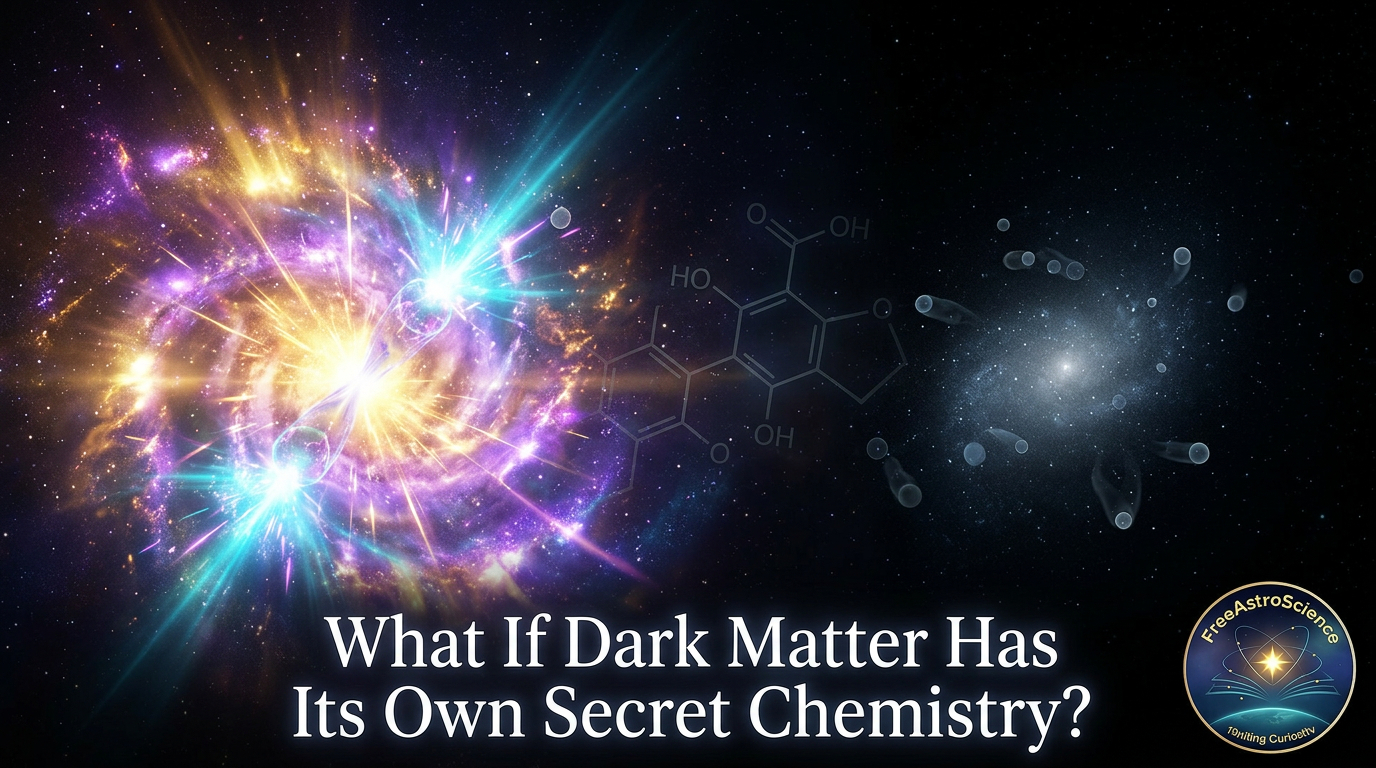
What if everything we thought we knew about dark matter was built on a flawed assumption? What if the invisible substance holding our universe together isn’t one single particle — but a whole *family* of particles, each behaving differently depending on where they live?
Welcome to FreeAstroScience.com, where we explain complex scientific principles in simple terms. We believe the sleep of reason breeds monsters, and we’re here to keep your mind active, curious, and alive. Today, we’re talking about a brand-new idea from Fermilab that could reshape the entire dark matter search. A team of physicists has proposed that dark matter may have its own “chemistry” — and that’s why our telescopes keep getting mixed signals from different corners of the cosmos.
This isn’t just another incremental update. It’s a genuine shift in thinking. So grab a coffee, settle in, and stay with us. By the end of this article, you’ll understand why silence from deep space might actually be *the* clue we’ve been looking for.
—
📑 Table of Contents
—
Dark Matter’s Hidden Chemistry — Why Some Galaxies Glow and Others Stay Silent
1. What Is the Galactic Center Gamma-Ray Excess?
Let’s start with a mystery that has puzzled astrophysicists for over a decade.
The center of our Milky Way glows with an unexpected surplus of high-energy gamma rays. NASA’s Fermi Gamma-Ray Space Telescope first captured this peculiar signal — a spherical haze of radiation radiating from the galactic core that doesn’t fit neatly into any known astrophysical model .
For years, many researchers hoped this *Galactic Center Gamma-Ray Excess* (or GCE, as the community calls it) was the long-sought fingerprint of dark matter. The logic was straightforward: if dark matter particles collide and annihilate in the densest regions of space, they should release detectable energy. And the heart of our galaxy — packed with dark matter — seemed like the perfect stage for that show.
Here’s the exciting part. The GCE’s spectrum and shape match what we’d expect from annihilating dark matter particles with a mass of roughly **50 GeV** (that’s about 50 times the mass of a proton) . The signal’s intensity also lines up with an annihilation cross section of approximately **⟨σv⟩ ~ 10⁻²⁶ cm³/s** — exactly the value predicted by the thermal relic hypothesis .
But — and there’s always a “but” in science — the scientific community hasn’t reached a consensus. There’s a competing explanation that fits the data almost as well: a dense population of **millisecond pulsars**, rapidly spinning neutron stars that emit radiation patterns eerily similar to what dark matter annihilation would produce .
We can’t tell the two apart with current instruments. Not yet, anyway.
—
2. Why Are Dwarf Galaxies So Strangely Quiet?
If the Galactic Center signal really comes from dark matter, we should see something similar — even if weaker — in other dark-matter-rich environments. Right?
That’s exactly why astronomers turned their telescopes toward **dwarf spheroidal galaxies** (dSphs). These tiny satellite galaxies of the Milky Way are almost ideal laboratories for dark matter research. They’re poor in stars and gas, which means very little astrophysical “noise” to confuse the signal. They’re essentially bags of dark matter with a faint dusting of stars.
In theory, we should see dark matter annihilation happening there. In practice? Absolute silence.
Not a whisper. Not a flicker of gamma rays above the background. Nothing.
This absence has been a thorn in the side of dark matter researchers. If the same particles that glow at the Galactic Center live inside dwarf galaxies too, why don’t we see them annihilating there? With a velocity-independent cross section, the dwarf galaxy signal should be roughly 10,000 times fainter than the Galactic Center signal — faint, yes, but not zero.
The silence has pushed many in the community to doubt the dark matter interpretation of the GCE altogether. Some even suggested we should abandon the idea.
But a team from Fermilab had a different thought. What if the silence isn’t a contradiction — but a *clue*?
—
## 3. What Is “dSphobic” Dark Matter?
Enter one of the most creative ideas in particle astrophysics in recent years.
Theoretical physicist **Gordan Krnjaic** of Fermilab, along with collaborators **Asher Berlin**, **Joshua W. Foster**, and **Dan Hooper**, published a paper presenting what they call **”dSphobic Dark Matter”** — dark matter that avoids producing signals in dwarf spheroidal galaxies .
The name itself tells you the story: *dSph* (dwarf spheroidal) + *phobic* (afraid of). This dark matter is, in a poetic sense, “allergic” to the conditions inside dwarf galaxies.
The key insight is this: instead of one dark matter particle species, their model proposes **two distinct states** — a lighter ground state called **χ₁** and a slightly heavier excited state called **χ₂** — separated by a small mass gap .
Here’s the catch: a gamma-ray signal only appears when **both states interact together** through a process called *coannihilation*. One species alone won’t do anything. You need both to be present in the same place at the same time, like two specific chemical reagents that only react when mixed together .
This simple requirement changes everything.
—
4. How Does “Dark Chemistry” Actually Work?
Think of it like a chemical reaction. You can have a warehouse full of hydrogen, but without oxygen, you’ll never get water. The “reaction” — in this case, the annihilation that produces gamma rays — needs both ingredients.
In the Milky Way’s halo, dark matter particles are zipping around at relatively high velocities. When particles of the lighter state (χ₁) slam into each other, they have enough kinetic energy to “kick” one another into the heavier excited state (χ₂). This is called upscattering: χ₁ + χ₁ → χ₂ + χ₂ .
Once enough χ₂ particles exist, coannihilation between χ₁ and χ₂ can happen. Energy pours out as gamma rays. The Galactic Center lights up.
But in dwarf spheroidal galaxies, the dark matter particles move much more slowly. Their kinetic energy is about **three orders of magnitude lower** than in the inner Milky Way . They simply don’t have enough speed to excite one another into the heavier state.
No χ₂ particles get created. No coannihilation occurs. No gamma-ray signal appears.
Silence.
It’s not that there’s no dark matter in dwarf galaxies. There’s plenty of it. But with only one “ingredient” present — like having a room full of hydrogen with no oxygen — no reaction can take place .
The team at Fermilab calls this concept the framework of **”dark chemistry,”** and we love that term. It captures something profound: the dark sector may be governed by its own rules of interaction, mixing, and environmental sorting — much like ordinary chemistry governs the behavior of atoms and molecules .
—
5. How Do Different Cosmic Environments Compare?
To visualize why this model works, let’s compare the key environments side by side.
Source: Berlin, Foster, Hooper & Krnjaic (2025), arXiv:2504.12372
The pattern is striking. The dark matter signal doesn’t simply scale with how much dark matter is present — it depends on how fast those particles are moving. Speed determines whether the upscattering reaction can occur. And that changes everything about how we interpret indirect detection data.
—
6. What Is the Thermal Relic Connection?
Let’s take a quick step back and understand why this matters so deeply to particle physics.
The most compelling theory for how dark matter was produced in the early universe is called thermal freeze-out. In this picture, dark matter particles once swam freely in the hot cosmic soup, constantly creating and destroying each other in collisions with ordinary matter. As the universe expanded and cooled, these reactions stopped — and the dark matter abundance “froze” at a specific level.
This mechanism makes a very clear prediction. For a dark matter particle with roughly weak-scale mass (think tens of GeV), the annihilation cross section should be:
THERMAL RELIC ANNIHILATION CROSS SECTION
⟨σv⟩ ≈ 3 × 10⁻²⁶ cm3 s−1
This is often called the “thermal relic target” — the benchmark for indirect detection experiments.
Here’s what’s remarkable about the Galactic Center Excess: the signal requires an annihilation cross section of almost exactly this value . That’s not a coincidence we can easily dismiss. It fits the thermal relic prediction like a glove.
The dSphobic dark matter model preserves this match beautifully. In the Galactic Center, where upscattering keeps both χ₁ and χ₂ abundantly present, the coannihilation rate matches what a standard thermal relic would produce. No suppression. No extra tweaking needed.
Only in slow environments — like dwarf galaxies — does the signal vanish. And that’s exactly the behavior we observe.
—
7. What Does This Mean for Future Dark Matter Searches?
This new framework carries a serious warning for the next generation of telescopes and surveys.
Until now, the strategy has been clear: if you see dark matter annihilation at the Galactic Center, you should eventually see a fainter version of the same signal in dwarf galaxies. It was supposed to be our confirmation step. Our “second opinion” from the cosmos .
But **dSphobic dark matter shatters that assumption**.
If this model is correct, even a telescope with extraordinary sensitivity might see *nothing* from dwarf galaxies — and the GCE could still be 100% real dark matter.
Several upcoming observatories are entering the picture:
- The Fermi Gamma-Ray Space Telescope** continues to collect data, improving its sensitivity year by year.
- The Vera C. Rubin Observatory (formerly LSST) is expected to discover dozens of new dwarf galaxies, potentially improving indirect detection sensitivity.
- The proposed Advanced Particle-astrophysics Telescope (APT)** could reach sensitivity levels down to ⟨σv⟩ ~ 10⁻²⁷ cm³/s — deep enough to test the thermal relic prediction in dwarf galaxies under standard assumptions.
- Pulsar timing arrays may detect gravitational waves produced by processes in the dark sector, providing an entirely independent way to probe dark matter .
The paper also notes that gravitational lensing — where massive objects warp the path of light — complicates signal interpretation even in well-studied regions. Powerful gravitational fields can alter the apparent intensity of gamma rays, masking or mimicking dark matter signals.
We’re going to need every tool in our toolbox.
—
8. Why Should We Care About Multi-Component Dark Matter?
Let’s be honest. For decades, the dominant approach to dark matter was almost philosophical in its simplicity: one particle, one interaction, one cross section. Hunt it down.
That simplicity was elegant. And it gave us a clear roadmap for experiments. But nature doesn’t owe us simplicity.
Ordinary matter — the stuff we’re made of — involves dozens of fundamental particles, several forces, and an entire periodic table of elements. Why should the dark sector be any different? If anything, assuming dark matter is a single featureless particle might be the most naive possible guess .
The dSphobic model invites us to think bigger. If dark matter has multiple components, if those components interact with each other in ways that depend on energy and environment, then we’re looking at a dark sector with its own physics — its own rules, its own complexity, its own “chemistry”.
Accepting this complexity means something else, too. The silence we hear from dwarf galaxies isn’t evidence against dark matter. It’s a natural consequence of an uneven distribution of dark matter species across different cosmic environments. Silence, in this framework, is data — not absence of data.
That thought should comfort us. We haven’t been looking in the wrong places. We may just have been asking the wrong question.
—
A Final Thought
We’ve covered a lot of ground today — from the glowing heart of our galaxy to the silent, dim dwarf galaxies orbiting it. We’ve explored how a small team at Fermilab built a model where dark matter isn’t one thing, but two things working together. And we’ve seen how the speed of particles in different environments determines whether we see a signal or hear only cosmic silence.
The takeaway? Dark matter is probably more complex than we imagined. And that’s not a failure. That’s science working exactly as it should — following the evidence, updating our models, and resisting the urge to cling to tidy answers when the data points somewhere stranger and more beautiful.
As the astrophysicists of the coming decades combine gamma-ray observations, gravitational wave detections, and multi-wavelength surveys, they’ll slowly transform the silence of space into a detailed map of the invisible matter that governs our universe .
This article was written specifically for you by FreeAstroScience.com — a Science and Cultural Group where complex scientific principles are explained in simple terms. We’re here to educate you, to inspire you, and most of all, to remind you: never turn off your mind. Keep it active at all times. Because the sleep of reason breeds monsters.
Come back to FreeAstroScience.com often. There’s always something new to learn, something new to wonder about, and a community that believes curiosity is the most human thing we have.
—
📚 References & Sources
- Brosseau, F. (2026, April 13). “Materia oscura: oltre il mito della particella singola.” Reccom.org. reccom.org
- Berlin, A., Foster, J. W., Hooper, D., & Krnjaic, G. (2025). “dSphobic Dark Matter.” arXiv:2504.12372v1 [hep-ph]. Fermilab Publication FERMILAB-PUB-25-0227-T. Published in Journal of Cosmology and Astroparticle Physics. arxiv.org/abs/2504.12372