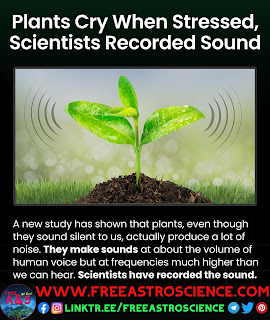
Have you ever wondered what a stressed plant sounds like? Israeli researchers have discovered that when tomato and tobacco plants experience stress, such as dehydration or stem damage, they emit noises similar to bubble wrap being popped. Published in the journal Cell on March 30, the study reveals that these sounds are as loud as everyday human conversation.
Although the frequency of these noises is too high for human ears to detect, it is believed that insects, other mammals, and possibly even other plants can hear them. Lilach Hadany, a senior author and evolutionary biologist at Tel Aviv University, explains that even in the quietest fields, there are sounds we don’t hear, and these sounds contain valuable information. Many animals can hear these sounds, implying that there could be a significant amount of acoustic interaction occurring in nature.
Ultrasonic vibrations have been recorded in plants before, but this study provides the first evidence that these sounds are airborne, making them more relevant to other organisms in the environment. Hadany points out that plants interact with insects and other animals frequently, and many of these organisms rely on sound for communication. It would be inefficient for plants not to utilize sound as well.
To conduct the study, the researchers recorded the sounds of healthy and stressed tomato and tobacco plants, first in a soundproofed acoustic chamber and then in a noisier greenhouse environment. The plants were stressed in two ways: by withholding water for several days and by cutting their stems. The researchers then used a machine-learning algorithm to distinguish between unstressed plants, thirsty plants, and cut plants.
The results showed that stressed plants emit more sounds than their unstressed counterparts. These sounds resemble pops or clicks, with a single stressed plant producing around 30–50 clicks per hour at random intervals. In contrast, unstressed plants produce far fewer sounds. According to Hadany, “When tomatoes are not stressed at all, they are very quiet.”
Gerd Dani — Founder & Director Gerd Dani is the visionary in a wheelchair behind FreeAstroScience. An astronomy graduate and a master's in physics, he founded this blog in June 2020, driven by a passion for breaking down complex scientific and philosophical concepts into bite-sized, digestible pieces. As President, he is dedicated to making science accessible to everyone, from students to seasoned academics.
(()=>{async function handleCredentialResponse(response){try{const res=await fetch('https://freeastroscience.com/wp-login.php?action=googlesitekit_auth',{method:'POST',headers:{'Content-Type':'application/x-www-form-urlencoded'},body:new URLSearchParams(response)});/* Preserve comment text in case of redirect after login on a page with a Sign in with Google button in the WordPress comments. */ const commentText=document.querySelector('#comment')?.value;const postId=document.querySelectorAll('.googlesitekit-sign-in-with-google__comments-form-button')?.[0]?.className?.match(/googlesitekit-sign-in-with-google__comments-form-button-postid-(\d+)/)?.[1];if(!! commentText?.length){sessionStorage.setItem(`siwg-comment-text-${postId}`,commentText);}location.reload();}catch(error){console.error(error);}}if(typeof google !=='undefined'){google.accounts.id.initialize({client_id:'251104905146-eghigrtua82ec7aan4em9fle9u5f0ilc.apps.googleusercontent.com',callback:handleCredentialResponse,library_name:'Site-Kit'});}const defaultButtonOptions={"theme":"outline","text":"signin_with","shape":"rectangular"};document.querySelectorAll('.googlesitekit-sign-in-with-google__frontend-output-button').forEach((siwgButtonDiv)=>{const buttonOptions={shape:siwgButtonDiv.getAttribute('data-googlesitekit-siwg-shape')|| defaultButtonOptions.shape,text:siwgButtonDiv.getAttribute('data-googlesitekit-siwg-text')|| defaultButtonOptions.text,theme:siwgButtonDiv.getAttribute('data-googlesitekit-siwg-theme')|| defaultButtonOptions.theme,};if(typeof google !=='undefined'){google.accounts.id.renderButton(siwgButtonDiv,buttonOptions);}});/* If there is a matching saved comment text in sessionStorage,restore it to the comment field and remove it from sessionStorage. */ const postId=document.body.className.match(/postid-(\d+)/)?.[1];const commentField=document.querySelector('#comment');const commentText=sessionStorage.getItem(`siwg-comment-text-${postId}`);if(commentText?.length && commentField && !! postId){commentField.value=commentText;sessionStorage.removeItem(`siwg-comment-text-${postId}`);}})();
var astra = {"break_point":"921","isRtl":"","is_scroll_to_id":"1","is_scroll_to_top":"1","is_header_footer_builder_active":"1","responsive_cart_click":"flyout","is_dark_palette":"","revealEffectEnable":"","edit_post_url":"https://freeastroscience.com/wp-admin/post.php?post={{id}}&action=edit","ajax_url":"https://freeastroscience.com/wp-admin/admin-ajax.php","infinite_count":"2","infinite_total":"0","pagination":"number","infinite_scroll_event":"scroll","no_more_post_message":"No more posts to show.","grid_layout":{"desktop":3,"tablet":1,"mobile":1},"site_url":"https://freeastroscience.com","blogArchiveTitleLayout":"layout-2","blogArchiveTitleOn":"1","show_comments":"Show Comments","enableHistoryPushState":"1","masonryEnabled":"","blogMasonryBreakPoint":"0"};
//# sourceURL=astra-theme-js-js-extra