What Can a Comet Born Before Our Sun Tell Us About the Universe?
Have you ever wondered what secrets a wanderer from another star system might carry across billions of years and trillions of kilometers? Welcome to FreeAstroScience.com, where we explain complex scientific ideas in language that feels like a conversation between friends. We’re glad you’re here—whether you’re a seasoned space enthusiast or someone just beginning to look up at the night sky with curiosity. Today, we’re telling the story of Comet 3I/ATLAS: an ancient interstellar traveler that dropped by our Solar System and got studied by a spacecraft headed to Jupiter. It’s a story of surprise, ingenuity, and a little cosmic humility. Stick with us to the end—you won’t regret it.

📖 Table of Contents
- 1. What Exactly Is Comet 3I/ATLAS—and Why Does It Matter?
- 2. How Did a Jupiter-Bound Spacecraft End Up Studying a Comet?
- 3. 70 Swimming Pools a Day: How Much Water Was 3I/ATLAS Losing?
- 4. What’s an Anti-Tail, and Why Did This Comet Have One?
- 5. The Numbers Behind an Interstellar Visitor
- 6. Exceptional Yet Ordinary: What Does That Paradox Mean?
- 7. Why Do These Observations Help Protect Earth?
- 8. What Happens Next for JUICE and for Us?
What Exactly Is Comet 3I/ATLAS—and Why Does It Matter?
Picture a snowball older than our Sun, drifting through the dark between stars for billions of years. Then, one day, gravity gently steers it into an unfamiliar neighborhood—ours. That’s Comet 3I/ATLAS in a nutshell.
Discovered on July 1, 2025, 3I/ATLAS became only the third known interstellar object ever detected passing through our Solar System . The first was 1I/’Oumuamua in 2017, a strange cigar-shaped rock that sparked plenty of debate (and yes, alien speculation). The second was 2I/Borisov in 2019, a comet that behaved more like what we’d expect. And now, 3I/ATLAS joined that very exclusive club.
What made this visitor special? Its age, for starters. Scientists estimate it formed over 7 billion years ago—possibly as far back as 10 to 12 billion years . Our own Solar System is about 4.6 billion years old. So this comet was already ancient when Earth was still a swirling cloud of gas and dust. Let that sink in.
By late 2025, 3I/ATLAS reached its closest distance to Earth just before Christmas, becoming a favorite target for telescopes and space missions around the world . Then it slipped behind the Sun for several weeks, hidden from ground-based telescopes. Only robotic explorers—patient and tireless—kept watch.
How Did a Jupiter-Bound Spacecraft End Up Studying a Comet?
Here’s where the story takes an unexpected turn.
The European Space Agency’s JUICE mission (short for JUpiter ICy moons Explorer) wasn’t designed to study comets at all. Its destination is Jupiter and its icy moons—a journey that won’t end until 2031 . Right now, JUICE is in its cruise phase, traveling through interplanetary space, constrained by thermal limits because it’s still relatively close to the Sun.
So how did it end up photographing and analyzing 3I/ATLAS?
Sometimes science demands improvisation. When astronomers realized that JUICE had a chance to observe the comet right after its perihelion (closest approach to the Sun), they made a call. Despite the thermal challenges and the fact that no instrument operations were planned at this stage, the team designed an entirely new observation campaign .
“This campaign was unexpected for everybody! For JUICE, indeed, we are in a cruise phase during which there are thermal constraints… no payload activities were expected to take place at this moment. However, given the uniqueness of these observations, it was decided to prepare this extra observation planning.”
— Olivier Witasse, ESA Project Scientist
That’s the beauty of human curiosity. When something extraordinary happens, we adapt.
70 Swimming Pools a Day: How Much Water Was 3I/ATLAS Losing?
Let’s talk numbers—because they’re wild.
At perihelion, 3I/ATLAS was about 210 million kilometers (130 million miles) from the Sun . That’s farther than Earth’s orbit, so it never got scorching hot. And yet, for a body that may not have passed by any star for at least 10 million years, even that warmth was enough to crack open its icy reserves.
JUICE’s instruments revealed that the comet was shedding roughly 70 Olympic swimming pools’ worth of water per day—about 2,000 kilograms of water vapor every second .
That’s a lot. But perspective matters. Halley’s Comet, which gets much closer to the Sun during its orbit, releases about ten times more water . So while 3I/ATLAS was an enthusiastic outgasser by interstellar standards, it was still moderate compared to familiar Solar System comets.
| Property | 3I/ATLAS | Halley’s Comet |
|---|---|---|
| Water vapor loss rate | ~2,000 kg/s | ~20,000 kg/s |
| Daily loss (Olympic pools) | ~70 | ~700 |
| Perihelion distance from the Sun | 210 million km | ~88 million km |
| Estimated age | 7–12 billion years | ~4.6 billion years |
Here’s what makes this even more fascinating. Most of that water vapor didn’t come directly from the comet’s nucleus. Instead, it came from icy grains in the coma—the halo of dust and gas surrounding the nucleus . The comet was essentially shedding particles, and those particles were evaporating as sunlight heated them. It’s a subtle but important distinction.
What’s an Anti-Tail, and Why Did This Comet Have One?
Most of us have seen pictures of comets with a bright tail streaming behind them, pushed away by sunlight and the solar wind. That’s the classic look. But 3I/ATLAS decided to be a bit dramatic.
Early in the observations, astronomers noticed an anti-tail—a feature that appears to point toward the Sun, not away from it . Sounds impossible, right?
It’s not. An anti-tail happens when a comet releases larger grains of dust and debris that sunlight and solar wind can’t push away effectively . These heavier particles linger near the comet, and from our viewing angle, they create the illusion of a tail pointing sunward.
JUICE’s data confirmed this. The emission of material came mostly from the Sun-facing side of the comet . Imagine walking into a stiff wind: the dust blows off your front, not your back. Same idea, cosmic scale.
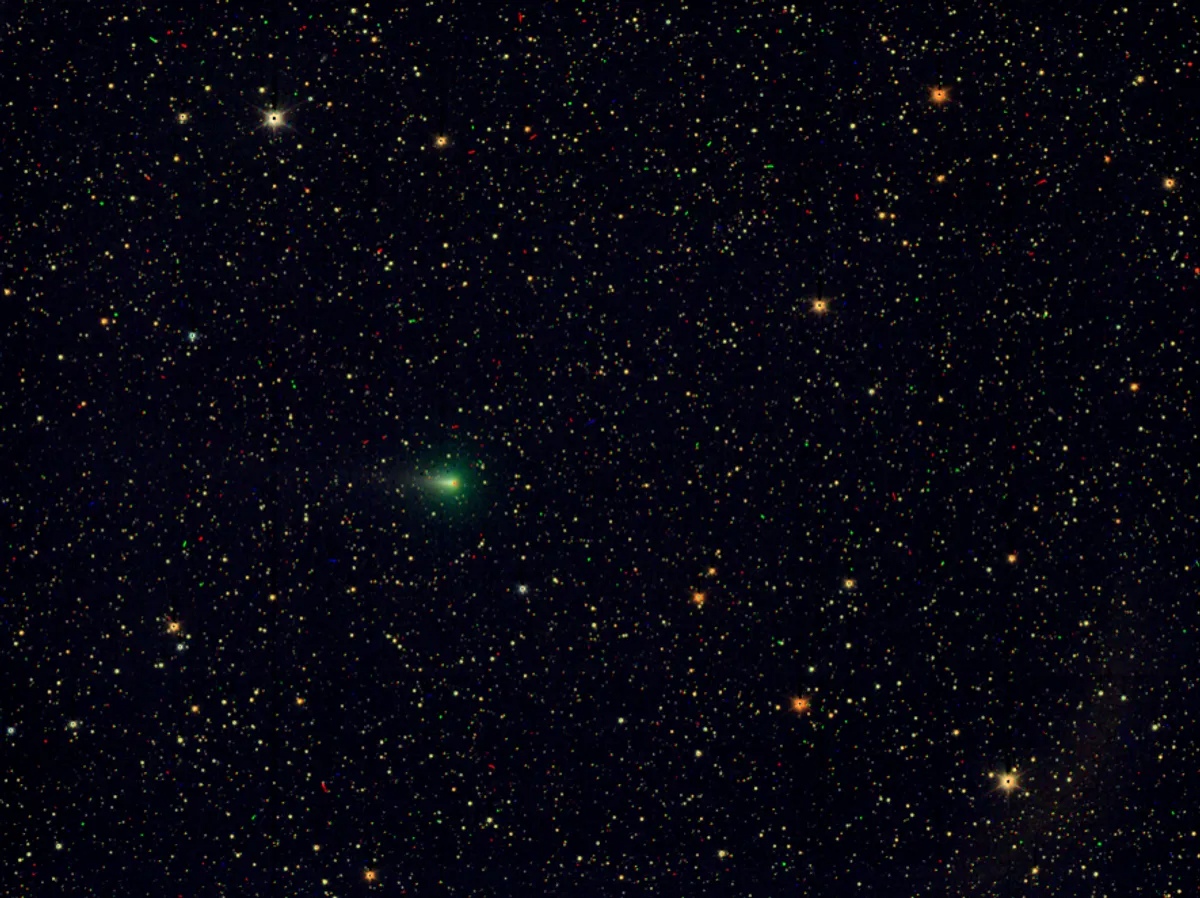
The JANUS camera aboard JUICE captured the comet in both red and blue filters, beautifully revealing its two distinct tails—the normal dust tail and the anti-tail . It’s a striking image, and a reminder that even objects from other star systems play by the same physics when they visit our neighborhood.
The Numbers Behind an Interstellar Visitor
We love numbers at FreeAstroScience—they ground big ideas in concrete reality. So let’s put together the key figures from JUICE’s observations of 3I/ATLAS.
| Parameter | Value |
|---|---|
| Discovery date | July 1, 2025 |
| Interstellar object number | 3rd known |
| Estimated age | 7–12 billion years |
| Time since last stellar encounter | ≥ 10 million years |
| Perihelion distance | 210 million km (130 million mi) |
| Water vapor release | ~2,000 kg/s (~70 Olympic pools/day) |
| Coma extent (UV observations) | 5 million km (3.1 million mi) |
| Comparison: largest known comet tails | Up to 10 million km (6.2 million mi) |
Those ultraviolet observations deserve special attention. The gas and dust envelope around 3I/ATLAS stretched for 5 million kilometers—roughly 3.1 million miles . That’s about 13 times the distance from Earth to the Moon. Large by everyday standards, but not record-breaking for comets. Some tails in our Solar System stretch to 10 million kilometers .
Once again, 3I/ATLAS sat in this strange sweet spot: impressive, but not off-the-charts.
Exceptional Yet Ordinary: What Does That Paradox Mean?
This is the part of the story that really makes you think.
3I/ATLAS was born before our Sun existed. It traveled through interstellar space for billions of years, possibly without ever seeing another star’s light up close. It came from an entirely different planetary system—maybe one that no longer exists. By every definition, it was an extraordinary visitor .
And yet, when scientists studied its behavior—how it released water, how its coma formed, how its tails behaved—it looked like a regular comet . Not alien. Not bizarre. Just… a comet.
What does that tell us? Something profound, actually.
The physics that built our Solar System—the same processes that created our water, our ice, our rocks—aren’t unique to us. Wherever this comet came from, those same fundamental rules were at work. Water ice forms the same way around other stars. Cometary activity follows the same patterns. The universe, it seems, uses the same playbook everywhere.
That’s both humbling and comforting. We’re not alone in the way the cosmos builds things. The ingredients and recipes are shared.
The conclusion so far stresses what astronomers have been saying: the comet was an exceptional object from beyond the Solar System and, at the same time, a pretty regular comet .
Why Do These Observations Help Protect Earth?
Here’s a bonus that many people miss when they hear about comet studies: planetary defense.
3I/ATLAS posed zero threat to Earth . That’s worth saying clearly. But the data JUICE collected allowed scientists to better define the uncertainties in the comet’s orbit . In plain language, they got better at tracking where a fast-moving object in deep space really is, and where it’s going.
Why does that matter? Because other objects—asteroids and comets that do come close to Earth—need the same kind of precision tracking. Every new technique, every new data source, sharpens our ability to detect a genuine threat and respond to it.
Deep-space missions like JUICE can serve as extra “eyes” that fill in the gaps when ground-based telescopes lose sight of an object . It’s like having a network of scouts spread across the Solar System. The more perspectives we have, the safer we are.
💡 Did you know? The water vapor loss rate of 3I/ATLAS can be expressed as a mass flux. At approximately 2,000 kg/s, the daily water mass loss was:
ṁ = 2,000 kg/s × 86,400 s/day ≈ 1.73 × 10⁸ kg/day
That’s roughly 173,000 metric tons of water evaporating into space every single day—from a body that had been frozen for billions of years.
What Happens Next for JUICE and for Us?
JUICE’s comet adventure was a side quest—a brilliant, unplanned one. Now the spacecraft returns to its primary mission: reaching Jupiter and its icy moons in 2031 .
The early performance of its instruments during this comet campaign has scientists optimistic.
“The data we are already seeing from Juice’s instruments is really promising. We are getting more excited about how well they work and how much we will reveal about Jupiter and its icy moons in the 2030s.”
— Claire Vallat, Co-Project Scientist
As for 3I/ATLAS, more data from the observation campaign is still being analyzed. Scientists hope to learn about the comet’s chemical makeup and how its activity changed as it moved away from the Sun . Those details might reveal even more about the conditions in whatever distant star system gave birth to this ancient traveler.
And for the rest of us? We keep watching. We keep asking questions. The universe has sent us three interstellar visitors so far. There will be more. Each one carries a message written in ice and dust, and we’re only beginning to learn how to read it.
A Final Thought
Sometimes the most remarkable discoveries don’t shout. They whisper. Comet 3I/ATLAS didn’t arrive with flashing lights or alien signals. It arrived as a quiet ball of ancient ice, behaving much like any other comet that’s warmed by a star—despite being born in a completely different corner of the galaxy, billions of years before Earth existed.
That’s the message worth carrying: the universe speaks the same language everywhere. Water is water. Ice behaves like ice. Physics doesn’t change at the border of our Solar System. And a spacecraft designed to study Jupiter’s moons can, with a bit of creative thinking, turn into one of the best instruments we’ve ever pointed at an interstellar guest.
We wrote this article for you—here at FreeAstroScience.com, where we break down complex scientific ideas into words that feel like a conversation. We believe that the sleep of reason breeds monsters, so we’ll never stop encouraging you to stay curious, stay skeptical, and stay hungry for understanding.
Come back soon. There’s always more to learn, and we’ll be here when you’re ready.
📚 References & Sources
- Carpineti, A. (2026). “New Deep-Space Color Image And Revolutionary Insight About Interstellar Comet 3I/ATLAS From Jupiter-Bound JUICE Mission.” IFLScience. iflscience.com
- European Space Agency (ESA). JUICE Mission – JUpiter ICy moons Explorer. esa.int/juice
- ESA/Juice/JANUS. RGB and multi-filter imagery of Comet 3I/ATLAS. Image Credit: ESA/Juice/JANUS, 2026.