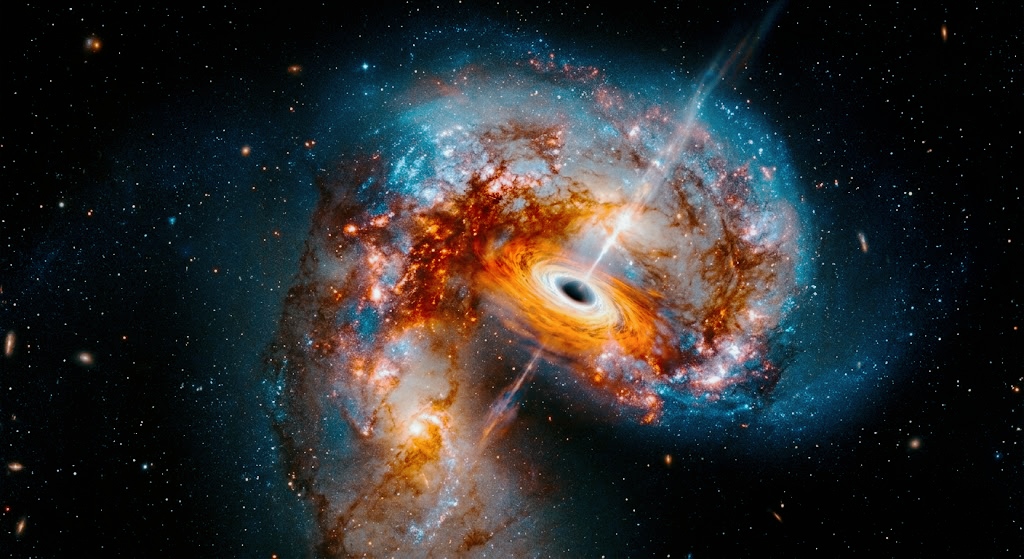

Interacting galaxies are galaxies whose gravitational fields result in a disturbance of one another.
An example of minor interaction is a giant galaxy interacting with its satellites, which is common. A satellite’s gravity could attract one of the primary’s spiral arms, or the secondary satellite’s path could coincide with the position of the primary satellite’s and so would dive into the primary galaxy (the Sagittarius Dwarf Elliptical Galaxy into the Milky Way being an example of the latter).
That can possibly trigger a small amount of star formation. Such orphaned clusters of stars were sometimes referred to as “blue blobs” before they were recognized as stars.
An example of a major interaction is a galactic collision, which may lead to a galaxy merger. Colliding galaxies are common during galaxy evolution. The extremely tenuous distribution of matter in galaxies means these are not collisions in the traditional sense of the word, but rather gravitational interactions.
In case of merging of galaxies, they fall back into each other and eventually merge into one galaxy after many passes through each other. If one of the colliding galaxies is much larger than the other, it will remain largely intact after the merger.
The larger galaxy will look much the same, while the smaller galaxy will be stripped apart and become part of the larger galaxy. When galaxies pass through each other, unlike during mergers, they largely retain their material and shape after the pass.
Galactic collisions are now frequently simulated on computers, which use realistic physics principles, including the simulation of gravitational forces, gas dissipation phenomena, star formation, and feedback. Dynamical friction slows the relative motion galaxy pairs, which may possibly merge at some point, according to the initial relative energy of the orbits. ©NASA
©NASA
Another type of interaction is galaxy harassment, which occurs between a low-luminosity galaxy and a brighter one that takes place within rich galaxy clusters (such as Virgo and Coma), where galaxies are moving at high relative speeds and suffering frequent encounters with other systems of the cluster by the high galactic density of the latter.
According to computer simulations, the interactions convert the affected galaxy disks into disturbed barred spiral galaxies and produces starbursts followed by, if more encounters occur, loss of angular momentum and heating of their gas.
The result would be the conversion of (late type) low-luminosity spiral galaxies into dwarf spheroidals and dwarf ellipticals.
Evidence for the hypothesis had been claimed by studying early-type dwarf galaxies in the Virgo Cluster and finding structures, such as disks and spiral arms, which suggest they are former disk systems transformed by the above-mentioned interactions.
However, the existence of similar structures in isolated early-type dwarf galaxies, such as LEDA 2108986, has undermined this hypothesis.