Tonight’s Sky Holds a Quiet Wonder: The Blue Micromoon of May 31, 2026
Have you ever looked up and felt that the sky was whispering something special, just for you? Tonight, that whisper has a name—the Blue Micromoon—and we won’t see another one quite like it for more than 25 years . Welcome, dear reader. We’re so glad you’re here. We’ve written this piece for you at FreeAstroScience.com, where we translate complex science into clear language for curious minds. Stay with us until the last line: by the end, you’ll know exactly when to step outside, where to look, and why this small, distant Moon carries a story worth telling.
Table of Contents
📑 What you’ll find in this article
- What exactly is a Blue Micromoon?
- When can we actually see it?
- How small and how dim, in real numbers?
- How do we watch it best from home?
- Why is a red star sitting beside the Moon?
- Why isn’t the Moon actually blue?
- When will the next one happen?
- FAQ
What Exactly Is a Blue Micromoon?
Let’s clear the air. The Moon won’t turn blue tonight. The phrase comes from a 16th-century English idiom describing something so rare it might never happen — that’s where “once in a blue moon” was born .
In modern usage, a calendrical Blue Moon is simply the second full Moon to fall within the same calendar month . Our first May full Moon — the Flower Moon — rose on May 1. Tonight’s full Moon is the second, which makes it the “blue” one .
A Micromoon, on the other hand, is a full Moon happening near apogee — the farthest point of the Moon’s elliptical orbit around Earth . So a Blue Micromoon stacks two coincidences on top of each other: a second-in-the-month full Moon, and a full Moon at its greatest distance from us.
That combination is what makes tonight uncommon.
A quick word about names
Some news outlets are calling this a “mini moon.” That’s not right. In astronomy, a minimoon refers to a small natural object — even an asteroid — temporarily captured by Earth’s gravity . A micromoon is something different. We figured you’d want to know.
When Can We Actually See It?
The Moon reaches its exact full phase at 08:45 UTC on Sunday, May 31, 2026 . That’s:
- 10:45 in Italy (CEST)
- 09:45 BST in the UK
- 04:45 a.m. EDT in New York
- 18:45 AEST in Australia
Here’s the thing — peak fullness is a clock moment, not a viewing moment. The Moon looks essentially full from the night of May 30 through the night of June 1 . So you have a wide window.
For most of us, the magic happens at moonrise on Saturday night, when the Moon climbs above the eastern horizon glowing orange and gold.
| Region | City | Local Moonrise |
|---|---|---|
| North America | New York City | 21:12 (May 31) |
| North America | Los Angeles | 20:51 (May 31) |
| North America | Toronto | 21:49 (May 31) |
| UK & Ireland | London | 22:05 (May 31) |
| UK & Ireland | Dublin | 22:45 (May 31) |
| Europe | Paris | 22:40 (May 31) |
| Europe | Berlin | 22:18 (May 31) |
| Europe | Madrid | 22:18 (May 31) |
| Italy | Rome / Milan area | ~21:17 (May 31) |
| Asia / Middle East | Dubai | 19:34 (May 31) |
| Asia | Singapore | 19:08 (May 31) |
| Asia | New Delhi | 19:31 (May 31) |
| Oceania | Sydney | 16:30 (May 31) |
| Pacific | Honolulu | 19:03 (May 30) |
Sources: Sky at Night Magazine and Star Walk
How Small and How Dim, in Real Numbers?
Here’s where the physics gets fun. The Moon’s path around Earth isn’t a perfect circle — it’s an ellipse. So the distance between us and our companion shifts every single day.
Tonight, the Moon will sit roughly 406,134 km (252,360 miles) from Earth at peak fullness, drifting on toward absolute apogee at about 406,366 km on June 1 . Compare that with the Moon’s average distance — around 384,472 km (238,855 miles) — and you can see the gap .
📐 The Math Behind the Smallness
The apparent angular size of the Moon scales inversely with distance. We can express the percentage change in apparent diameter like this:
Δ size (%) = ( 1 − davg / dapogee ) × 100
Plugging in numbers: (1 − 384,472 / 406,134) × 100 ≈ 5.3% smaller in diameter. Brightness scales with the square of distance, which is why this Moon shines roughly 10–10.5% dimmer than an average full Moon — and up to 30% dimmer than a supermoon.
The takeaway? Tonight’s Moon is the smallest full Moon of 2026. To the naked eye, the difference is tiny — about 6% smaller than average and roughly 14% smaller than a supermoon. You won’t gasp at how little it looks. But if you photograph it tonight with the same camera settings you used during last year’s supermoon, the side-by-side will reveal the truth.
How Do We Watch It Best From Home?
We don’t need a telescope. We don’t need an app subscription. We just need a clear horizon and a few quiet minutes.
Simple steps for the best view
- Pick the moonrise window. Step outside at the local time listed in our table above .
- Find the southeast horizon. That’s where the Moon will climb .
- Get away from streetlights if you can. Even a dark balcony works .
- Look low. Late-spring full Moons don’t ride high. They hug the southern sky .
- Wait for the orange glow. Earth’s atmosphere scatters blue light more than red, so a low Moon often looks copper or amber .
A neat trick from photography
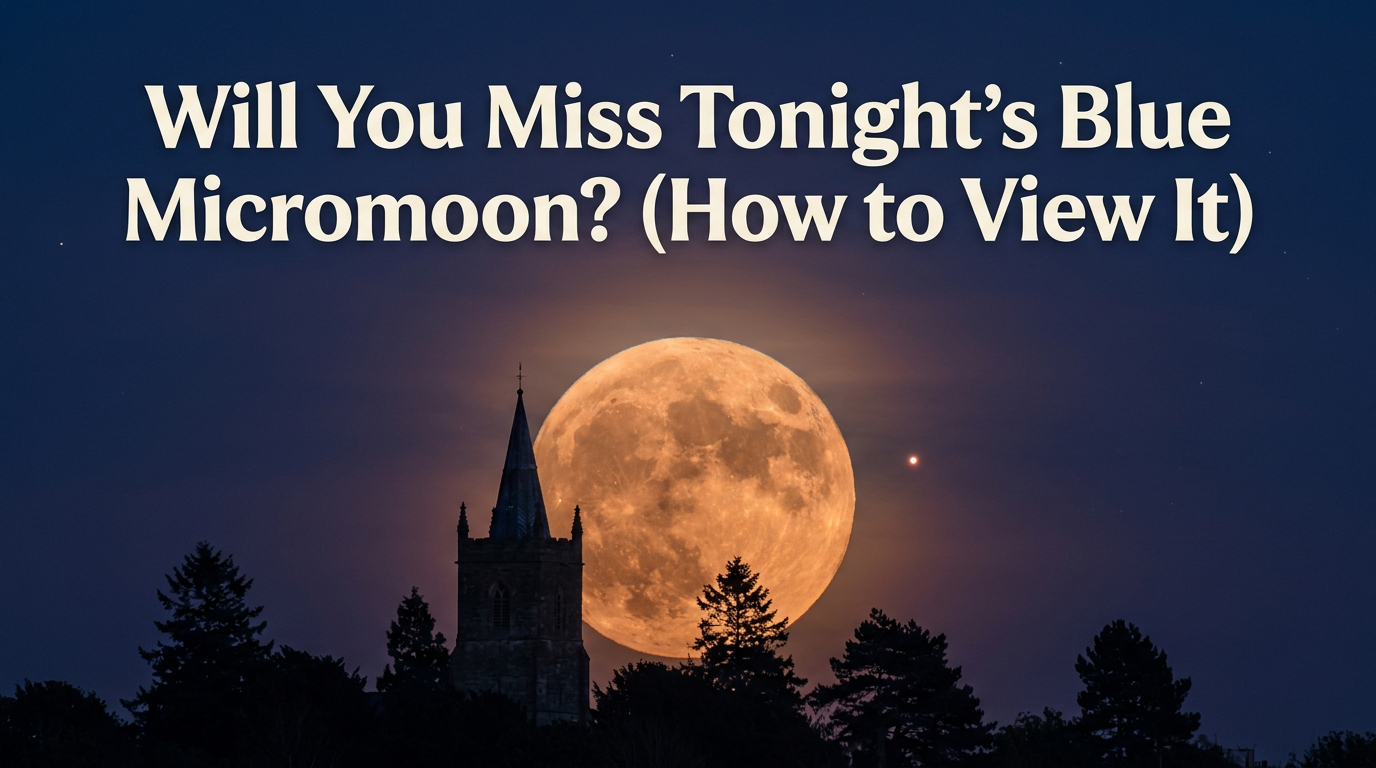
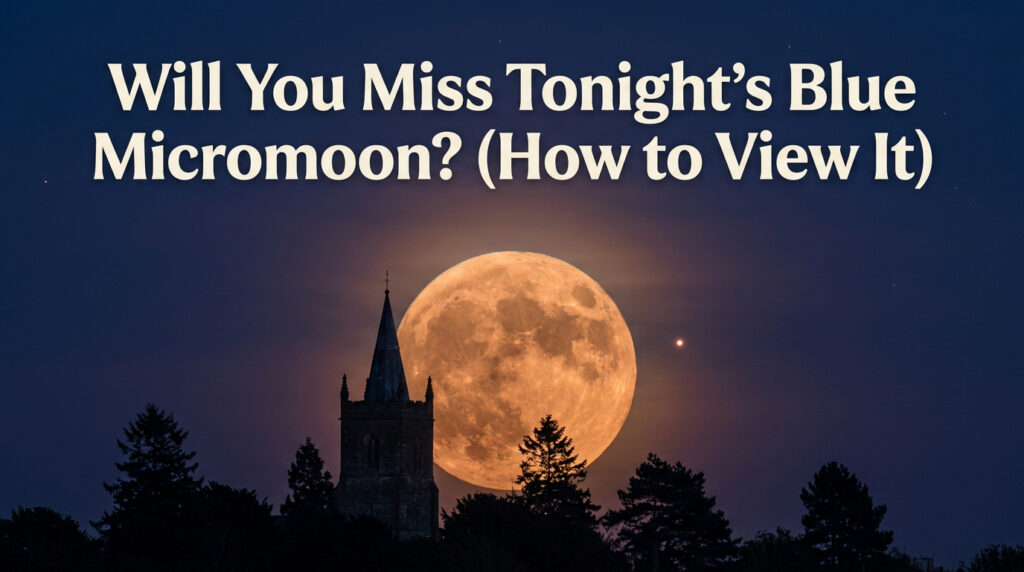
The Moon illusion makes a low Moon look enormous when our brain compares it with trees, buildings, or hills . Frame it behind a landmark — a church tower, a treetop, a distant ridge — and the “micro” suddenly looks majestic. Photographers sometimes use a 200–400 mm lens to compress perspective and make the Moon swell dramatically next to a foreground subject .
For phone shooters: tap to focus on the Moon, drop the exposure so the disk doesn’t blow out, and burst-shoot with a 2-second timer .
Can’t get outside?
The Virtual Telescope Project runs a livestream of the event led by astronomer Gianluca Masi . Hot tea, blanket, browser. Done.
Why Is a Red Star Sitting Beside the Moon?
Look just to the right of the Blue Micromoon and you’ll spot a glowing red point of light. That’s Antares — Greek for “rival of Mars” — the red supergiant heart of the constellation Scorpius . Ancient skywatchers kept mistaking its rusty color for the Red Planet itself.
Antares shines at magnitude 1, which is bright enough to hold its own next to the full Moon’s glare .
And here’s the part that gives us goosebumps: from parts of Antarctica, Argentina, Chile, Bolivia, and nearby regions, the Moon will actually pass in front of Antares, briefly hiding it from view . Astronomers call this a lunar occultation — a small, beautiful eclipse of one celestial body by another.
If you’re south of the equator tonight, that’s worth watching for.
Why Isn’t the Moon Actually Blue?
Honest answer: it almost never is. The Moon’s familiar yellow-white glow comes from sunlight bouncing off lunar regolith — that grey, dusty surface we’ve all seen in close-ups .
A truly blue Moon needs something dramatic in our atmosphere. After the 1883 Krakatoa eruption, ash particles wider than 900 nanometers scattered red wavelengths and let blue light through, and the Moon really did glow blue for months . Massive wildfires can do something similar .
But tonight? No volcano. No mega-fire. The Moon will look like it always does — just slightly smaller, slightly dimmer, and beautifully full .
The name is poetry, not optics.
When Will the Next One Happen?
If you miss tonight, you’ll be waiting a while. Here’s the schedule:
| Event | Date | Type |
|---|---|---|
| Blue Micromoon (this one) | May 31, 2026 | Monthly + Apogee |
| Next Full Moon (Strawberry Moon) | June 29, 2026 | Standard |
| Next Seasonal Blue Moon | May 20, 2027 | Seasonal |
| Next Monthly Blue Moon | December 31, 2028 | Monthly |
| Year with two Blue Moons | 2037 (Jan & Mar) | Double calendrical |
Source: Star Walk, Today.com
A Blue Moon paired specifically with a Micromoon? That combination is what makes tonight unrepeatable for the next quarter-century .
Closing Thoughts From Us at FreeAstroScience
Tonight’s sky is offering us a small thing — a Moon that looks 6% smaller, 10% dimmer, sitting next to a red giant we’ll probably watch our whole lives without truly seeing. And yet here we are, you and us, paying attention together. That’s the whole point.
We wrote this piece for you at FreeAstroScience.com because we believe the night sky is a free university. Every full Moon is a physics lesson. Every red star is chemistry written in light. Every “rare” event is mostly a lesson in geometry — orbits, ellipses, distances we can calculate but rarely feel.
Don’t let your mind switch off. Step outside tonight. Look southeast. Watch a copper Moon rise next to Antares and remember: the sleep of reason breeds monsters, but a curious eye keeps them at bay.
Come back to us at FreeAstroScience.com soon. There’s always more sky to read, and we’ll keep translating it for you, one wonder at a time.
Clear skies. 🌙
FAQ — Quick Answers to Your Top Questions
Q1: What time does the Blue Micromoon peak on May 31, 2026?
The exact full phase happens at **08:45 UTC** — that’s 4:45 a.m. EDT in New York, 09:45 BST in London, 10:45 in Italy, and 18:45 AEST in Sydney.
Q2: Will the Moon really look blue?
No. The “blue” in Blue Moon comes from a 16th-century English phrase for something rare. The Moon will show its usual silvery-white color, possibly tinged orange near the horizon.
Q3: How much smaller will the Micromoon really look?
About 5.5% to 6.9% smaller in diameter and roughly **10–10.5% dimmer** than an average full Moon. The naked eye can barely tell. Cameras can. *
Q4: Where should I look in the sky?
Toward the southeast at moonrise**, then tracking south through the night and setting in the southwest before dawn. The bright red star to the right is Antares.
Q5: When is the next Blue Moon?
The next seasonal Blue Moon arrives on May 20, 2027, and the next monthly Blue Moon falls on **December 31, 2028. But another Blue Micromoon like tonight’s? Not for over 25 years.