Right now, as you read this sentence, a subatomic bullet fired by a dying star is passing straight through your body. You never feel it. Roughly one of these particles crosses every square centimeter of you each minute, and not one has ever asked permission.
Welcome to FreeAstroScience, where we take the universe’s strangest news and hand it back to you in plain language. Cosmic rays are those bullets. They carry direct word from supernovae, black holes, and the restless Sun. Stay with us to the end and you will understand not only what they are, but why a single one of them, caught over a Utah desert in 2021, still keeps physicists up at night.
TL;DR — the direct answer
Cosmic rays are not rays but particles, mostly protons and atomic nuclei, that hit Earth’s atmosphere at almost the speed of light. Most are accelerated by supernova remnants and other violent objects inside and beyond our galaxy, and the rarest carry more energy than any machine on Earth can produce. They are harmless at sea level, yet a serious hazard for astronauts and spacecraft electronics.
What exactly are cosmic rays?
Cosmic rays are fast-moving particles, not beams of light. The name is a century-old mistake we never bothered to fix. When Victor Hess flew a balloon to 5,000 meters in 1912 and found the mysterious radiation growing stronger the higher he went, “rays” seemed a fair guess. It won him a Nobel Prize in 1936. By then physicists already knew the truth: these are bits of matter, mostly bare atomic nuclei stripped of their electrons.
Sort them by what they are and where they are, and two families appear.
| Type | What they are | Typical make-up |
|---|---|---|
| Primary | Particles arriving from space, before they touch the air | About 90% protons, 9% helium nuclei, 1% heavier nuclei like carbon, oxygen and iron |
| Secondary | Debris made when a primary slams into the upper atmosphere | Muons, pions, neutrons, electrons and photons, raining down in a shower |
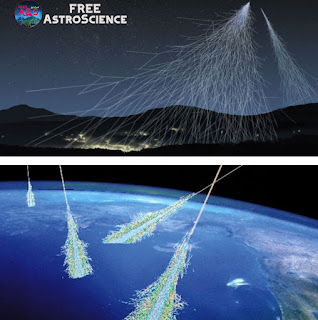
Think of a primary cosmic ray as the incoming round and the secondary shower as the shrapnel. That shrapnel is not trivia. The muon and the positron, two particles that rewrote physics in the 1930s, were both first spotted in cosmic-ray showers years before any accelerator could make them. The sky was the first particle collider, and it is still the most powerful one we have.
Where do cosmic rays come from?
Most cosmic rays are born in the wreckage of dead and dying stars. A supernova remnant, the expanding shell left when a massive star explodes, works as a natural particle accelerator: its shock wave bounces protons back and forth across the magnetic field for thousands of years, adding a kick each pass until they tear free at close to light speed. This has been the textbook answer for decades, and in 2024 it gained a spectacular new chapter.
The Large High Altitude Air Shower Observatory in China, known as LHAASO, found a vast bubble of ultra-high-energy gamma rays glowing over the Cygnus star-forming region. Some of those photons carried 2.5 quadrillion electron volts, the fingerprint of an accelerator flinging particles up to 20 quadrillion electron volts. The team named the class of object a “super-PeVatron” and pinned the most likely culprit on Cygnus OB2, a cluster of young, furnace-hot stars whose colliding winds do the accelerating. It is the first source of its kind ever identified.
Other cosmic rays trace back to the most extreme objects we know. Neutron stars and the whirling gas around black holes shredding stars apart wind particles up in magnetic fields strong enough to fling them across the galaxy. And a gentler, closer source sits 150 million kilometers away: our own Sun. Solar storms hurl clouds of charged particles our way. They carry far less energy than the galactic kind, yet enough to knock out satellites and scramble GPS.
Then there is the small, stubborn fraction that comes from nowhere we can name. Hold that thought.
Just how much energy can one particle carry?
The record-holders carry an almost absurd amount. On 27 May 2021, the Telescope Array in Utah, a grid of 507 detectors spread across 700 square kilometers of desert, registered a single particle of 244 exa-electron-volts. Researchers called it the Amaterasu particle, after the sun goddess of Japanese myth, and published the result in Science in November 2023. Only one confirmed cosmic ray has ever beaten it: the legendary Oh-My-God particle of 1991.
Numbers that large stop meaning anything, so here is the comparison that does.
| Particle | Year | Energy | Caught by |
|---|---|---|---|
| Oh-My-God particle | 1991 | ~320 EeV (3.2 × 10²⁰ eV) | Fly’s Eye, Utah |
| Amaterasu particle | 2021 | ~244 EeV (2.44 × 10²⁰ eV) | Telescope Array, Utah |
| Proton in the Large Hadron Collider | 2015 on | ~0.0000065 EeV (6.5 × 10¹² eV) | CERN, Geneva |
Do the division and the gap is staggering. Amaterasu packed roughly 35 million times the energy the Large Hadron Collider gives a proton. All of it rode on a single particle smaller than an atom. Physicists like to say the Oh-My-God particle carried the energy of a fast-pitched baseball; Amaterasu was in the same league, a brick’s worth of impact folded into one speck of matter. Nature builds accelerators we cannot dream of matching, and it does not tell us how.
How do we catch something we cannot see?
We almost never catch the cosmic ray itself. Instead we catch its shower, or its ghosts, and this is where the last few years have transformed the field. Four instruments now read the sky in ways that were science fiction a generation ago.
Ground arrays that watch the shower
When a primary hits the atmosphere it blooms into billions of secondary particles across kilometers of ground. The Telescope Array and the Pierre Auger Observatory in Argentina carpet the desert with detectors and reconstruct the original particle from where and when the shower lands. In 2024 Auger commissioned its AugerPrime upgrade, adding radio antennas and buried scintillators so it can tell a proton from a heavy nucleus. Its measurements already show that the cosmic rays above 8 EeV arrive slightly more often from one half of the sky, a lopsidedness now measured at 6.8 sigma that points their origin outside the Milky Way.
Neutrinos that draw the map
In June 2023 the IceCube Observatory, a cubic kilometer of instrumented ice at the South Pole, published the first picture of our galaxy made not from light but from neutrinos. These near-massless particles are made when cosmic rays crash into gas in the galactic disk, so the glowing plane in that image is indirect proof of cosmic rays coursing through the Milky Way. It was the first time anyone had seen our own galaxy in this messenger.
Antimatter counted in orbit
Bolted to the International Space Station since 2011, the Alpha Magnetic Spectrometer sifts cosmic rays particle by particle. It confirmed a puzzling excess of positrons, antimatter electrons, that climbs above 10 GeV and falls back near 300 GeV. For years that bump teased the possibility of dark matter. The weight of evidence has since swung toward a duller but likelier answer: nearby pulsars.
Each instrument reads a different page of the same story, and together they have turned a single mystery into a working map.
How do cosmic rays affect life on Earth and in space?
On the ground, cosmic rays barely touch you, thanks to two shields working in tandem. Earth’s magnetic field deflects incoming charged particles, and the atmosphere soaks up the rest, which is why the shower breaks apart high overhead rather than at your feet. We covered the magnetic half of that story in how Earth’s Van Allen belts intercept solar and cosmic radiation. What survives to sea level is mostly muons, about one crossing each square centimeter every minute, harmless as they pass.
Leave the shields behind and the picture darkens fast. This is a real health question for anyone planning to send people to Mars, so it deserves real numbers rather than dread.
| Where you are | Dose | Where the figure comes from |
|---|---|---|
| Natural background on Earth | ~3 mSv per year | UNSCEAR average |
| In transit to Mars | ~1.84 mSv per day | Curiosity RAD detector |
| On the Martian surface | ~0.64 mSv per day | Curiosity RAD detector |
| A full Mars mission (~2.5 years) | ~1.01 Sv total | Curiosity RAD detector |
| Career limit for an ESA astronaut | 1 Sv (about 5% added fatal-cancer risk) | ESA standard |
Read the last two rows together and the problem is plain: a single round trip to Mars would spend an astronaut’s entire career radiation budget, and NASA’s own cancer-risk cap is stricter still. Galactic cosmic rays, not solar storms, are the hard part, since they arrive steadily and are far harder to shield against. Solving that is one of the quiet obstacles standing between us and boots on the red planet.
Machines feel cosmic rays too. A single particle can flip one bit in a memory chip, an effect engineers call a single-event upset. One flipped bit can corrupt a satellite’s data, unsettle an aircraft’s avionics, or crash a server on the ground, which is why systems that cannot fail are built with shielding, error-correcting memory, and backups that vote on the right answer.
Why are the highest-energy ones still a mystery?
The most energetic cosmic rays should not be able to reach us, and yet they do. In 1966 physicists Kenneth Greisen, Georgiy Zatsepin and Vadim Kuzmin predicted a ceiling, now called the GZK limit: a proton above roughly 5 × 10¹⁹ eV loses energy every time it collides with the faint microwave glow left over from the Big Bang. Travel more than a few hundred million light-years and it should slow below that ceiling. So an ultra-high-energy ray must be born close by, in cosmic terms.
Amaterasu breaks the rule twice over. Its energy sits above the GZK limit, and when the Telescope Array traced its arrival direction back across the sky, the line pointed into the Local Void, an unusually empty patch of space next to the Milky Way with no galaxy, no black hole, nothing obvious to have launched it. Either our map of nearby magnetic fields is bending these particles more than we thought, or the physics that makes and carries them is not yet in our books.
That is the honest state of the field: we can send a spacecraft past Pluto and land a rover on Mars, and still the sky drops the occasional particle on us that we cannot explain. A century after Hess, cosmic rays remain a running argument with the universe, and it is winning on points.
Conclusion
Cosmic rays are the universe refusing to stay silent. Every second it sends us particles from exploded stars, from the winds of giant star clusters, and from a few sources so violent or so strange we cannot yet name them. They shaped the physics of the last century, they set limits on how far and how safely we can travel, and their rarest members still make expert physicists shrug and admit they do not know.
This article was written specifically for you by FreeAstroScience.com, where we explain complex scientific principles in simple terms. We ask only one thing in return: never turn off your mind. Keep it awake, curious and a little stubborn, for the sleep of reason breeds monsters. Come back soon. The universe has more to send, and we will read the next message together.
Gerd Dani, President, FreeAstroScience — Science and Cultural Group
Frequently asked questions
What are cosmic rays made of?
Cosmic rays are mostly bare atomic nuclei. About 90 percent are protons, roughly 9 percent are helium nuclei, and about 1 percent are heavier nuclei such as carbon, oxygen, and iron. When they strike the atmosphere they create showers of secondary particles such as muons and pions.
Where do cosmic rays come from?
Most galactic cosmic rays are accelerated by supernova remnants and massive star clusters inside the Milky Way. Others come from the Sun during solar storms, and the rarest, highest energy ones arrive from beyond our galaxy, from sources that remain unidentified.
Are cosmic rays dangerous to humans?
At sea level cosmic rays are harmless, since the atmosphere and Earth magnetic field absorb almost all of them. In space they become a real hazard. A round trip to Mars could expose astronauts to about 1 sievert, close to the lifetime limit set by space agencies.
What was the Amaterasu particle?
The Amaterasu particle was an ultra high energy cosmic ray detected over Utah on 27 May 2021 and announced in 2023. It carried about 244 exa electron volts, rivaling the record 1991 Oh My God particle, yet it appeared to arrive from an almost empty region of space.
Can cosmic rays affect computers and planes?
Yes. A single cosmic ray can flip a bit in a memory chip, an effect engineers call a single event upset. It can corrupt data in satellites, aircraft avionics, and ground computers, which is why critical systems rely on shielding, error correction, and redundant backups.
Sources
- Telescope Array Collaboration. “An extremely energetic cosmic ray observed by a surface detector array.” Science, 24 November 2023. University of Utah announcement: Telescope Array detects second highest-energy cosmic ray ever.
- IceCube Collaboration. “Observation of high-energy neutrinos from the Galactic plane.” Science, 30 June 2023. Announcement: Our galaxy seen through a new lens.
- LHAASO Collaboration. “An ultrahigh-energy gamma-ray bubble powered by a super PeVatron.” Science Bulletin, 26 February 2024: LHAASO identifies the first super PeVatron.
- Pierre Auger Collaboration. “The Pierre Auger Observatory: Results and Prospects” (2025), covering the dipole anisotropy above 8 EeV and the AugerPrime upgrade: arXiv:2504.10333.
- Zeitlin, C., Hassler, D. M., et al. Curiosity Radiation Assessment Detector measurements, Science (2013 and 2014). Southwest Research Institute summary: radiation exposure on a trip to Mars.
- AMS Collaboration. Positron-fraction results from the Alpha Magnetic Spectrometer, and the pulsar interpretation: Could pulsars explain the positron excess?