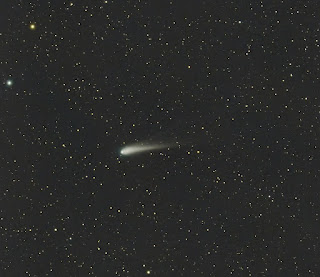

Have you ever wondered what it’s like to witness a celestial visitor streak across our night sky? As stargazers and enthusiasts of the cosmos, we have exciting news to share! Comet C/2023 A3 (Tsuchinshan-ATLAS) is making its grand approach, and it’s expected to become visible to the naked eye. Join us at FreeAstroScience as we explore how you can experience this once-in-a-lifetime astronomical event.
Comet C/2023 A3 (Tsuchinshan–ATLAS) back in July. Image Credit: Dominique Dierick via Flickr CC BY-NC-ND 2.0
What Makes Comet Tsuchinshan-ATLAS Special?
Comet Tsuchinshan-ATLAS, officially designated as C/2023 A3, is garnering significant attention from the astronomical community. Discovered jointly by the Tsuchinshan Observatory in China and the Asteroid Terrestrial-impact Last Alert System (ATLAS), this comet is on a trajectory that brings it unusually close to Earth and the Sun.
- Unique Trajectory: The comet’s orbit will bring it within a favorable viewing distance from Earth.
- Potential Brightness: Predictions suggest it could become one of the brightest comets in recent years.
- Rare Opportunity: Such celestial events are infrequent, making this a must-see for both amateur and professional astronomers.
When and How to Observe the Comet
We expect Comet Tsuchinshan-ATLAS to become visible to the naked eye as it approaches its closest point to the Sun, known as perihelion.
Key Dates to Mark on Your Calendar
- Closest Approach to the Sun (Perihelion): Around September 27, 2024.
- Best Viewing Period: From late September to mid-October 2024.
- Closest Approach to Earth: Approximately October 12, 2024.
Optimal Viewing Conditions
- Location: Look towards the eastern horizon just before dawn in late September, shifting to the western sky after sunset by October.
- Light Pollution: Find a location with minimal light pollution for the best visibility.
- Equipment: While the comet may be visible to the naked eye, using binoculars or a small telescope will enhance your viewing experience.
Tips for Observing Comet Tsuchinshan-ATLAS
- Check Weather Forecasts: Clear skies are essential for observing celestial objects.
- Use Astronomy Apps: Apps can help you track the comet’s position in real-time.
- Photography: For astrophotographers, consider using a tripod and long exposure settings to capture the comet’s tail.
The Science Behind Comets
Comets are fascinating celestial bodies composed of ice, dust, and rocky materials. As they approach the Sun, the heat causes them to sublimate, releasing gas and dust and forming a glowing coma and often a spectacular tail.
- Composition: Primarily water ice, methane, ammonia, and carbon dioxide.
- Origin: Most comets originate from the Kuiper Belt or the Oort Cloud at the outer reaches of our solar system.
- Scientific Importance: Studying comets helps us understand the early solar system since they are considered primordial building blocks.
Previous Observations from Space
Astronauts aboard the International Space Station (ISS) have been privileged to capture stunning images of comets from orbit. The vantage point of the ISS offers a unique perspective, free from atmospheric disturbances.
- Matthew Dominick’s Observation: Astronaut Matthew Dominick recently captured a video of Comet Tsuchinshan-ATLAS rising from Earth’s limb, showcasing its beauty from space.
- Cupola Module: The ISS’s Cupola, a dome-like viewing area, allows astronauts to observe and photograph celestial events with unparalleled clarity.
What We Can Expect
While comets are notoriously unpredictable, astronomers are optimistic about Comet Tsuchinshan-ATLAS:
- Brightness Predictions: It could become as bright as some of the brightest stars, potentially even rivaling Jupiter or Venus in the night sky.
- Visibility: If it survives its journey around the Sun, it will be visible across both the Northern and Southern Hemispheres.
Conclusion
Witnessing Comet Tsuchinshan-ATLAS is an extraordinary opportunity to connect with the cosmos. As we look up at the night sky, we become part of a grander universe, experiencing wonders that have fascinated humankind for millennia. We encourage everyone to take a moment to observe this celestial spectacle.
Stay curious and keep exploring the stars! For more insights and updates on Comet Tsuchinshan-ATLAS and other astronomical events, visit us at FreeAstroScience.com.