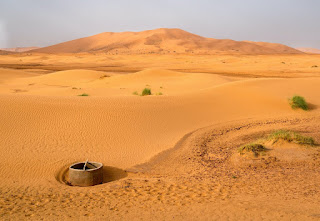
A pair of environmental scientists at the University of California, Santa Barbara, has found that up to 20% of all the groundwater wells in the world are at risk of going dry in the near future. In their paper published in the journal Science, Scott Jasechko and Debra Perrone describe their analysis of groundwater well construction data from millions of wells around the world.
James Famiglietti and Grant Ferguson with the University of Saskatchewan, have published a Perspectives piece in the same journal issue outlining the importance of groundwater management and the work done by the researchers on this new effort.
As the researchers note, most of the water consumed by people comes from groundwater wells—nearly half of the water used for agricultural irrigation does, too. But they also note that to date, very little research has been conducted regarding the state of groundwater levels on a global scale. In this new effort, they sought to fill some of that gap by studying records made of well construction for approximately 39 million wells around the world.
The researchers were able to draw conclusions about the state of groundwater levels. They found that between 6 and 20% of all of the wells around the world currently sit at no more than 16 feet below the water table in which they exist. They note that this means that they are at risk of going dry in the coming decades. They also found that new well construction has, in many instances, not taken into consideration the reduced levels of groundwater, and therefore have not been dug deeper than older wells. They suggest this practice will lead to the new wells running dry just as quickly as the older wells.
Famiglietti and Ferguson note that the reason for shrinking volumes of water in aquifers is that humans remove more water than nature can replenish. In addition to the massive amounts of water withdrawn from underground sources, many places have also begun to experience extended droughts due to global warming. They suggest that unless something changes, access to fresh water may soon become one of the privileges of the rich.
Reference: Scott Jasechko et al. Global groundwater wells at risk of running dry, Science (2021). DOI: 10.1126/science.abc2755
James S. Famiglietti et al. The hidden crisis beneath our feet, Science (2021). DOI: 10.1126/science.abh2867
Gerd Dani — Founder & Director Gerd Dani is the visionary in a wheelchair behind FreeAstroScience. An astronomy graduate and a master's in physics, he founded this blog in June 2020, driven by a passion for breaking down complex scientific and philosophical concepts into bite-sized, digestible pieces. As President, he is dedicated to making science accessible to everyone, from students to seasoned academics.
(()=>{async function handleCredentialResponse(response){try{const res=await fetch('https://freeastroscience.com/wp-login.php?action=googlesitekit_auth',{method:'POST',headers:{'Content-Type':'application/x-www-form-urlencoded'},body:new URLSearchParams(response)});/* Preserve comment text in case of redirect after login on a page with a Sign in with Google button in the WordPress comments. */ const commentText=document.querySelector('#comment')?.value;const postId=document.querySelectorAll('.googlesitekit-sign-in-with-google__comments-form-button')?.[0]?.className?.match(/googlesitekit-sign-in-with-google__comments-form-button-postid-(\d+)/)?.[1];if(!! commentText?.length){sessionStorage.setItem(`siwg-comment-text-${postId}`,commentText);}location.reload();}catch(error){console.error(error);}}if(typeof google !=='undefined'){google.accounts.id.initialize({client_id:'251104905146-eghigrtua82ec7aan4em9fle9u5f0ilc.apps.googleusercontent.com',callback:handleCredentialResponse,library_name:'Site-Kit'});}const defaultButtonOptions={"theme":"outline","text":"signin_with","shape":"rectangular"};document.querySelectorAll('.googlesitekit-sign-in-with-google__frontend-output-button').forEach((siwgButtonDiv)=>{const buttonOptions={shape:siwgButtonDiv.getAttribute('data-googlesitekit-siwg-shape')|| defaultButtonOptions.shape,text:siwgButtonDiv.getAttribute('data-googlesitekit-siwg-text')|| defaultButtonOptions.text,theme:siwgButtonDiv.getAttribute('data-googlesitekit-siwg-theme')|| defaultButtonOptions.theme,};if(typeof google !=='undefined'){google.accounts.id.renderButton(siwgButtonDiv,buttonOptions);}});/* If there is a matching saved comment text in sessionStorage,restore it to the comment field and remove it from sessionStorage. */ const postId=document.body.className.match(/postid-(\d+)/)?.[1];const commentField=document.querySelector('#comment');const commentText=sessionStorage.getItem(`siwg-comment-text-${postId}`);if(commentText?.length && commentField && !! postId){commentField.value=commentText;sessionStorage.removeItem(`siwg-comment-text-${postId}`);}})();
var astra = {"break_point":"921","isRtl":"","is_scroll_to_id":"1","is_scroll_to_top":"1","is_header_footer_builder_active":"1","responsive_cart_click":"flyout","is_dark_palette":"","revealEffectEnable":"","edit_post_url":"https://freeastroscience.com/wp-admin/post.php?post={{id}}&action=edit","ajax_url":"https://freeastroscience.com/wp-admin/admin-ajax.php","infinite_count":"2","infinite_total":"0","pagination":"number","infinite_scroll_event":"scroll","no_more_post_message":"No more posts to show.","grid_layout":{"desktop":3,"tablet":1,"mobile":1},"site_url":"https://freeastroscience.com","blogArchiveTitleLayout":"layout-2","blogArchiveTitleOn":"1","show_comments":"Show Comments","enableHistoryPushState":"1","masonryEnabled":"","blogMasonryBreakPoint":"0"};
//# sourceURL=astra-theme-js-js-extra