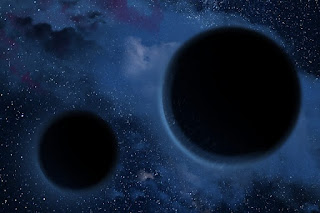
Situated at the heart of our Milky Way galaxy resides a supermassive black hole named Sagittarius A*, possessing a mass equivalent to about 4 million suns. Recent research hints at the potential existence of an adjacent intermediate black hole, its mass yet to be determined. While it’s confirmed that Sagittarius A* lacks nearby supermassive or stellar black holes (those formed by a star’s end-stage collapse), studies seeking intermediate-mass black holes have been scarce.
These astronomical bodies, with masses ranging from 100 to a few thousand solar masses, are considered the missing link in the evolution of supermassive entities. Their elusive nature makes them challenging to pinpoint, though it’s speculated they are more prevalent than believed. Candidates for these intermediate-mass black holes have been detected by the James Webb and Hubble telescopes, with confirmation pending.
To investigate the vicinity of Sagittarius A*, the study’s authors, including a Nobel laureate recognized for proving the existence of this black hole, utilized the orbit of the star named S2. Orbiting closely to the supermassive entity, S2’s trajectory could indicate the presence of another sizable mass. In essence, another black hole near Sagittarius A* would disrupt S2’s orbit, particularly if it’s an intermediate hole, and even more so if supermassive. The star completes an orbit around Sagittarius A* every 16 years, with over two decades of observational data available. Despite no detected gravitational disruptions in S2’s orbit, the researchers hypothesize the intermediate black hole may still be in proximity. They suggest that if the supposed intermediate black hole orbits Sagittarius A* beyond S2’s orbit, its mass would range between 1,000 and 10,000 suns. If it’s closer to Sagittarius A* than the star, it would be as large as 400 solar masses at maximum.
Gerd Dani — Founder & Director Gerd Dani is the visionary in a wheelchair behind FreeAstroScience. An astronomy graduate and a master's in physics, he founded this blog in June 2020, driven by a passion for breaking down complex scientific and philosophical concepts into bite-sized, digestible pieces. As President, he is dedicated to making science accessible to everyone, from students to seasoned academics.
(()=>{async function handleCredentialResponse(response){try{const res=await fetch('https://freeastroscience.com/wp-login.php?action=googlesitekit_auth',{method:'POST',headers:{'Content-Type':'application/x-www-form-urlencoded'},body:new URLSearchParams(response)});/* Preserve comment text in case of redirect after login on a page with a Sign in with Google button in the WordPress comments. */ const commentText=document.querySelector('#comment')?.value;const postId=document.querySelectorAll('.googlesitekit-sign-in-with-google__comments-form-button')?.[0]?.className?.match(/googlesitekit-sign-in-with-google__comments-form-button-postid-(\d+)/)?.[1];if(!! commentText?.length){sessionStorage.setItem(`siwg-comment-text-${postId}`,commentText);}location.reload();}catch(error){console.error(error);}}if(typeof google !=='undefined'){google.accounts.id.initialize({client_id:'251104905146-eghigrtua82ec7aan4em9fle9u5f0ilc.apps.googleusercontent.com',callback:handleCredentialResponse,library_name:'Site-Kit'});}const defaultButtonOptions={"theme":"outline","text":"signin_with","shape":"rectangular"};document.querySelectorAll('.googlesitekit-sign-in-with-google__frontend-output-button').forEach((siwgButtonDiv)=>{const buttonOptions={shape:siwgButtonDiv.getAttribute('data-googlesitekit-siwg-shape')|| defaultButtonOptions.shape,text:siwgButtonDiv.getAttribute('data-googlesitekit-siwg-text')|| defaultButtonOptions.text,theme:siwgButtonDiv.getAttribute('data-googlesitekit-siwg-theme')|| defaultButtonOptions.theme,};if(typeof google !=='undefined'){google.accounts.id.renderButton(siwgButtonDiv,buttonOptions);}});/* If there is a matching saved comment text in sessionStorage,restore it to the comment field and remove it from sessionStorage. */ const postId=document.body.className.match(/postid-(\d+)/)?.[1];const commentField=document.querySelector('#comment');const commentText=sessionStorage.getItem(`siwg-comment-text-${postId}`);if(commentText?.length && commentField && !! postId){commentField.value=commentText;sessionStorage.removeItem(`siwg-comment-text-${postId}`);}})();
var astra = {"break_point":"921","isRtl":"","is_scroll_to_id":"1","is_scroll_to_top":"1","is_header_footer_builder_active":"1","responsive_cart_click":"flyout","is_dark_palette":"","revealEffectEnable":"","edit_post_url":"https://freeastroscience.com/wp-admin/post.php?post={{id}}&action=edit","ajax_url":"https://freeastroscience.com/wp-admin/admin-ajax.php","infinite_count":"2","infinite_total":"0","pagination":"number","infinite_scroll_event":"scroll","no_more_post_message":"No more posts to show.","grid_layout":{"desktop":3,"tablet":1,"mobile":1},"site_url":"https://freeastroscience.com","blogArchiveTitleLayout":"layout-2","blogArchiveTitleOn":"1","show_comments":"Show Comments","enableHistoryPushState":"1","masonryEnabled":"","blogMasonryBreakPoint":"0"};
//# sourceURL=astra-theme-js-js-extra