The discipline of exoplanetary science and the pursuit of life beyond our solar system are advancing at an extraordinary pace. With confirmed exoplanets approaching 6,300, including 223 terrestrial bodies, the development of the Photometric Observations of Exoplanet Transits, or POET, mission represents a critical step forward. This Canadian microsatellite project is specifically designed to identify Earth-sized worlds orbiting the galaxy’s smallest and coolest stars.
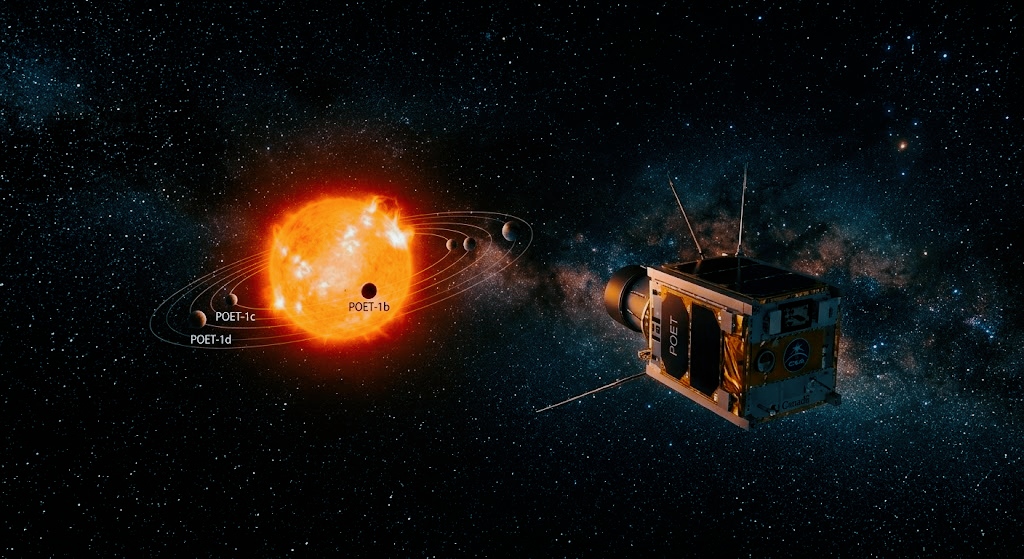
The POET mission
In this context, POET targets what researchers define as ultracool dwarfs, a category that encompasses K-type and M-type stars as well as brown dwarfs. These “failed stars” provide a unique opportunity for detection due to their diminished physical scale compared to larger stellar bodies. Recent documentation, including preprints and proceedings from the SPIE, highlights how POET will leverage these environments to expand our catalog of potentially habitable planets.
The mission focuses on identifying Earth-sized planets and super-Earths that have previously escaped detection. By concentrating on stars that are significantly smaller and cooler than our sun, POET aims to fill a vital gap in our understanding of planetary distribution. This strategic alignment ensures that the mission remains at the forefront of modern astronomical inquiry into extraterrestrial terrestrial analogs.
Technical evolution and the legacy of canadian microsatellites
The POET mission represents a technological evolution of previous Canadian microsatellite successes, specifically the MOST and NEOSSat missions launched in 2003 and 2013. Those earlier satellites featured 15-centimeter telescopes restricted to visible light imaging, focusing on stellar composition and the tracking of asteroids or space debris. Notably, the MOST mission achieved fame for determining the low reflectivity of the hot Jupiter orbiting HD 209458.
POET distinguishes itself through enhanced imaging capabilities and a larger 20-centimeter telescope aperture. Unlike its predecessors, POET is designed to observe across a broad spectrum, including the near-ultraviolet, visible, near-infrared, and short-wave infrared bands. Scheduled for launch in 2029, the current study outlines the proposed goals and projected outcomes regarding the quantity and characteristics of the planets the mission expects to discover.
The integration of multi-wavelength imaging allows for a more comprehensive analysis of stellar environments and potential planetary atmospheres. By moving beyond the limitations of visible light, POET can better distinguish the faint signatures of planets orbiting cooler, redder stars. This leap in capability ensures that the mission will provide high-quality data essential for characterizing the next generation of terrestrial candidates.
Target selection and the search for habitable terrestrial analogs
To ensure mission success, researchers have developed the POET Input Catalog of ultracool dwarfs to identify the most viable candidates within 100 parsecs of Earth. The selection process involved narrowing an initial list of 7,200 stars down to approximately 3,000 by excluding binary systems and overly luminous stars that might interfere with detection. Computer modeling was then utilized to simulate POET’s ability to identify specific Earth-sized targets.
Current estimates suggest that POET could detect planets with radii between 1 and 2.5 times that of Earth and orbital periods ranging from 7 to 50 days. From the refined catalog, the team has identified 100 to 300 high-priority targets for a primary one-year mission. These specific targets are selected based on their potential to host rocky planets within regions where liquid water might exist.
The study concludes that Earth-sized planets discovered around nearby ultracool dwarfs are premier candidates for atmospheric characterization. With short orbital periods, many of these worlds likely reside within the habitable zones of their host stars, making them ideal subjects for the James Webb Space Telescope or the future Habitable World Observatory. Consequently, POET is positioned to provide the most promising terrestrial analogs in the ongoing search for extraterrestrial life.
The study is published on arXiv.