
Ever wondered if a cat could be both alive and dead at the same time? If so, you’ve stumbled into the captivating and puzzling world of quantum mechanics. Schrödinger’s Cat, an iconic thought experiment, challenges our understanding of reality, questioning the nature of observation, measurement, and existence itself. In this article, we’ll dive into the paradox of Schrödinger’s Cat, dissecting its scientific implications and exploring what it means for our understanding of the universe. Let’s see how this simple idea stumped the brightest minds and how it continues to intrigue us!
The Origins of Schrödinger’s Cat: A Mind-Bending Thought Experiment
To understand Schrödinger’s Cat, let’s take a trip back to the 1930s. Quantum physicist Erwin Schrödinger, one of the founding figures of quantum theory, proposed this scenario to critique the Copenhagen Interpretation of quantum mechanics. According to this interpretation, particles exist in multiple states simultaneously until observed. Schrödinger devised his famous “cat-in-a-box” to highlight what he saw as a flaw in this view.
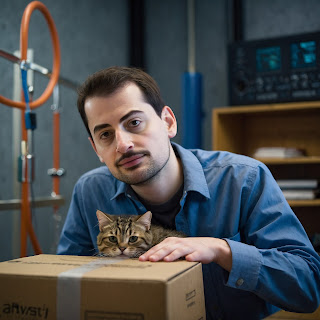
Imagine this: a cat is placed inside a sealed box with a radioactive atom, a Geiger counter, and a vial of poison. If the Geiger counter detects radiation from the decaying atom, the vial breaks, releasing poison and killing the cat. If no decay occurs, the cat remains alive. Quantum mechanics asserts that until we open the box, the cat exists in a superposition—both dead and alive at once. This state of “alive and dead” defies everyday logic, yet it accurately reflects the strange behavior observed in the quantum realm.

Schrödinger’s cat in a closed, trapped box with a random quantum trigger could be simultaneously dead and alive. Hence, the only way to know whether the cat is dead or alive is to open the box and look. Opening the box, however, risks killing the cat. Credits: depositphotos
Why Schrödinger’s Cat Matters: The Debate Over Reality
So, why did Schrödinger choose such a morbid setup to illustrate his point? This experiment was more than a quirky concept; it represented a challenge to the idea that observing or measuring a system determines its state. Schrödinger argued that this notion doesn’t work for complex, visible systems like a cat. By extension, if quantum theory suggests the cat is both alive and dead, then either the theory is incomplete, or we misunderstand the fundamental nature of reality.
Albert Einstein, a close friend and colleague of Schrödinger, supported this critique. Einstein famously quipped that quantum mechanics was like “playing dice with the universe,” and he felt it didn’t fully describe reality. In a letter to Schrödinger, Einstein expressed his admiration for the thought experiment, calling it an “elegant” refutation of the idea that reality is merely a product of observation.
The Interpretations: Multiverses, Objective Collapse, and More
Schrödinger’s Cat has inspired various interpretations of quantum mechanics. Here are some of the most intriguing ones:
-
Many-Worlds Interpretation: This interpretation suggests that every possible outcome occurs in a separate, parallel universe. In one universe, the cat is alive; in another, it’s dead. These realities exist simultaneously but do not interact. This view, though speculative, has been popularized by science fiction and appeals to our curiosity about parallel worlds.
-
Objective Collapse Theories: These suggest that the superposition state collapses automatically due to time or external interactions, meaning that the cat’s fate (alive or dead) is determined well before anyone opens the box. Although these theories are less discussed, they attempt to bridge the gap between quantum behavior and observable reality.
-
The Copenhagen Interpretation: This mainstream theory holds that particles exist in all possible states until observed. Applying it to the cat, Schrödinger’s experiment illustrates the absurdity of applying quantum principles to the macro world we experience. This interpretation highlights how different quantum rules may be from our everyday expectations.
Beyond the Paradox: What Experiments Tell Us
Although Schrödinger’s Cat remains a thought experiment, modern science has conducted tests on larger-than-microscopic objects in superposition. Researchers have placed certain molecules in quantum states, observing temporary superpositions. These experiments demonstrate that superposition is real, but maintaining such states for larger objects remains a massive challenge.
Scientists also know that quantum mechanics works exceptionally well on a microscopic scale, yet they’re still exploring if and how it governs larger, visible objects. For now, Schrödinger’s Cat helps bridge our understanding of quantum theory’s potential and its limits.
So, Is Schrödinger’s Cat Dead or Alive?
The beauty of Schrödinger’s Cat lies in its mystery and its challenge to our perception of reality. Physicist Richard Feynman warned against obsessing over “how” this dual state could be real, likening it to a “drain” that would lead us into confusion rather than clarity. His advice underscores the fundamental strangeness of quantum mechanics: it doesn’t conform to our intuitive sense of reality.
Today, the cat lives on as a symbol of quantum paradox and the mysteries that science is still unraveling. Quantum mechanics has applications in computing, cryptography, and understanding the universe’s origins, yet the full philosophical implications remain unknown. At FreeAstroScience, we embrace these enigmas, where simple questions lead to profound insights into the fabric of reality.
Conclusion: What Schrödinger’s Cat Teaches Us About the Universe
Schrödinger’s Cat is more than just a thought experiment; it’s a lens through which we can view the mind-bending nature of quantum mechanics. By proposing this paradox, Schrödinger dared us to rethink what we consider “real” and the role of observation in determining the state of the universe. Whether the cat is alive, dead, or both, this experiment reminds us that reality, as quantum mechanics shows, may be far stranger than we can comprehend.
In a world where science constantly challenges boundaries, Schrödinger’s Cat encourages curiosity and a willingness to question. At FreeAstroScience, we believe that every question brings us one step closer to the truth—even if it leads to more questions along the way.