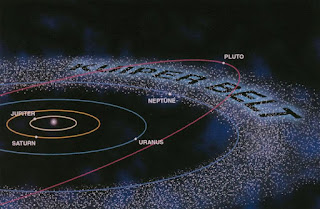

The Kuiper Belt is a region of our solar system close to Pluto’s orbit that was discovered in 1992.
In 1950, Jan Hendrik Oort theorized that long-period comets (lasting more than 200 years) had their origin at a distant 30,000 AU (astronomical unit, or, astronomical unit, 1 AU = 149,597,870 km ( distance from earth to sun) at 60,000 AU from the sun in a region known as the Oort Cloud.
Because they are located beyond Neptune’s orbit, Kuiper belt objects are called Transneptunians, as are Pluto and its moon Charon, and the dwarf planet Eris.
More than 800 Kuiper Belt objects have been observed, which proves its existence. In fact, the proof of the existence of the Kuiper Belt, and the existence of these 800 objects, caused the IAU (International Astronomical Union) to create a new definition for planets, thus making Pluto cease to be considered a planet of solar system and would be considered just a dwarf planet.

In addition to Pluto, many other Kuiper objects are worth mentioning, such as Quaoar, Makemake, Haumea, Orcus and Eris. These are large belt bodies, with many of the largest objects in the region having moons of their own.
💫
1- The belt is beyond the orbits of Jupiter, Saturn, Uranus and Neptune. You can also see the position of Pluto
2- Biggest known objects of the belt