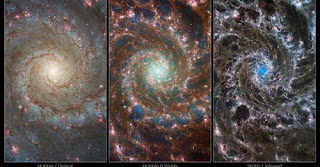
The James Webb Space Telescope just published photographs of the magnificently spiral M74 Phantom Galaxy, demonstrating why it is humanity’s best space telescope to date. The European Space Agency made the images public.
Because it is named after one of NASA’s administrators, the James Webb Space Telescope (JWST) may appear to be a NASA project. What gets lost in the jargon is that the Canadian Space Agency (CSA) and the European Space Agency (ESA) also contribute to the programme.
For example, the ESA contributed to the NIRSpec, the MIRI Instrument, and the launch of the telescope last year. The ESA’s contributions are rewarded with a promise of at least 15% of JWST observation time, a policy that was also maintained for the Hubble Space Telescope.
Taking Down the Phantom Galaxy
The Phantom Galaxy is 32 million light years away from Earth in the constellation Pisces, facing our planet. This makes it easy to see it as a study object.
Furthermore, the galaxy’s spatial arms make it an appealing object to observe in the sky. There are numerous spiral galaxies in the universe. Their spirals, however, are “patchy and jagged to structures,” according to ESA. The spiral arms of the M74, on the other hand, are conspicuous and well-defined, earning it the moniker “grand design spiral.”
Other observatories, including the ground-based Atacama Large Millimeter/submillimeter Array, ALMA, have also captured the M74 using sensors capable of both ultraviolet and visible spectrum wavelengths.
JWST’s perspective on the Phantom Galaxy
Using its Mid-Infrared Instrument, the JWST recently took photos of the Phantom Galaxy M74 (MIRI). The MIRI has a wavelength range of 5-28 microns and is equipped with a camera, according to NASA’s JWST page. This enables the equipment to take wide-field, broadband photos of distant galaxies, freshly emerging stars, and barely detectable comets.
Gerd Dani — Founder & Director Gerd Dani is the visionary in a wheelchair behind FreeAstroScience. An astronomy graduate and a master's in physics, he founded this blog in June 2020, driven by a passion for breaking down complex scientific and philosophical concepts into bite-sized, digestible pieces. As President, he is dedicated to making science accessible to everyone, from students to seasoned academics.
(()=>{async function handleCredentialResponse(response){try{const res=await fetch('https://freeastroscience.com/wp-login.php?action=googlesitekit_auth',{method:'POST',headers:{'Content-Type':'application/x-www-form-urlencoded'},body:new URLSearchParams(response)});/* Preserve comment text in case of redirect after login on a page with a Sign in with Google button in the WordPress comments. */ const commentText=document.querySelector('#comment')?.value;const postId=document.querySelectorAll('.googlesitekit-sign-in-with-google__comments-form-button')?.[0]?.className?.match(/googlesitekit-sign-in-with-google__comments-form-button-postid-(\d+)/)?.[1];if(!! commentText?.length){sessionStorage.setItem(`siwg-comment-text-${postId}`,commentText);}location.reload();}catch(error){console.error(error);}}if(typeof google !=='undefined'){google.accounts.id.initialize({client_id:'251104905146-eghigrtua82ec7aan4em9fle9u5f0ilc.apps.googleusercontent.com',callback:handleCredentialResponse,library_name:'Site-Kit'});}const defaultButtonOptions={"theme":"outline","text":"signin_with","shape":"rectangular"};document.querySelectorAll('.googlesitekit-sign-in-with-google__frontend-output-button').forEach((siwgButtonDiv)=>{const buttonOptions={shape:siwgButtonDiv.getAttribute('data-googlesitekit-siwg-shape')|| defaultButtonOptions.shape,text:siwgButtonDiv.getAttribute('data-googlesitekit-siwg-text')|| defaultButtonOptions.text,theme:siwgButtonDiv.getAttribute('data-googlesitekit-siwg-theme')|| defaultButtonOptions.theme,};if(typeof google !=='undefined'){google.accounts.id.renderButton(siwgButtonDiv,buttonOptions);}});/* If there is a matching saved comment text in sessionStorage,restore it to the comment field and remove it from sessionStorage. */ const postId=document.body.className.match(/postid-(\d+)/)?.[1];const commentField=document.querySelector('#comment');const commentText=sessionStorage.getItem(`siwg-comment-text-${postId}`);if(commentText?.length && commentField && !! postId){commentField.value=commentText;sessionStorage.removeItem(`siwg-comment-text-${postId}`);}})();
var astra = {"break_point":"921","isRtl":"","is_scroll_to_id":"1","is_scroll_to_top":"1","is_header_footer_builder_active":"1","responsive_cart_click":"flyout","is_dark_palette":"","revealEffectEnable":"","edit_post_url":"https://freeastroscience.com/wp-admin/post.php?post={{id}}&action=edit","ajax_url":"https://freeastroscience.com/wp-admin/admin-ajax.php","infinite_count":"2","infinite_total":"0","pagination":"number","infinite_scroll_event":"scroll","no_more_post_message":"No more posts to show.","grid_layout":{"desktop":3,"tablet":1,"mobile":1},"site_url":"https://freeastroscience.com","blogArchiveTitleLayout":"layout-2","blogArchiveTitleOn":"1","show_comments":"Show Comments","enableHistoryPushState":"1","masonryEnabled":"","blogMasonryBreakPoint":"0"};
//# sourceURL=astra-theme-js-js-extra