Where shooting star colors come from

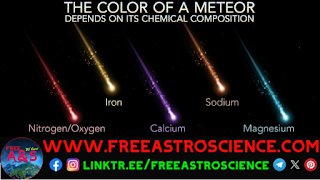
Infographic compares meteor colors from meteoroid sodium, magnesium and iron with green and red atmospheric oxygen emissions.

Why does one meteor streak green and the next one orange, in the same hour of the same shower?

Welcome to FreeAstroScience. After this you’ll be able to look up on a Perseid night and say which part of a shooting star’s streak came off the rock and which part is oxygen in our own air. You’ll also know why the tidy color chart you have seen is only half right.

Meteor colors come from two separate sources: atoms boiled off the meteoroid, and atoms in the air it is tearing through. Sodium glows orange-yellow at 589.2 nm and magnesium green at 518.2 nm, with an iron band running from 526.9 to 544.1 nm, all of it from the grain. Green that lingers after a bright fireball has passed is a forbidden oxygen line at 557 nm, and that one belongs to the atmosphere.

Do the arithmetic on a single Perseid and the number comes out looking like a typo. Perseid grains meet our air at 59 kilometers a second, the figure the International Meteor Organization lists beside every other number for the shower. One gram of anything moving that fast carries about 1.7 million joules. TNT releases 4,184 joules per gram. So the grain, one to ten millimeters across, arrives holding roughly four hundred times its own weight in explosive, and it has to shed every bit of that on the way down.

Why does a meteor glow, if not from friction?

Friction is the wrong picture, and it is the picture almost every explanation reaches for, including the one that stood on this page until today. Ondřejov’s Meteor Physics Group, which has been photographing fireball spectra since the 1950s, describes the light as coming from a cloud of hot gas around the vaporizing meteoroid. Two populations of atoms sit in that cloud. One is the meteoroid’s own material, boiling off its surface, which is what ablation means. The other is air the grain has run into and heated.

Rubbing does not come into it.

At 59 km/s the grain is not sliding past air molecules, it is hitting them hard enough to knock their electrons into higher orbits and to strip atoms off its own face. What you see is those electrons falling back down, each fall releasing one photon at one wavelength. That is why a color chart is possible at all: the light arrives in narrow lines, not as a smooth glow.

Air can do more than one thing with light. It scatters sunlight into the blue overhead, a completely different mechanism, one we took apart in our piece on what color the sky is. Nothing is being scattered here. The air itself is emitting.

The three lines that come off the rock

Three elements do most of the work in an ordinary meteor, and all three belong to the grain itself. Vojáček, Borovička, Koten, Spurný and Štork assembled a catalogue of 84 representative meteor spectra in 2015 and measured exactly these: sodium, magnesium and iron. The lines they tabulate as significant run from 380 to 870 nm. Their meteors sat in the magnitude band +2 to −3, magnitude being the astronomer’s brightness scale where smaller numbers mean brighter, and came from grains one to ten millimeters across.

Betzler and Sekiguchi later put numbers on those same lines across 3,023 spectra recorded from Saitama, Japan, using a Sony a7S, a 50 mm lens and a diffraction grating ruled at 500 lines per millimeter. Sodium sits at 589.2 nm. Magnesium is greener, at 518.2 nm, and iron spreads across a band from 526.9 to 544.1 nm.

Sodium is the one you already know by sight. Low-pressure sodium street lamps run on that same D line. Rüdiger Paschotta’s RP Photonics Encyclopedia gives their output as two narrow lines at 589.0 and 589.6 nm, which is why they wash a road in that flat orange with no color left in it. Sodium-rich grains paint that same orange across the sky, and then stop.

Calcium is in there too. Vojáček and colleagues name magnesium, sodium, iron and calcium as the four meteoric elements their video spectra can pick out. Calcium and the other high-temperature lines come out in the brighter meteors. Our 2023 version of this article gave calcium a purple. None of the sources here supports that color assignment, so it has gone.

Table 1 — Which colors belong to the meteoroid and which to the air (Vojáček et al. 2015 and 2022, Betzler and Sekiguchi 2024, and the Ondřejov Meteor Physics Group).

EmitterLine or bandColor of that wavelengthComes from
Sodium589.2 nmorange-yellowthe meteoroid
Magnesium518.2 nmgreenthe meteoroid
Iron526.9 to 544.1 nmgreen to yellow-greenthe meteoroid
Oxygen, forbidden line557 nmgreenour atmosphere
Oxygen triplet777.4 nmdeep redour atmosphere

Which green belongs to the air?

One green does not come off the rock at all. Among the features the Ondřejov group lists in meteor trails is a forbidden oxygen line at 557 nm, and forbidden has a precise meaning here: a transition so slow only thin air allows it. Down where you are breathing, a collision would knock the atom out of that state long before it emitted anything. Higher up, collisions are rare enough that the atom gets its moment.

Two thermometers are running inside that gas cloud at once. Vojáček and colleagues separate a low-temperature component near 4,500 K from a high-temperature one near 10,000 K, and the hot one shows up mainly in bright, fast meteors. Calcium sits in the hot component. Atmospheric oxygen and nitrogen contribute there too, and the same catalogue says they matter most in the fast ones. A slow meteor keeps a cool cloud and shows mostly the rock’s own lines, while fast ones bring the atmosphere’s lines up with them.

Aurora green comes from that same line and that same atom. Whiter, Partamies, Gustavsson and Kauristie measured where green aurora actually lights up and found it peaks at 114.84 ± 0.06 km, from atomic oxygen at 557.7 nm. Our explainer on how auroras form describes oxygen collisions producing the red and green curtains over the poles. Meteors get there by a different route, hammering the same oxygen atoms with a grain of comet dust instead of with electrons steered down a magnetic field.

You can see the difference from the ground. Magnesium green lives and dies with the streak, because the magnesium is in the streak. An oxygen green can outlast it. When the meteor has gone and a faint green smudge hangs for a second or two where it was, you are not looking at the meteoroid any more. You are looking at our own atmosphere finishing something the grain started.

What still surprises us is how often the green people remember best was never the meteor’s at all.

Does speed change what you see?

Speed changes the mix, and the measurement that pins it down uses a line nobody sees by eye. Vojáček, Borovička and Spurný fitted the oxygen triplet at 777.4 nm across 43 fireballs recorded by the European Fireball Network. Their data run from December 2015 to April 2021, and the relationship came out as a straight line on a logarithmic scale.

log(I777 / Itotal) = 0.026 × v − 3.294

In words: the share of a meteor’s light coming out at 777.4 nm climbs steadily with how fast the thing arrives. Here I777 is the light in that oxygen triplet, Itotal is the meteor’s whole output, and v is speed in km/s; the two coefficients carry uncertainties of ±0.001 and ±0.077. Feed in a Perseid’s 59 km/s and the fraction comes out near 1.7 percent. Geminids arrive at 35 km/s, and the figure drops to about 0.41 percent. The faster shower puts roughly four times as much of its light into that one atmospheric line.

Our arithmetic in that last step does something the authors flag. Their 43 fireballs run from magnitude −8 to −15, far brighter than anything in a normal shower. They also note that meteors faster than about 40 km/s with a flare on the light curve show lower relative 777 nm radiation than the fit predicts. A Perseid sits in exactly that regime.

The direction of the effect is solid. Our factor of four is not.

Composition tracks speed at the shower level too. Betzler and Sekiguchi ran a principal component analysis over their 3,023 spectra and found orbital and kinematic parameters driving line intensity for the Geminids, Leonids, Quadrantids and Perseids. Their classification puts 96.8 percent of Perseids in the normal-spectrum class against 39.5 percent of Geminids. Perseid nights and Geminid nights are not the same night. They also found no pure iron meteoroids anywhere in the set.

What a spectrograph records is not what your eye sees

Every number above came out of an instrument, and the distance between an instrument and an eye is where this article stops being able to help. Vojáček and colleagues say so themselves in the 2015 catalogue, in one flat sentence: “We are not able, at this stage of the research, to determine uncertainties for line strengths or their ratios.” Their spectral resolution limits them to sodium, magnesium, calcium and iron, and nothing more. Betzler and Sekiguchi note that their own sample is biased by the limited meteor magnitude their cameras reach.

None of these sources tells us what a dark-adapted human eye does with those lines at the brightness of an ordinary meteor. Not one.

Nor is that gap small. Between a wavelength on a chart and the thing you actually reported seeing at two in the morning sits a distance we cannot close from this material.

We are also leaving something out on purpose. Some meteoroids arrive with their sodium already gone, and Vojáček and colleagues treat sodium-free and sodium-poor grains as classes of their own, while Ondřejov lists differential sodium ablation as a thread of its own. Sodium loss changes what a whole shower looks like. It deserves its own article, not a paragraph buried here.

Our air is full of things that look like they belong to space and do not. Light pillars standing over a cold town are one. Green that outlasts a meteor is another, and telling them apart is most of the pleasure.

Updated 11 August 2026. Our August 2023 version ran a color chart with no wavelengths on it and credited the glow to friction. Calcium got a purple there that no source supports. Measured lines replace that chart now, and the two atmospheric oxygen lines at 557 and 777.4 nm are new. Seven sources stand where the original had none.

The air brings a color of its own

  • Sodium at 589.2 nm and magnesium at 518.2 nm belong to the grain, and so does the iron band from 526.9 to 544.1 nm.
  • Oxygen’s 557 nm green doesn’t.
  • Forbidden oxygen at 557 nm is our own atmosphere, the same atom Whiter, Partamies, Gustavsson and Kauristie measured peaking at 114.84 km in green aurora.
  • Speed sets the balance: Perseids at 59 km/s put roughly four times as much light into the 777.4 nm oxygen triplet as Geminids at 35 km/s.
  • Our four-times comparison runs past the magnitude range Vojáček, Borovička and Spurný actually fitted.
  • No source here measured any of it against a human eye.

We rewrote this one because the version that stood here for three years handed you a chart with no way to check it. Turning hard physics into words you already own is the job here, and the sources are attached so you can go around us and read them yourself. A mind that stops checking is where nonsense settles. So argue with our reading of that green, and hold the wavelengths up against your own photographs. Geminids peak on 13 and 14 December 2026 at 35 km/s from asteroid 3200 Phaethon, and we will put these same two questions to them then. Written in Rimini on 11 August 2026, the night before the peak, by Gerd Dani for FreeAstroScience.

Sources

  1. Vojáček, V., Borovička, J., Koten, P., Spurný, P., and Štork, R. (2015). Catalogue of representative meteor spectra. Astronomy & Astrophysics, 580, A67. DOI 10.1051/0004-6361/201425047. https://www.aanda.org/articles/aa/full_html/2015/08/aa25047-14/aa25047-14.html
  2. Vojáček, V., Borovička, J., and Spurný, P. (2022). Oxygen line in fireball spectra and its application to satellite observations. Astronomy & Astrophysics, 668, A102. DOI 10.1051/0004-6361/202244217. https://www.aanda.org/articles/aa/full_html/2022/12/aa44217-22/aa44217-22.html
  3. Betzler, A. S., and Sekiguchi, T. (2024). A statistical analysis of over three thousand meteors and their spectra. Monthly Notices of the Royal Astronomical Society, 529(4), 3408-3423. DOI 10.1093/mnras/stae763. https://academic.oup.com/mnras/article/529/4/3408/7630220
  4. Whiter, D. K., Partamies, N., Gustavsson, B., and Kauristie, K. (2023). The altitude of green OI 557.7 nm and blue N2+ 427.8 nm aurora. Annales Geophysicae, 41, 1-12. DOI 10.5194/angeo-41-1-2023. https://angeo.copernicus.org/articles/41/1/2023/
  5. Meteor Physics Group, Astronomical Institute of the Czech Academy of Sciences, Ondřejov. Meteor spectroscopy. https://meteor.asu.cas.cz/en/spectroscopy/
  6. International Meteor Organization. Meteor Shower Calendar. https://www.imo.net/resources/calendar/
  7. Paschotta, R. Sodium vapor lamps. RP Photonics Encyclopedia. https://www.rp-photonics.com/sodium_vapor_lamps.html

*

Scroll to Top