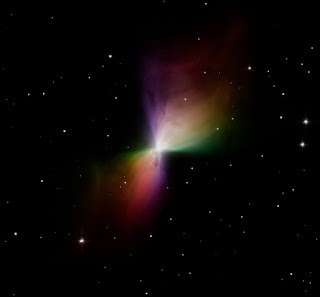
The Boomerang Nebula, recognized as the most frigid object in the universe, boasts a staggering temperature of -272°C. This extreme cold can be attributed to the distinctive evolutionary phase of the central star-nebula system, in which the star is in the process of shedding its outer layers at an exceptional pace. As a result, the gases within the nebula expand at an astounding speed, leading to its unique temperature profile.
Located approximately 5,000 light-years away from Earth in the constellation Centaurus, the Boomerang Nebula was first discovered in 1980. Its peculiar, bow-shaped structure is how it earned its memorable moniker. Further exploration and analysis of the nebula with the Atacama Large Millimeter/submillimeter Array (ALMA) in 2013 unveiled its ultra-cold nature.
The Boomerang Nebula’s central star is believed to be a dying, low-mass sun-like star transitioning into a white dwarf – a dense, compact stellar remnant. The star’s rapid loss of mass triggers the nebula’s gas expansion, resulting in a phenomenon known as adiabatic cooling. As the gas expands, it also cools in the process, plummeting the temperature to near absolute zero (-273.15°C).
This remarkable celestial object provides scientists with valuable insights into the life cycles of stars and the intricate processes that occur within their surrounding environments. Moreover, it offers a rare opportunity to study the interplay between stellar evolution and the formation of planetary nebulae – the colorful, glowing shells of gas and dust expelled by aging stars.
In addition to its importance for understanding stellar life cycles, the Boomerang Nebula also serves as a fascinating window into the broader mysteries of the cosmos. Its extreme conditions and unique characteristics enable researchers to probe the limits of our knowledge about the universe’s vast and diverse landscape, ultimately deepening our appreciation for the complexity and beauty of the cosmos.
Gerd Dani — Founder & Director Gerd Dani is the visionary in a wheelchair behind FreeAstroScience. An astronomy graduate and a master's in physics, he founded this blog in June 2020, driven by a passion for breaking down complex scientific and philosophical concepts into bite-sized, digestible pieces. As President, he is dedicated to making science accessible to everyone, from students to seasoned academics.
(()=>{async function handleCredentialResponse(response){try{const res=await fetch('https://freeastroscience.com/wp-login.php?action=googlesitekit_auth',{method:'POST',headers:{'Content-Type':'application/x-www-form-urlencoded'},body:new URLSearchParams(response)});/* Preserve comment text in case of redirect after login on a page with a Sign in with Google button in the WordPress comments. */ const commentText=document.querySelector('#comment')?.value;const postId=document.querySelectorAll('.googlesitekit-sign-in-with-google__comments-form-button')?.[0]?.className?.match(/googlesitekit-sign-in-with-google__comments-form-button-postid-(\d+)/)?.[1];if(!! commentText?.length){sessionStorage.setItem(`siwg-comment-text-${postId}`,commentText);}location.reload();}catch(error){console.error(error);}}if(typeof google !=='undefined'){google.accounts.id.initialize({client_id:'251104905146-eghigrtua82ec7aan4em9fle9u5f0ilc.apps.googleusercontent.com',callback:handleCredentialResponse,library_name:'Site-Kit'});}const defaultButtonOptions={"theme":"outline","text":"signin_with","shape":"rectangular"};document.querySelectorAll('.googlesitekit-sign-in-with-google__frontend-output-button').forEach((siwgButtonDiv)=>{const buttonOptions={shape:siwgButtonDiv.getAttribute('data-googlesitekit-siwg-shape')|| defaultButtonOptions.shape,text:siwgButtonDiv.getAttribute('data-googlesitekit-siwg-text')|| defaultButtonOptions.text,theme:siwgButtonDiv.getAttribute('data-googlesitekit-siwg-theme')|| defaultButtonOptions.theme,};if(typeof google !=='undefined'){google.accounts.id.renderButton(siwgButtonDiv,buttonOptions);}});/* If there is a matching saved comment text in sessionStorage,restore it to the comment field and remove it from sessionStorage. */ const postId=document.body.className.match(/postid-(\d+)/)?.[1];const commentField=document.querySelector('#comment');const commentText=sessionStorage.getItem(`siwg-comment-text-${postId}`);if(commentText?.length && commentField && !! postId){commentField.value=commentText;sessionStorage.removeItem(`siwg-comment-text-${postId}`);}})();
var astra = {"break_point":"921","isRtl":"","is_scroll_to_id":"1","is_scroll_to_top":"1","is_header_footer_builder_active":"1","responsive_cart_click":"flyout","is_dark_palette":"","revealEffectEnable":"","edit_post_url":"https://freeastroscience.com/wp-admin/post.php?post={{id}}&action=edit","ajax_url":"https://freeastroscience.com/wp-admin/admin-ajax.php","infinite_count":"2","infinite_total":"0","pagination":"number","infinite_scroll_event":"scroll","no_more_post_message":"No more posts to show.","grid_layout":{"desktop":3,"tablet":1,"mobile":1},"site_url":"https://freeastroscience.com","blogArchiveTitleLayout":"layout-2","blogArchiveTitleOn":"1","show_comments":"Show Comments","enableHistoryPushState":"1","masonryEnabled":"","blogMasonryBreakPoint":"0"};
//# sourceURL=astra-theme-js-js-extra