Have you ever looked up at the Sun and wondered what it will become? We all share this sky, and the Sun’s story is our story too. Welcome to FreeAstroScience.com, where we break down the biggest cosmic questions into simple, human terms. Today, we’ll walk together through every stage of the Sun’s life cycle—from its steady glow today to its fiery future as a red giant, and beyond. If you’ve ever asked, “How long until the Sun becomes a red giant?” or “Will the Sun engulf Earth as a red giant?”—you’re in the right place. Stick with us to the end for a deeper understanding of our star’s fate, and remember: at FreeAstroScience, we believe in keeping our minds awake, because the sleep of reason breeds monsters.
Table of Contents
- Where Does the Sun Stand Today — and Why Does It Matter?
- What Starts the Sun’s Transformation? The Subgiant Phase
- How Does the Sun Swell into a Red Giant? The Red Giant Branch Explained
- What Is the Helium Flash — and Should We Be Worried?
- Does the Sun Get a Second Wind? The Horizontal Branch
- What Comes After? The Asymptotic Giant Branch and the Sun’s Final Expansion
- How Does the Sun Create a Planetary Nebula?
- What Is the Sun’s Final Fate as a White Dwarf?
- Solar Evolution at a Glance: All 8 Stages Compared
- Key Solar Formulas: Luminosity, Density, and Core Temperatures
- Final Thoughts: Why the Sun’s Story Matters
- References
What Happens to Our Sun on Its Journey from Main Sequence Star to Red Giant?
Where Does the Sun Stand Today — and Why Does It Matter?
Right now, our Sun is a main sequence star—a cosmic engine quietly fusing hydrogen into helium in its core. This stage is the longest and most stable part of the sun life cycle. The Sun has been shining for about 4.6 billion years, and it’s got roughly 5 billion years left before things start to change in a big way. On the Hertzsprung-Russell diagram, the Sun sits comfortably in the middle, a G-type main sequence star, radiating warmth and light that makes life possible on Earth.
Solar Luminosity Formula:
L☉ = 3.828 × 1026 W
Hydrogen fusion is the Sun’s secret: four hydrogen nuclei combine to make one helium nucleus, releasing energy that keeps the Sun shining and in stellar equilibrium. This balance between gravity pulling in and pressure pushing out is what keeps the Sun stable. But nothing lasts forever—not even stars.
What Starts the Sun’s Transformation? The Subgiant Phase
After about 10 billion years of steady burning, the Sun will run out of hydrogen in its core. That’s when the subgiant phase begins. The core contracts under gravity, getting hotter and denser, while the outer layers start to puff up. The Sun’s radius will grow to about 2–3 times its current size. Its luminosity increases, but the surface cools a bit. This is a quiet but profound shift—the Sun is no longer the star we know.
During this time, the Sun’s energy comes from a shell of hydrogen burning around an inert helium core. The transformation is slow, taking about a billion years, but it sets the stage for the fireworks to come.
How Does the Sun Swell into a Red Giant? The Red Giant Branch Explained
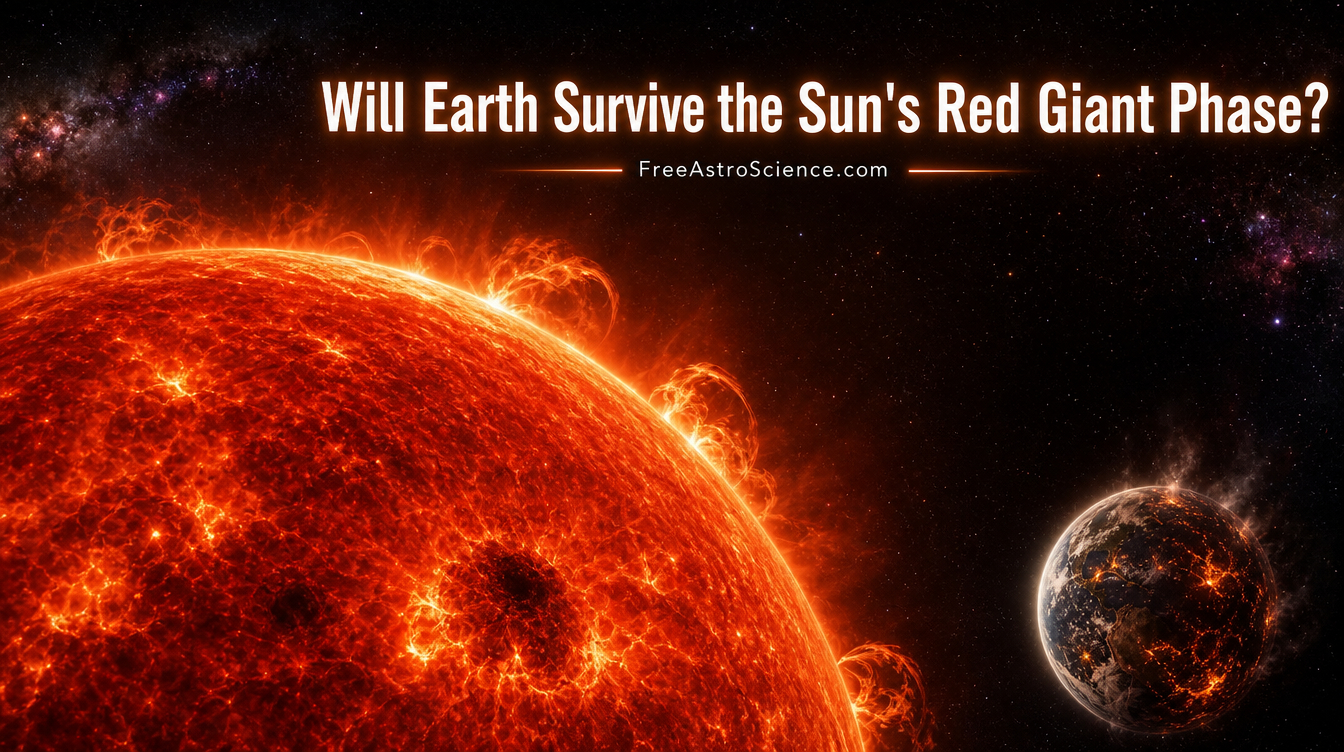
The real drama starts when the Sun enters the red giant branch (RGB), about 11 billion years after its birth. Hydrogen fusion moves to a shell around the core, and the Sun balloons outward—its radius can reach up to 200 times what it is today. The surface cools to between 3,200 and 4,000 K, giving the Sun its red color. But don’t let that fool you: the Sun’s luminosity will soar to 2,000–5,000 times its current brightness.
Inside, the core contracts and heats up, reaching temperatures close to 100 million K. The Sun’s outer layers become so vast that Mercury and Venus will be swallowed whole. Earth’s fate? Let’s take a closer look.
What Happens to Earth When the Sun Becomes a Red Giant?
As the Sun expands, Mercury and Venus will be engulfed. Earth might escape being swallowed, but it won’t be a happy ending. The Sun’s heat will boil away our oceans long before the red giant phase even begins. The surface will be scorched, and life as we know it will be impossible. Some models suggest the Sun’s outer layers could drag Earth inward, sealing its fate. Either way, our planet will be unrecognizable.
What Is the Helium Flash — and Should We Be Worried?
At the tip of the red giant branch, the Sun’s core becomes so dense that electrons are squeezed into a quantum state called degeneracy. When the core temperature hits about 100 million K, helium fusion ignites in a runaway reaction—the helium flash. This event is explosive inside the core but doesn’t blow the Sun apart. Instead, it lifts the degeneracy, allowing the core to expand and cool a bit. The Sun transitions to a new, more stable phase. The helium flash lasts only minutes to hours and isn’t visible from outside, but it’s a turning point in the Sun’s life.
Does the Sun Get a Second Wind? The Horizontal Branch
After the helium flash, the Sun settles onto the horizontal branch. For about 100 million years, it fuses helium into carbon and oxygen in its core. The Sun shrinks to about 10 times its current radius, and its luminosity drops to around 50 times what it is today. The surface temperature rises to about 5,000 K. This is a calmer, shorter chapter—a brief second wind before the final act.
What Comes After? The Asymptotic Giant Branch and the Sun’s Final Expansion
Once the helium in the core is gone, the Sun enters the asymptotic giant branch (AGB). Now, both hydrogen and helium burn in shells around a carbon-oxygen core. The Sun swells again, its radius growing beyond 200 times today’s size. Every 100,000 years or so, thermal pulses shake the star, causing it to lose mass in powerful stellar winds. The Sun’s outer layers are blown away, and its luminosity peaks at up to 5,000 times the current value. The end is near.
How Does the Sun Create a Planetary Nebula?
As the Sun sheds its outer layers, it creates a glowing shell of gas—a planetary nebula. The exposed core, now hotter than 100,000 K, lights up the nebula in brilliant colors. These nebulae are some of the most beautiful sights in the galaxy, captured in stunning detail by the Hubble Space Telescope. This phase is short-lived, lasting only about 10,000 years, but it’s the Sun’s final gift to the cosmos.
What Is the Sun’s Final Fate as a White Dwarf?
What’s left after the nebula fades? A white dwarf—a dense, Earth-sized remnant with a mass about half that of the Sun. There’s no more fusion; the white dwarf simply cools over trillions of years. Its density is mind-boggling: a teaspoon of white dwarf matter would weigh as much as a truck.
White Dwarf Density:
ρ ≈ 106 g/cm3
Over unimaginable timescales, the white dwarf will cool and fade, becoming a “black dwarf.” But the universe isn’t old enough for any black dwarfs to exist yet. The Sun’s story ends in quiet darkness, but its atoms will live on—perhaps in new stars, planets, or even life elsewhere.
Solar Evolution at a Glance: All 8 Stages Compared
| Stage Name | Timeframe | Core Temp (K) | Surface Temp (K) | Luminosity (L☉) | Radius (R☉) | Key Events |
|---|---|---|---|---|---|---|
| Main Sequence | 0–10 billion yrs | ~15 million | ~5,778 | 1 | 1 | Stable hydrogen fusion |
| Subgiant | 10–11 billion yrs | Rising | Slightly decreasing | Increasing | 2–3 | Core contracts, outer layers expand |
| Red Giant Branch | 11–12.2 billion yrs | Up to 100 million | 3,200–4,000 | 2,000–5,000 | Up to 200 | Hydrogen shell burning, huge expansion |
| Helium Flash | ~12.2 billion yrs | ~100 million | N/A | N/A | N/A | Explosive helium ignition in core |
| Horizontal Branch | ~12.2–12.3 billion yrs | ~100 million | ~5,000 | ~50 | ~10 | Stable helium fusion |
| Asymptotic Giant Branch | ~12.3–12.32 billion yrs | ~100 million | ~3,000 | Up to 5,000 | >200 | Double shell burning, mass loss |
| Planetary Nebula | ~12.32 billion yrs | >100,000 | N/A | N/A | N/A | Outer layers expelled, nebula forms |
| White Dwarf | >12.32 billion yrs | >100,000 (initially) | Cooling from >100,000 | ~0.01 | ~0.01 (Earth-sized) | No fusion, slow cooling |
Key Solar Formulas: Luminosity, Density, and Core Temperatures
Solar Luminosity:
L☉ = 3.828 × 1026 W
White Dwarf Density:
ρ ≈ 106 g/cm3
Core Temperature Comparison:
Tcore(Main Sequence) ≈ 1.5 × 10⁷ K
Tcore(RGB tip) ≈ 1 × 10⁸ K
Final Thoughts: Why the Sun’s Story Matters
The Sun’s journey from a stable main sequence star to a cosmic colossus and finally a quiet white dwarf is a story of change, resilience, and cosmic recycling. We’ve seen how the Sun’s life cycle unfolds in eight dramatic stages—each one shaping not just our solar system, but the very atoms that make us who we are. Understanding the solar evolution stages connects us to the bigger story of the universe. It reminds us that change is natural, endings lead to new beginnings, and even stars have their time to shine.
At FreeAstroScience.com,* we’re here to explain complex science in simple terms, and to remind you: never turn off your mind. As Goya warned, the sleep of reason breeds monsters. Stay curious, keep questioning, and come back soon to keep your mind—and your universe—awake.