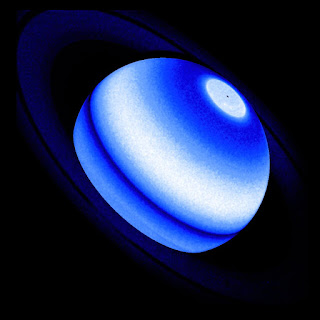
The iconic planet Saturn, famous for its stunning ring system, has always captivated astronomers and stargazers alike. These majestic rings, which can be effortlessly observed through a simple telescope, are now believed to play a significant role in influencing the giant planet’s climate. A groundbreaking discovery, made possible through a combination of observations from the Hubble Space Telescope, the Cassini probe, Voyager 1 and 2 probes, and the International Ultraviolet Explorer mission, has shed new light on the interaction between Saturn’s rings and its atmosphere.
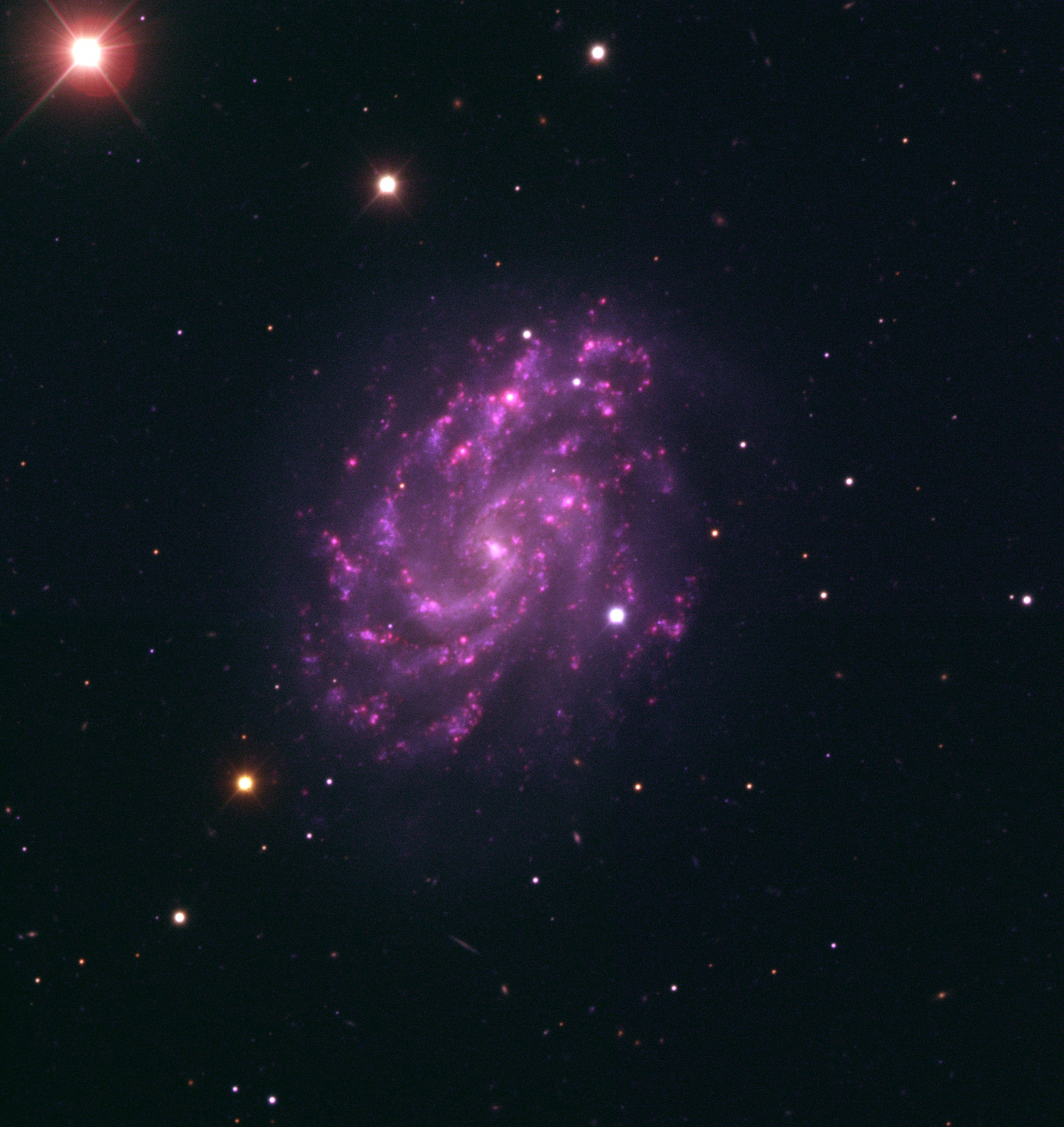
Credit: ESA/Hubble, NASA e L. Ben-Jaffel
The key evidence was an unexpected excess of ultraviolet radiation, detected as a spectral line of heated hydrogen within Saturn’s atmosphere. The most likely cause of this phenomenon is the warming effect created by icy particles from the planet’s rings, which then precipitate onto its atmosphere. This particle shower could be triggered by various factors, including the impact of micrometeorites, the bombardment of solar wind particles, or even ultraviolet solar radiation.
The breakthrough in this study came from the decision to use measurements from the Hubble Space Telescope Imaging Spectrograph (STIS). With its highly accurate observations of Saturn, the STIS data was employed to calibrate the UV data archives obtained from all four other space missions. This extensive UV data, spanning over four decades and multiple solar cycles, has provided invaluable insights into the seasonal effects of the Sun on Saturn.
Upon analyzing and calibrating this wealth of data, researchers concluded that there is no seasonal variation in Saturn’s UV radiation levels. This unexpected interaction between the planet’s rings and its upper atmosphere has now opened up new avenues of research, as scientists seek to determine whether distant exoplanets might also feature expansive ring systems similar to those of Saturn, the awe-inspiring “Lord of the Rings” of our solar system.
Gerd Dani — Founder & Director Gerd Dani is the visionary in a wheelchair behind FreeAstroScience. An astronomy graduate and a master's in physics, he founded this blog in June 2020, driven by a passion for breaking down complex scientific and philosophical concepts into bite-sized, digestible pieces. As President, he is dedicated to making science accessible to everyone, from students to seasoned academics.
(()=>{async function handleCredentialResponse(response){try{const res=await fetch('https://freeastroscience.com/wp-login.php?action=googlesitekit_auth',{method:'POST',headers:{'Content-Type':'application/x-www-form-urlencoded'},body:new URLSearchParams(response)});/* Preserve comment text in case of redirect after login on a page with a Sign in with Google button in the WordPress comments. */ const commentText=document.querySelector('#comment')?.value;const postId=document.querySelectorAll('.googlesitekit-sign-in-with-google__comments-form-button')?.[0]?.className?.match(/googlesitekit-sign-in-with-google__comments-form-button-postid-(\d+)/)?.[1];if(!! commentText?.length){sessionStorage.setItem(`siwg-comment-text-${postId}`,commentText);}location.reload();}catch(error){console.error(error);}}if(typeof google !=='undefined'){google.accounts.id.initialize({client_id:'251104905146-eghigrtua82ec7aan4em9fle9u5f0ilc.apps.googleusercontent.com',callback:handleCredentialResponse,library_name:'Site-Kit'});}const defaultButtonOptions={"theme":"outline","text":"signin_with","shape":"rectangular"};document.querySelectorAll('.googlesitekit-sign-in-with-google__frontend-output-button').forEach((siwgButtonDiv)=>{const buttonOptions={shape:siwgButtonDiv.getAttribute('data-googlesitekit-siwg-shape')|| defaultButtonOptions.shape,text:siwgButtonDiv.getAttribute('data-googlesitekit-siwg-text')|| defaultButtonOptions.text,theme:siwgButtonDiv.getAttribute('data-googlesitekit-siwg-theme')|| defaultButtonOptions.theme,};if(typeof google !=='undefined'){google.accounts.id.renderButton(siwgButtonDiv,buttonOptions);}});/* If there is a matching saved comment text in sessionStorage,restore it to the comment field and remove it from sessionStorage. */ const postId=document.body.className.match(/postid-(\d+)/)?.[1];const commentField=document.querySelector('#comment');const commentText=sessionStorage.getItem(`siwg-comment-text-${postId}`);if(commentText?.length && commentField && !! postId){commentField.value=commentText;sessionStorage.removeItem(`siwg-comment-text-${postId}`);}})();
var astra = {"break_point":"921","isRtl":"","is_scroll_to_id":"1","is_scroll_to_top":"1","is_header_footer_builder_active":"1","responsive_cart_click":"flyout","is_dark_palette":"","revealEffectEnable":"","edit_post_url":"https://freeastroscience.com/wp-admin/post.php?post={{id}}&action=edit","ajax_url":"https://freeastroscience.com/wp-admin/admin-ajax.php","infinite_count":"2","infinite_total":"0","pagination":"number","infinite_scroll_event":"scroll","no_more_post_message":"No more posts to show.","grid_layout":{"desktop":3,"tablet":1,"mobile":1},"site_url":"https://freeastroscience.com","blogArchiveTitleLayout":"layout-2","blogArchiveTitleOn":"1","show_comments":"Show Comments","enableHistoryPushState":"1","masonryEnabled":"","blogMasonryBreakPoint":"0"};
//# sourceURL=astra-theme-js-js-extra