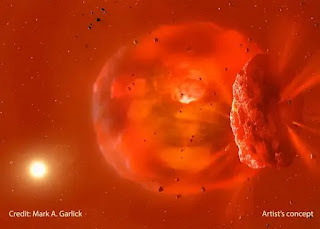
Cosmic clouds, in their radiant luminosity, have unraveled the remnants of catastrophic collisions, mirroring the traces of massive planetary crashes even observed within our own solar system. These lasting impressions, including the unique tilt of Uranus and the genesis of Earth’s Moon, testify to past planetary collisions that have reformed their orbits and features. Scientists, broadening their research scope beyond our solar system, have discovered comparable signs of planetary impacts across the cosmos. In this recent study, the remnants of such a collision are visible in an extraordinary dust and gas cloud, marked by a fascinating, variable luminosity.
In an enthralling astronomical study, scientists inspecting a young star, akin to our Sun and estimated to be around 300 million years old, discovered an unusual anomaly. The star experienced a sudden, significant dimming, leading to a detailed investigation that revealed a prior surge in infrared luminosity lasting for a millennium. Remarkably, halfway through this radiant period, the star underwent an unforeseen eclipse lasting for over a year, cloaking it in darkness. Further examination unveiled a massive, luminous cloud of dust and gas as the instigator of both the luminosity burst and the subsequent eclipse. The most plausible explanation for this cosmic event is a collision between two exoplanets, one of which likely contained ice, leaving an unerasable mark on the stellar landscape.
In this extensive study, scientists propose a gripping scenario: the collision of two giant exoplanets, with masses ranging from several to dozens of Earth masses. This cosmic confrontation not only generated the infrared luminosity surge but also birthed a radiant cloud composed of gas, scorching rock, and dust. The collision’s intensity would have entirely melted the two planets, leaving behind a singular molten core surrounded by the aftermath. Post this colossal event, the remaining cloud, still bearing the collision’s remnants, continued its orbit around the star. Eventually, it positioned itself to eclipse the star, casting a cosmic shadow that provided a spellbinding spectacle for astronomers to decode [1].
This exploration leveraged archival data from NASA’s discontinued WISE mission, currently functioning as NEOWISE, with the star under investigation initially identified in 2021 by the ASAS-SN ground-based robotic survey. While these data revealed the remnants of a planetary collision, the radiant aftermath of this celestial crash is still detectable by advanced telescopes such as NASA’s upcoming James Webb Space Telescope. The research team, led by Matthew Kenworthy and comprised of 21 co-authors, has already started developing proposals for observations with the Webb telescope. The study, titled “A planetary collision afterglow and transit of the resultant debris cloud,” was publicized on October 11, 2023, in the journal Nature, presenting an in-depth exploration of this cosmic spectacle.
Gerd Dani — Founder & Director Gerd Dani is the visionary in a wheelchair behind FreeAstroScience. An astronomy graduate and a master's in physics, he founded this blog in June 2020, driven by a passion for breaking down complex scientific and philosophical concepts into bite-sized, digestible pieces. As President, he is dedicated to making science accessible to everyone, from students to seasoned academics.
(()=>{async function handleCredentialResponse(response){try{const res=await fetch('https://freeastroscience.com/wp-login.php?action=googlesitekit_auth',{method:'POST',headers:{'Content-Type':'application/x-www-form-urlencoded'},body:new URLSearchParams(response)});/* Preserve comment text in case of redirect after login on a page with a Sign in with Google button in the WordPress comments. */ const commentText=document.querySelector('#comment')?.value;const postId=document.querySelectorAll('.googlesitekit-sign-in-with-google__comments-form-button')?.[0]?.className?.match(/googlesitekit-sign-in-with-google__comments-form-button-postid-(\d+)/)?.[1];if(!! commentText?.length){sessionStorage.setItem(`siwg-comment-text-${postId}`,commentText);}location.reload();}catch(error){console.error(error);}}if(typeof google !=='undefined'){google.accounts.id.initialize({client_id:'251104905146-eghigrtua82ec7aan4em9fle9u5f0ilc.apps.googleusercontent.com',callback:handleCredentialResponse,library_name:'Site-Kit'});}const defaultButtonOptions={"theme":"outline","text":"signin_with","shape":"rectangular"};document.querySelectorAll('.googlesitekit-sign-in-with-google__frontend-output-button').forEach((siwgButtonDiv)=>{const buttonOptions={shape:siwgButtonDiv.getAttribute('data-googlesitekit-siwg-shape')|| defaultButtonOptions.shape,text:siwgButtonDiv.getAttribute('data-googlesitekit-siwg-text')|| defaultButtonOptions.text,theme:siwgButtonDiv.getAttribute('data-googlesitekit-siwg-theme')|| defaultButtonOptions.theme,};if(typeof google !=='undefined'){google.accounts.id.renderButton(siwgButtonDiv,buttonOptions);}});/* If there is a matching saved comment text in sessionStorage,restore it to the comment field and remove it from sessionStorage. */ const postId=document.body.className.match(/postid-(\d+)/)?.[1];const commentField=document.querySelector('#comment');const commentText=sessionStorage.getItem(`siwg-comment-text-${postId}`);if(commentText?.length && commentField && !! postId){commentField.value=commentText;sessionStorage.removeItem(`siwg-comment-text-${postId}`);}})();
var astra = {"break_point":"921","isRtl":"","is_scroll_to_id":"1","is_scroll_to_top":"1","is_header_footer_builder_active":"1","responsive_cart_click":"flyout","is_dark_palette":"","revealEffectEnable":"","edit_post_url":"https://freeastroscience.com/wp-admin/post.php?post={{id}}&action=edit","ajax_url":"https://freeastroscience.com/wp-admin/admin-ajax.php","infinite_count":"2","infinite_total":"0","pagination":"number","infinite_scroll_event":"scroll","no_more_post_message":"No more posts to show.","grid_layout":{"desktop":3,"tablet":1,"mobile":1},"site_url":"https://freeastroscience.com","blogArchiveTitleLayout":"layout-2","blogArchiveTitleOn":"1","show_comments":"Show Comments","enableHistoryPushState":"1","masonryEnabled":"","blogMasonryBreakPoint":"0"};
//# sourceURL=astra-theme-js-js-extra