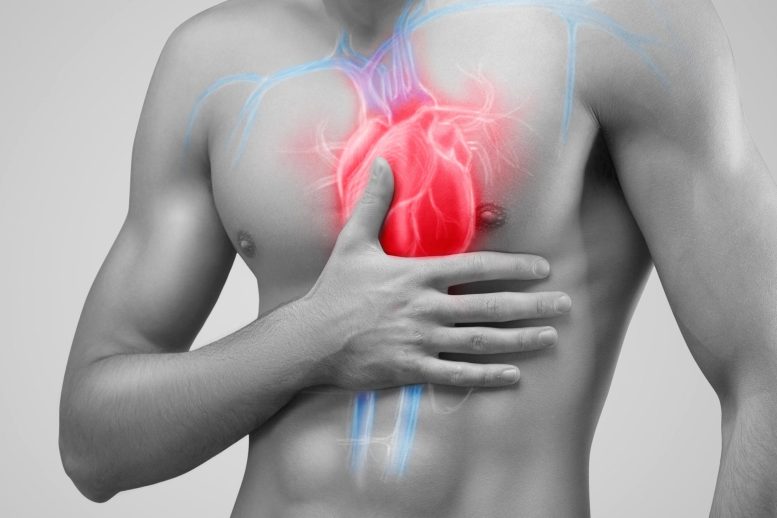
A case-control study found that despite low absolute risk, there is an increased relative risk of carditis associated with BNT162b2 (commonly-known as Pfizer/BioNTech vaccine) vaccination. Considering the markedly increased risk in adolescents after the second dose, vaccination strategies may need to continuously consider the risk and benefits for different sub-populations, rather than taking a ‘one-size-fits-all’ approach. The findings will be published today (January 24, 2022) in Annals of Internal Medicine.
Carditis is a rare inflammation of the heart often caused by bacterial, viral, and parasitic infections. Common subtypes of carditis include myocarditis, an inflammation of the heart muscle, and pericarditis, an inflammation of the outer lining of the heart. Case reports of carditis after BNT162b2 vaccination have accrued globally. Several studies have also reported similar findings, but analytic research on the speculative association is limited.
Researchers from the University of Hong Kong studied 160 case patients (with carditis) and 1,533 control patients (without carditis) to examine the potential risk of carditis associated with vaccination with BNT162b2 or CoronaVac. Ten control patients were matched with case patients based on age, sex, and date of hospital admission.
After conducting analyses, the authors found 20 cases of carditis associated with BNT162b2 and 7 associated with CoronaVac vaccination. Patients who received BNT162b2 were 3 times more likely to experience carditis than unvaccinated patients. On the other hand, patients who received CoronaVac had a similar chance as unvaccinated patients to experience carditis.
The authors also observed that risk increase associated with BNT162b2 was predominant in males and was more likely to be seen after the second dose.
Cumulative incidence of carditis after vaccination was 0.57 per 100,000 doses of BNT162b2 and 0.31 per 100,000 doses of CoronaVac, demonstrating a very low absolute risk of carditis after vaccination.
According to the authors, none of the 20 case patients with carditis after BNT162b2 vaccination were admitted to the ICU or died within the observation period, compared with 14 of 133 unvaccinated patients admitted to the ICU and 12 deaths.
Reference: 24 January 2022, Annals of Internal Medicine.
Gerd Dani — Founder & Director Gerd Dani is the visionary in a wheelchair behind FreeAstroScience. An astronomy graduate and a master's in physics, he founded this blog in June 2020, driven by a passion for breaking down complex scientific and philosophical concepts into bite-sized, digestible pieces. As President, he is dedicated to making science accessible to everyone, from students to seasoned academics.
(()=>{async function handleCredentialResponse(response){try{const res=await fetch('https://freeastroscience.com/wp-login.php?action=googlesitekit_auth',{method:'POST',headers:{'Content-Type':'application/x-www-form-urlencoded'},body:new URLSearchParams(response)});/* Preserve comment text in case of redirect after login on a page with a Sign in with Google button in the WordPress comments. */ const commentText=document.querySelector('#comment')?.value;const postId=document.querySelectorAll('.googlesitekit-sign-in-with-google__comments-form-button')?.[0]?.className?.match(/googlesitekit-sign-in-with-google__comments-form-button-postid-(\d+)/)?.[1];if(!! commentText?.length){sessionStorage.setItem(`siwg-comment-text-${postId}`,commentText);}location.reload();}catch(error){console.error(error);}}if(typeof google !=='undefined'){google.accounts.id.initialize({client_id:'251104905146-eghigrtua82ec7aan4em9fle9u5f0ilc.apps.googleusercontent.com',callback:handleCredentialResponse,library_name:'Site-Kit'});}const defaultButtonOptions={"theme":"outline","text":"signin_with","shape":"rectangular"};document.querySelectorAll('.googlesitekit-sign-in-with-google__frontend-output-button').forEach((siwgButtonDiv)=>{const buttonOptions={shape:siwgButtonDiv.getAttribute('data-googlesitekit-siwg-shape')|| defaultButtonOptions.shape,text:siwgButtonDiv.getAttribute('data-googlesitekit-siwg-text')|| defaultButtonOptions.text,theme:siwgButtonDiv.getAttribute('data-googlesitekit-siwg-theme')|| defaultButtonOptions.theme,};if(typeof google !=='undefined'){google.accounts.id.renderButton(siwgButtonDiv,buttonOptions);}});/* If there is a matching saved comment text in sessionStorage,restore it to the comment field and remove it from sessionStorage. */ const postId=document.body.className.match(/postid-(\d+)/)?.[1];const commentField=document.querySelector('#comment');const commentText=sessionStorage.getItem(`siwg-comment-text-${postId}`);if(commentText?.length && commentField && !! postId){commentField.value=commentText;sessionStorage.removeItem(`siwg-comment-text-${postId}`);}})();
var astra = {"break_point":"921","isRtl":"","is_scroll_to_id":"1","is_scroll_to_top":"1","is_header_footer_builder_active":"1","responsive_cart_click":"flyout","is_dark_palette":"","revealEffectEnable":"","edit_post_url":"https://freeastroscience.com/wp-admin/post.php?post={{id}}&action=edit","ajax_url":"https://freeastroscience.com/wp-admin/admin-ajax.php","infinite_count":"2","infinite_total":"0","pagination":"number","infinite_scroll_event":"scroll","no_more_post_message":"No more posts to show.","grid_layout":{"desktop":3,"tablet":1,"mobile":1},"site_url":"https://freeastroscience.com","blogArchiveTitleLayout":"layout-2","blogArchiveTitleOn":"1","show_comments":"Show Comments","enableHistoryPushState":"1","masonryEnabled":"","blogMasonryBreakPoint":"0"};
//# sourceURL=astra-theme-js-js-extra