NGC 4151: What Powers the Eye of Sauron Galaxy?

Wide-field astrophoto of spiral galaxy NGC 4151, enlarged in a circular inset, beside the smaller spiral NGC 4156 in a rich starfield.

What if one of the most closely watched monsters in the nearby Universe were sitting almost on our galactic doorstep, staring back at us like a great fiery eye? Welcome, friends. Whether you are a curious newcomer or a seasoned stargazer, we are glad you are here. Today we return to a galaxy we first wrote about in 2021 and give it the update it deserves, with fresh measurements from X-ray satellites, geometric distance work and years of patient monitoring. Stay with us to the end, and you will see this famous eye with new clarity.

The direct answer

NGC 4151 is a nearby Seyfert 1.5 galaxy in Canes Venatici, roughly 62 million light-years away, whose actively feeding supermassive black hole of tens of millions of solar masses drives bright, fast winds. Astronomers nicknamed it the Eye of Sauron, and it now ranks among the best-studied changing-look active galaxies in the sky.

~62 Mlight-years away (dust-parallax)
~40 Msolar masses in the black hole
up to 0.33cspeed of its fastest winds
1787year William Herschel found it

What is NGC 4151?

NGC 4151 is an intermediate spiral Seyfert galaxy in the constellation Canes Venatici, and it is one of the closest galaxies to us with an actively growing supermassive black hole at its heart. Catalogued also as UGC 7166 and PGC 38739, it shows faint spiral arms, a weak bar and a delicate inner ring wrapped around a bright, busy nucleus. William Herschel first recorded it on 17 March 1787.

Its real fame came later. NGC 4151 was one of the handful of galaxies Carl Seyfert singled out in his 1943 study of galaxies with unusually bright, broad-lined cores, the class we now call Seyfert galaxies. More precisely, astronomers today classify it as a Seyfert 1.5, a galaxy whose spectrum sits between the two classic Seyfert types. That mixed character is part of why it has been observed across radio, infrared, optical, ultraviolet and X-ray light for more than half a century. If you enjoy this kind of nearby active galaxy, you may like our look at NGC 5033, a spiral Seyfert with an off-centre black hole.

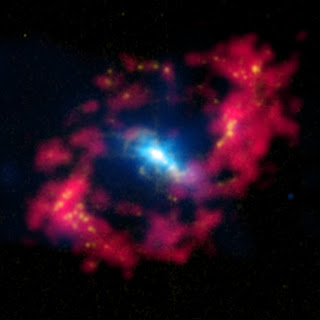
Bright blue-white core of galaxy NGC 4151 ringed by red and pink gas clouds dotted with yellow knots on a dark background.
Composite of NGC 4151, the Eye of Sauron. X-ray: NASA/CXC/CfA/J. Wang et al.; Optical: Isaac Newton Group/Jacobus Kapteyn Telescope; Radio: NSF/NRAO/VLA.

How far away is NGC 4151, really?

The honest answer is that its distance is genuinely hard to pin down, and the best modern figure is about 62 million light-years, larger than the value we quoted in 2021. Our earlier article gave roughly 53 million light-years, a number close to older redshift-based estimates near 52 million. The trouble is that NGC 4151 has strong local motions of its own, so its redshift does not translate cleanly into a distance.

To sidestep that problem, Sebastian Hönig and colleagues published a clever geometric measurement in Nature in 2014. They timed how long light took to travel from the galaxy’s core to a surrounding ring of hot dust, then compared that light-travel size with the ring’s apparent size on the sky. The ratio gives a direct, almost ruler-like distance of 19.0 megaparsecs, or about 62 million light-years. Past estimates had scattered anywhere from 13 to 95 million light-years, so this dust-parallax value is a real step forward. It matters beyond one galaxy, too, since NGC 4151 helps calibrate black hole masses right across the field, and the larger distance nudged those masses upward by roughly 40 per cent.

How big is the black hole at its centre?

The central black hole holds tens of millions of solar masses, most likely somewhere near 40 million. Two independent weighing methods broadly agree. Reverberation mapping, which times the echo of the core’s flickering light off surrounding gas clouds, gave Misty Bentz and collaborators a mass close to 4.6 times ten million Suns back in 2006. Later stellar-dynamical modelling by Caroline Roberts and colleagues in 2021, tracing how stars orbit the hidden mass, landed a little lower, near 36 million.

Agreement within a factor of a few counts as a genuine success at this distance, and it is one reason NGC 4151 is treated as a benchmark. The black hole is feeding, yet not gorging. X-ray work puts it well below its Eddington limit, sipping at only a few per cent of the maximum rate. That fits a wider pattern we have covered before, namely that many of the biggest black holes are feeding more slowly than they once did.

Does NGC 4151 hold one black hole or two?

It may hold two, but that idea stays unproven and openly debated. In 2012 a team led by Bon analysed decades of spectra and found a rhythmic, roughly 15.8-year cycle in the light and in the motion of the gas. They read it as the fingerprint of a sub-parsec binary, a pair of black holes of about 40 million and 10 million solar masses circling each other on a tight, eccentric orbit. Our 2021 note mentioned a similar pairing with a 16-year period, which lines up with this work.

Here is the catch. The proposed primary weighs about the same as the single black hole other methods already measure, so the periodic signal might instead come from one restless accretion disk, a warped disk or shifting hot spots rather than a true companion. Most candidate binaries proposed this way have not survived closer scrutiny. NGC 4151 remains one of the more interesting holdouts, and only continued monitoring will settle whether a second black hole truly lurks inside the eye.

Why is NGC 4151 called a changing-look galaxy?

NGC 4151 earns the label because its nucleus brightens and dims so dramatically that its spectrum appears to change type, a behaviour known as a changing-look active galactic nucleus. Stitch together the historical light curves and you see more than 50 years of activity, marked by a major outburst and a train of smaller flares. Right now the galaxy is climbing through its second big outburst on record.

Long monitoring campaigns from the Lijiang 2.4-metre telescope, led by S.-S. Li in 2022 and by Hai-Cheng Feng in 2024, tracked how its broad emission lines responded season by season. They caught the gas clouds rearranging themselves on timescales shorter than a year, an odd “anti-breathing” effect where the lines reacted faster as the galaxy grew brighter. Their verdict points away from dust drifting across our view and toward real changes in how fast the black hole is being fed. The switch comes from the engine itself, not from anything crossing in front of it.

What are those powerful winds streaming from the core?

NGC 4151 launches layered winds of hot, ionised gas, and the newest X-ray data show they reach staggering speeds. In 2023 and 2024 the Japanese-led XRISM satellite, with its ultra-sharp X-ray spectrometer, stared into the core and resolved as many as six separate wind components at once. They form a stratified, multiphase outflow, from slow warm absorbers moving at hundreds of kilometres per second up to ultrafast outflows racing at 0.03 to 0.33 times the speed of light.

This is the mechanism our 2021 article floated as one possible source of the galaxy’s X-ray glow, now caught in the act. Energy released as gas spirals inward drives material back out, heating the surrounding medium and regulating how the galaxy grows. Optical work found the outflow peaking at about three solar masses of gas per year near 70 parsecs from the core. That is black hole feedback in miniature, the same give-and-take that shapes galaxies far larger than this one.

Why is it nicknamed the Eye of Sauron?

The nickname comes from a striking composite image released by the Chandra X-ray Center in 2011, in which NGC 4151 looks unnervingly like the fiery eye from The Lord of the Rings. The picture layers three views of the same core. X-rays from the Chandra X-ray Observatory glow blue-white at the centre and form the pupil. Optical light from the 1-metre Jacobus Kapteyn Telescope on La Palma, tracing warm hydrogen, appears yellow. Radio data from the Very Large Array, mapping cooler neutral hydrogen, wraps around in red and pink to complete the iris.

Beyond the resemblance, the image told a scientific story. The bright X-ray core sits exactly where the outflowing gas heats its surroundings, tying the eerie glow to the feedback process now confirmed by XRISM. A single galaxy has recently added other events to its record too, including the supernova SN 2018aoq spotted in 2018, and it is a target for the James Webb Space Telescope, which is probing how gas flows in and out of the nucleus in unprecedented detail.

What has changed since our 2021 article?

Quite a lot has sharpened, and one figure has genuinely shifted. Here is how the earlier picture compares with what the data support today.

NGC 4151: the 2021 picture set beside the current one
PropertyEarlier view (2021)Current understanding
DistanceAbout 53 million light-yearsAbout 62 million light-years from a geometric dust-parallax measurement, still uncertain
Galaxy classSpiral Seyfert galaxySeyfert 1.5, a benchmark for weighing black holes
Central engineGrowing supermassive black holeConfirmed active black hole near 40 million Suns, feeding below its Eddington limit
Second black holeBinary suggested, 40 and 10 million Suns, 16-year orbitStill a debated candidate on a 15.8-year orbit, not confirmed
X-ray windsOutflow proposed to heat gas and emit X-raysMultiphase wind resolved by XRISM, reaching 0.33 times light speed
VariabilityIn a growing phaseA changing-look nucleus climbing through its second major outburst

Bringing the eye into focus

Step back and NGC 4151 stops being a single pretty picture and becomes a working laboratory. A nearby black hole of tens of millions of solar masses feeds in fits and starts, brightening and fading enough to switch the galaxy’s very appearance, while driving winds that tear outward at a third of light speed and reshape the gas around it. A geometric ruler of hot dust has fixed its distance more firmly, near 62 million light-years, and a possible hidden companion still teases astronomers with a 15.8-year beat. Each thread ties back to the same question we keep asking here, which is how galaxies and their central black holes grow up together.

This article was written specifically for you by FreeAstroScience.com, where we explain complex scientific principles in simple terms. Come back and explore more with us, and above all, never turn off your mind — the sleep of reason breeds monsters.

Written for you at FreeAstroScience.com. Never let your mind sleep.

Gerd Dani, President, FreeAstroScience

Questions readers ask about NGC 4151

How far away is NGC 4151?

NGC 4151 sits roughly 62 million light-years away in the constellation Canes Venatici, based on a geometric dust-parallax measurement of 19 megaparsecs. Earlier estimates placed it nearer 52 million light-years, and the true figure stays uncertain, since strong local motions spoil the simple redshift distance most galaxies rely on.

Why is NGC 4151 called the Eye of Sauron?

Astronomers nicknamed NGC 4151 the Eye of Sauron in 2011, for its likeness to the fiery eye in The Lord of the Rings. A composite image shows a bright blue-white nucleus as the pupil, ringed by red and pink hydrogen gas that forms the glowing iris around it.

Does NGC 4151 contain two black holes?

Possibly, though it stays unproven. In 2012 a team led by Bon read decades of spectra as a sub-parsec binary of roughly 40 million and 10 million solar masses on a 15.8 year orbit. Other astronomers read the very same variability as one restless accretion disk, so the debate remains open.

How massive is the black hole in NGC 4151?

The central black hole holds tens of millions of solar masses. Reverberation mapping points to a value near 40 million Suns, while stellar-dynamical modelling lands slightly lower, close to 36 million. The two methods agree within a factor of a few, which is normal for weighing black holes at this distance.

What is a changing-look galaxy, and is NGC 4151 one?

A changing-look active galaxy is one whose nucleus brightens or fades so sharply that its spectrum appears to switch type. NGC 4151 is a classic case, and it is now living through a second major outburst. The driver seems to be real swings in how fast the black hole feeds, not dust drifting across our line of sight.

Sources

  1. Hönig, S. F., Watson, D., Kishimoto, M. & Hjorth, J. (2014). A dust-parallax distance of 19 megaparsecs to the supermassive black hole in NGC 4151. Nature 515, 528–530. doi.org/10.1038/nature13914
  2. Bentz, M. C., et al. (2006). A Reverberation-based Mass for the Central Black Hole in NGC 4151. The Astrophysical Journal 651, 775–781. doi.org/10.1086/507417
  3. Bon, E., Jovanović, P., Marziani, P., et al. (2012). The First Spectroscopically Resolved Sub-parsec Orbit of a Supermassive Binary Black Hole. The Astrophysical Journal 759, 118. doi.org/10.1088/0004-637X/759/2/118
  4. Roberts, C. A., Bentz, M. C., Vasiliev, E., Valluri, M. & Onken, C. A. (2021). The Black Hole Mass of NGC 4151 from Stellar Dynamical Modeling. The Astrophysical Journal 916, 25. doi.org/10.3847/1538-4357/ac05b6
  5. Li, S.-S., et al. (2022). Velocity-resolved Reverberation Mapping of Changing-look AGN NGC 4151 during Outburst Stage. The Astrophysical Journal 936, 75. doi.org/10.3847/1538-4357/ac8745
  6. Feng, H.-C., et al. (2024). Velocity-resolved Reverberation Mapping of NGC 4151 during Outburst Stage II. The Astrophysical Journal 976, 176. arxiv.org/abs/2409.01637
  7. XRISM Spectroscopy of Accretion-driven Wind Feedback in NGC 4151 (2025). The Astrophysical Journal Letters 988, L54. doi.org/10.3847/2041-8213/adee9b
  8. Chandra X-ray Center (2011). NGC 4151: An Active Black Hole in the Eye of Sauron. chandra.harvard.edu/photo/2011/n4151

Scroll to Top